



Digital Sensors in Industrial Machinery: Function, Types, and Best Practices
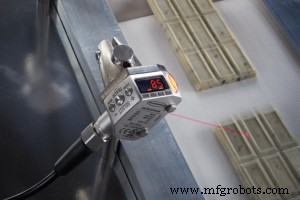
Industrial machinery and processing equipment won’t run without functioning sensors. A bad sensor will bring production to a halt by not sending a signal to a controller or enabling a movement or operation. Worse still is a sensor that sends incorrect signals or signals at the wrong time. “Misfires” like these lead to accidents and costly collisions.
Sensors are classified as either analog or digital. This blog post reviews digital sensor usage and the types available. It also offers some guidance on picking the right digital sensor for specific applications.
How and Where Sensors Are Used
Digital sensors are used to communicate presence, absence, level, and position of movement to something that will perform an action in response. Examples include sensing a container on a conveyor, measuring liquid levels and recognizing when a mechanism has reached a certain position.
The output from a digital sensor typically goes into the IO module of a PLC. In some cases it may feed into a PC via IO hardware, or in less complex implementations, it connects directly to a relay.
An application can be as simple as turning on a light to tell an operator a part is in position. A more complex example is part presence sensors in a robot gripper that let the controller know a part has been grasped.
Electrical Basics
Most industrial sensors use 24Vdc. (Some industries prefer 120Vac.) This comprises two of the three wires coming from the sensor body. The third is the signal lead. Sensors are described as being PNP or NPN and sourcing or sinking. Whether you’re replacing existing sensors, adding sensors to a system, or starting from scratch, it’s important to select the right type.
1. PNP and NPN Sensors
PNP and NPN refer to how the transistors within the sensor switch the signal on and off. In a PNP sensor the signal goes high (+24V) when switched on while in an NPN sensor it goes low. It’s important to use the right type because it must complement the input module.
When replacing sensors, note that European and North American machine manufacturers generally prefer PNP sensors while Asian equipment often uses NPN.
2. Sourcing and sinking
These terms also relate to the transistors in the sensor. In a PNP sensor the signal is raised to +24V to indicate a logical true and this flows into the PLC DI module. Thus the sensor is the source and the DI module the sink.
With an NPN sensor this becomes the sink and the PLC is the source. Thus 0V from the sensor is the logical true.
3. Switching logic
Sensors may be configured to be normally open (NO) or normally closed (NC). For example, a photosensor on a conveyor may output a low signal when no part is present and switch to high when the beam is blocked, or the opposite.
In addition, sensors can be wired in series or in parallel. This provides an opportunity to create AND and OR functions which reduces the number of wires running to the PLC and the amount of PLC programming needed.
Digital Sensor Types
- Photoelectric – use a photocell to detect a beam of light. The light source may be some distance away, making this type of sensor appropriate for conveyor applications.
- Inductive – these incorporate a coil that emits a fluctuating electromagnetic field. Metal passing through the field creates a disturbance that prompts an output. Inductive sensors are for very short range applications.
- Capacitive – using the same principle as an electrical capacitor, these detect the presence of any nearby material. They are available for both conductive and non-conductive materials.
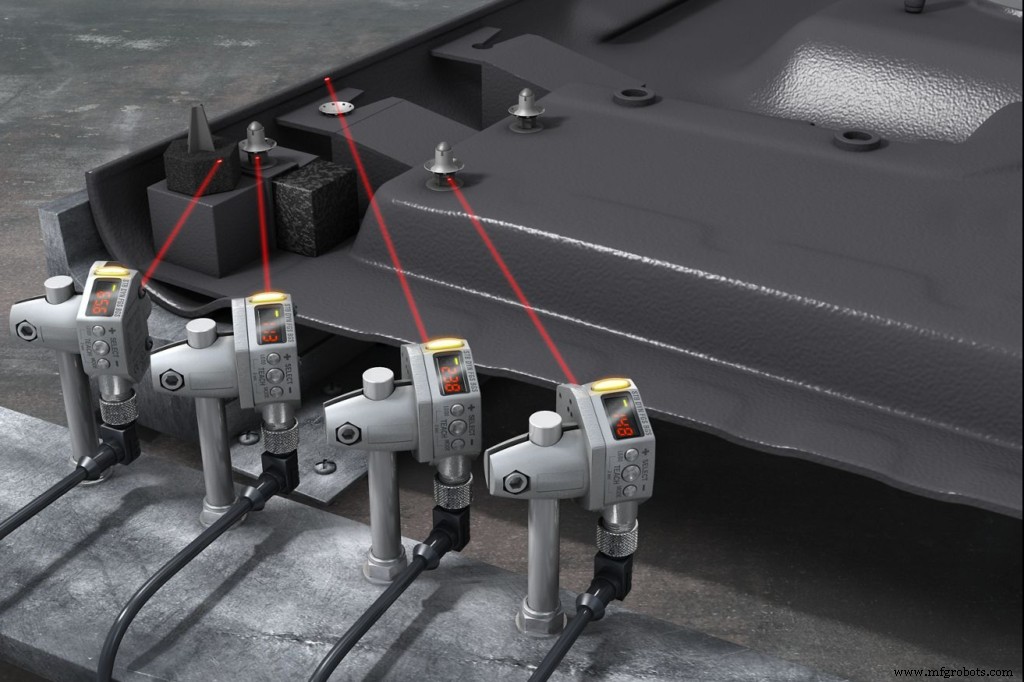
Digital Sensor Selection Considerations
The main points are:
- Target position and distance – determines if the sensor should be a contact or noncontact type
- Type of target – metallic or nonmetallic, solid or liquid, transparent or opaque, reflective or non reflective
- Space available – many, but not all, sensors are available in a 12mm diameter body. Others need more space.
- Working environment – washdown? Explosion proof? High levels of dust or moisture?
- Connections – PNP or NPN? 24Vdc or 120Vac? NO or NC?
- Sensitivity, resolution, accuracy and repeatability – these define the performance required from the sensor.
Get Help With Sensors from JH Foster
The best sensor delivers repeatable, accurate and reliable operation of the machine or other device to which it’s installed. Conversely, a poor choice could result in inconsistent operation that leads to variable quality, frequent stoppages, and may even create hazardous working conditions.
Specialists at JH Foster can advise on the best sensors for your applications. Contact us for a quote.
John Henry Foster recently acquired Sensors Incorporated and Sensors Integration. Sensors is a national leader in integration of industrial sensors, safety and machine vision with technical service and support for OEMs, system integrators and end users. Although both companies continue to operate independent of each other, both companies have strong intellectual resources and knowledge share with one another.
Images courtesy of Banner Engineering and Sensors Incorporated
Industrial equipment
- Key Automotive Sensors: How Modern Cars Use Advanced Technology
- Understanding the Oxygen (O2) Sensor: Role, Placement, and Failure Signs
- Digital Magnetic Hall Sensors: Fundamentals, Design, and Automotive Applications
- Which LiDAR Wavelength Will Dominate Automotive Applications?
- NASA-Developed Inductive Non-Contact Position Sensor for Precise Motion Control
- New Wearable Hologram Sensor Provides Instant Gas Leak Alerts
- Distance Sensors Explained: Types, Uses, and How to Choose the Right One
- Mastering Hall Effect Sensors: Principles, Applications, and Design
- Camshaft Position Sensor Explained: How It Keeps Your Engine Running Smoothly
- Crankshaft Position Sensor Explained: Powering Precise Engine Timing