



Board-Mount Pressure Sensors: How They Work, Key Benefits, and Selection Tips
In this article, learn what board‑mount pressure sensors are, how they operate, their advantages, typical applications, and how to choose the right sensor for your design.
Board‑mount pressure sensors (Figure 1) are already integral to medical devices, industrial automation, HVAC/R systems, and more. But why opt for a board‑mount solution over conventional pressure transducers?
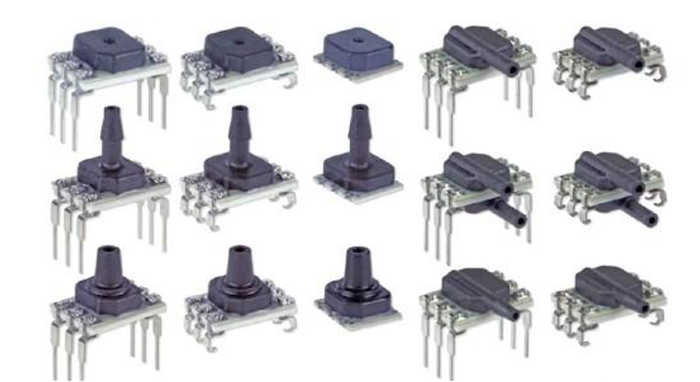
As the name suggests, these sensors are fabricated to be mounted directly on a PCB, becoming an integrated part of the electronic assembly. While some models measure contact pressure against a solid surface, others are engineered specifically for liquid or gas pressure measurement.
Key Benefits of Board‑Mount Sensors
Typical advantages include:
- Reduced component count and lower bill‑of‑materials costs.
- Simplified board layout, ideal for tight or crowded designs.
- Smaller overall system footprint.
- Greater design flexibility due to integrated ASICs.
Many board‑mount sensors feature on‑chip calibration, amplification, and temperature compensation, which:
- Improves system uptime.
- Facilitates straightforward sensor replacement.
- Enables a compact, lightweight pressure‑measurement module.
These devices are engineered for high‑humidity and fluid‑rich environments, allowing direct exposure to the media under test—crucial for applications such as ventilators or sleep‑apnea monitors (Figure 2).
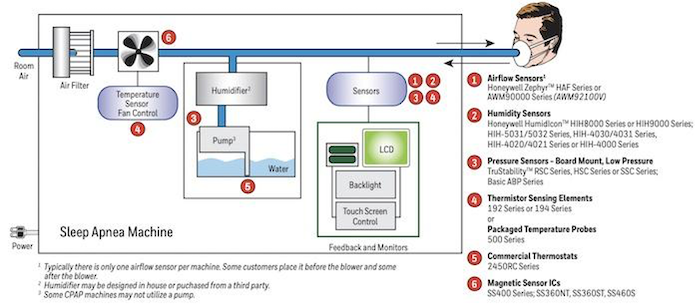
Some models deliver exceptionally high accuracy, precision, resolution, and repeatability—features essential for many safety‑critical devices.
Pressure Types Measured
Board‑mount sensors typically rely on a micro‑diaphragm or similar structure whose electrical property (capacitance, resistance, or charge) changes proportionally to deformation. The key pressure categories are:
- Gauge pressure – pressure relative to ambient.
- Differential pressure – difference between two ports.
- Absolute pressure – pressure relative to a vacuum (useful for barometric or altitude measurements).
Gauge sensors respond to deviations from atmospheric pressure; differential sensors compare two points; absolute sensors use an internal vacuum reference.
Applications in Medical and Industrial Fields
Board‑mount pressure sensors are deployed across a wide spectrum of use cases, illustrated in Figure 3.
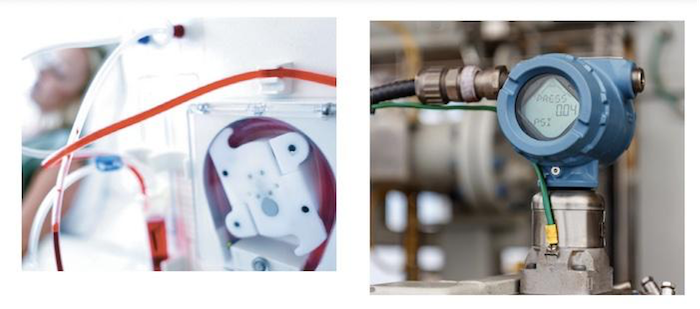
Medical Industry
Key medical equipment that relies on these sensors includes:
- Ventilators
- Anesthesia machines
- Hospital room air‑pressure monitors
- Spirometers
- Blood‑analysis, dialysis, and centrifugation units
- Gas‑distribution systems (oxygen, nitrogen)
Industrial Industry
In industrial settings, board‑mount sensors support:
- General machinery and condition monitoring
- IIoT and Industry 4.0 devices
- Robotics
- Pneumatic air control, process control, and leak detection
- Weather‑control systems, vacuum switches, altimeters, and barometers
Choosing the Right Sensor: Specifications to Consider
Key specifications include output signal type (ratiometric VDC analog vs. I²C or SPI digital), supply voltage, and update rate (typically in kHz). Core performance metrics are:
- Range – minimum and maximum pressure the sensor can reliably measure.
- Resolution – smallest pressure change that produces a detectable output.
- Burst pressure – the maximum transient pressure the sensor can withstand, critical for cleaning or sanitation cycles.
- Temperature compensation – correction for sensor offset, sensitivity, and non‑linearity, usually via an on‑chip ASIC.
- Accuracy – expressed as a percentage of full scale (FS) or full‑scale band span (FSS), sometimes reported as total error band (TEB).
- Media compatibility – suitability for non‑ionic, non‑corrosive gases and liquids.
Balancing range and resolution is essential; a wider range typically reduces resolution. Ensure the sensor’s burst pressure exceeds any transient spikes in your application.
Honeywell’s TruStability SSC Series
Honeywell’s TruStability Standard‑Accuracy Silicon Ceramic (SSC) line exemplifies a board‑mount solution that combines small size, direct media exposure, and superior performance.
- Pressure range: ±1.6 mbar to ±10 bar (±160 Pa to ±1 MPa).
- Temperature‑compensated for -20 °C to 85 °C with on‑chip ASIC.
- Supports gauge, differential, and absolute pressure.
- Output options: ratiometric analog or I²C/SPI digital.
- Update rates: 2 kHz (digital), 1 kHz (analog).
- Accuracy: ±2 % FSS to ±5 % FSS, with industry‑leading ±0.25 % FSS BFSL.
- Energy‑efficient sleep mode.
- Multiple porting and housing configurations for rapid prototyping.
Sager Electronics is an authorized distributor of Honeywell Sensing and IoT solutions, offering a broad selection of TruStability board‑mount pressure sensors and related switching products. Learn more here or explore the Honeywell catalog on Sager’s site.
Industry Articles provide a platform for partners to share news, insights, and technology with All About Circuits readers. These articles adhere to strict editorial guidelines and represent the viewpoints of the partner, not necessarily All About Circuits or its writers.
Sensor
- Why Ultra‑Low, High‑Accuracy Pressure Sensors Are Critical for Modern Applications
- Mikroe Air Flow Click: Affordable, Precise Pressure Sensor Board for Medical & Industrial Use
- Rapid, Low‑Cost Sensor Prototyping for Wearable Tech
- Advanced Self‑Heating Wearable Gas Sensor for Precise Health and Environmental Monitoring
- Advanced TOMOPLEX Sensor Film for Real-Time Aerospace Monitoring
- Texas Engineers Deliver Breakthrough Soft Pressure Sensor, Eliminating Sensitivity Issues in Wearable Devices
- Graphite‑Based Sensor Boosts Sensitivity & Flexibility for Wearable Medical Devices
- Latest Advancements in MEMS Sensors for Wearable Technology
- Revolutionary Math Framework Helps Engineers Select Optimal Aircraft Sensors
- Barometric Pressure Sensors Explained: Key Features & Applications