



Unpacking Industry 5.0: What It Means for Modern Manufacturing
The First Industrial Revolution started in the 18th century with the invention and advancement of steam engines. Further technological advancements brought about mass production and automation. These technologies represented the first three evolutions of the industrial revolution, with Industry 4.0 as the epoch we live in now. Or, are we in the fifth?
Industry 4.0
Industry 4.0 leverages digital technologies to transform the automation landscape in the manufacturing process. It also connects anything and everything to each other to improve communication and efficiency.
Industry 3.0 leveraged computational capabilities to partially automate processes. Industry 4.0 leverages data to increase the level of automation and introduce prediction ability to better tackle future events. Industry 4.0 is made possible by a set of technologies that connect, collect, and compute.
The technologies used in industry 4.0 include the following.
- Information systems: Management information systems (MIS) and enterprise resource planning (ERP) software help store and disseminate data across the enterprise. Since these are digital tools, the speed of information transfer is fast and has a global scale.
- IoT: The Internet of Things (IoT) is attaching sensors and data collecting devices to a network. In this manner, all industrial components can be connected to the internet. These devices would be capable of capturing and sending data over the network.
- Fast network connectivity: IoT devices connect to a fast network with very low latency. This aids a large amount of data transfer.
- Computing infrastructure: Computing infrastructure is critical to store and process data. Industry 4.0 uses edge computing and cloud computing capabilities to process the large quantum of information. Edge computing process information is captured by IoT devices immediately and only sends critical data to the cloud infrastructure to be stored.
- Big data analytics: Hardware has to be coupled with software capabilities to process large amounts of data collected with IoT devices. Machine learning (ML) algorithms can generate insights from big data.

Figure 1. Robotic vision systems for quality control are a popular industry 4.0 technology. Image used courtesy of FANUC
All the technology working in coordination can extract valuable insights from the vast amount of data stored using IoT devices. These insights drive process improvements, improved automation, and quality control. Another significant part is the prediction aspects of big data analytics. It can be leveraged for predictive maintenance, demand prediction, raw material price forecasting, and other forecasts that could benefit business operations.
Industry 5.0
As the various epochs of the industrial revolution are serialized in name, the next evolutionary epoch of the industrial revolution will be industry 5.0. But what exactly constitutes industry 5.0 is unknown.
The best way to predict your future is to create it.Abraham Lincoln
Industry 5.0 can be said to be in a brainstorming stage. Industry 5.0 will be what industry leaders make of it. There is no consensus on what technologies will be part of Industry 5.0. But there are broad strokes of ideas among thought leaders on how the new epoch of the industrial revolution will look.
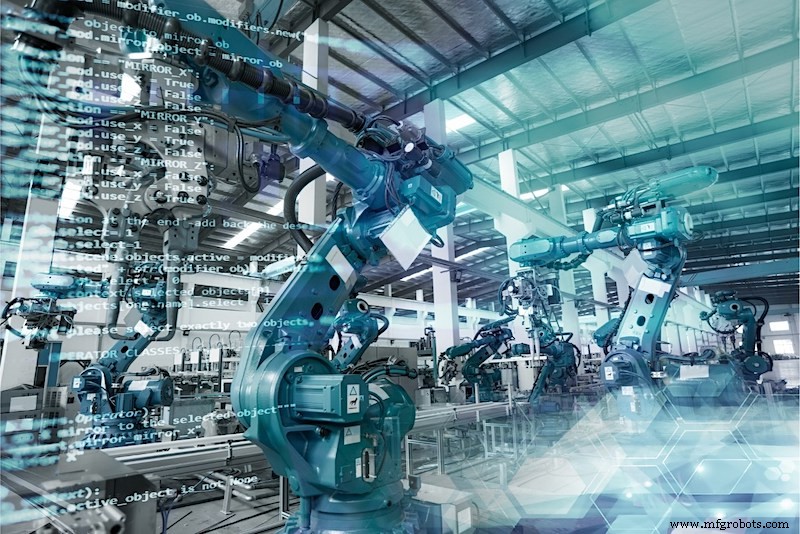
Figure 2. An industrial robot.
Larger companies are on their paths to digital transformation and embracing industry 4.0 technologies. The complete adoption of industry 4.0 is still years away. Meanwhile, agile startups are building the foundations for industry 5.0. They are building up the idea of industry 5.0, creating the space as they go. Once the going seems promising, there will be huge capital flows and participation from big industrial companies.
How Might Industry 5.0 Look?
The previous epochs of the industrial revolution focused on mass production, increasing scale, better efficiencies, and reducing costs. In the drive toward these goals, individual preferences were not a priority. Personalized products were reserved for consumers willing to pay a premium. This essentially means that personalized products were not accessible to everyone.
Industry 5.0 aims to democratize product personalization. Like industry 2.0 focused on mass production, industry 5.0 may focus on mass personalization. Industry 5.0 may take the technologies of industry 4.0 and put humans in the driving seat. It is about human-machine collaborations to support and propel human innovation.
Personalization of products requires human creativity. With industry 5.0, humans will be responsible for the personalization component, and robots will take care of actualizing the thought output of humans.
Technologies Involved in Industry 5.0
All the technologies used in industry 4.0 will be used in industry 5.0. But, the technologies will be focused on the individual. The equipment, machinery, and components will be IoT devices that use networks to communicate with each other. Artificial intelligence (AI) and machine learning will be the neural center for all industry 5.0 operations. These technologies will work off cloud computing infrastructure.
A technology that will find prominence with industry 5.0 is 3D printing. The technology has the potential to deliver personalization at a minimal cost. As technology advances, the cost for new 3D printers eventually comes down. Mass adoption of 3D printing will be one of the harbingers of the next industrial revolution.

Figure 3. Cobots work with humans in a factory setting. Image used courtesy of Universal Robots
Cobots, or collaborative robots, will be another key piece of technology. Cobots are different from commonplace industrial robots. Cobots focus on human collaboration. They are designed with humans in focus; they can understand and work together with humans.
The Future of Industry 5.0
An analogy of what industry 5.0 aims to achieve is Jarvis from the comic series Iron Man. Jarvis:
- Is connected
- Has strong artificial intelligence
- Works out of cloud infrastructure
- Has access to all information systems
- Understands humans
- Works collaboratively with humans
- Performs mundane tasks
- Has humans at the center
Jarvis’ functionality revolves around the personal needs of Tony Stark. Tony can pursue his creative endeavors, and Jarvis does all the heavy lifting for him. This is what industry 5.0 will likely aim to achieve. Disagree? What do you see industry 5.0 aiming to achieve in automation’s future?
Industrial robot
- Industrial Internet of Things vs Industry 4.0: What You Need to Know
- How Industry 4.0 Transforms Modern Manufacturing: Benefits, Practices, and ROI
- Pigments in the Paper & Pulp Industry: Types, Uses, and Applications
- Harnessing Industry 4.0: Cisco’s Path to Manufacturing Excellence
- Implementing Industry 4.0: Practical Steps for Machine and Component Manufacturers
- Demystifying XaaS: Understanding the 'X as a Service' Trend
- Digital Transformation Demystified: Expert Insights into Industry Buzzwords
- Unlocking Competitive Edge: How Industry 4.0 Boosts Manufacturing Efficiency
- Industrial Automation 4.0: Revolutionizing Production Efficiency
- Robots Transforming Aerospace Production: Precision & Reliability