



Assembly Robots 101: Transforming Manufacturing with Precision Automation
By Ashley Belliveau
Steven Douglas Corp. (SDC) offers manufacturers a wide range of solutions for high-speed precision assembly automation. For over 20 years, our team of automation experts have worked with manufacturers in virtually every industry to automate historically manual, labor-intensive tasks and improve current automation processes. By relying on our custom and specialized automated robotic assembly machines and systems, manufacturers are able to increase speed and productivity and improve accuracy within their operations. To gain a better understanding, we briefly explained the basics of assembly robots below.
What is Robotic Assembly?
Simply put, robotic assembly involves a robot that constructs a variety of products—ranging from large-scale systems to microscopic items—in the most efficient operation. Assembly robots offer a range of capabilities that can allow it to position, mate, fit, and assemble components or parts for a product.
Types of Assembly Robots
In order to choose the best type of assembly robot for your operation, you’ll need to determine the different configurations or movements that are required. There are three types of assembly robots that are most commonly used today:
- Six-axis articulated arms: The six axes allow the robot arm to move in the X, Y, and Z planes, as well as position itself using roll, pitch, and yaw movements.
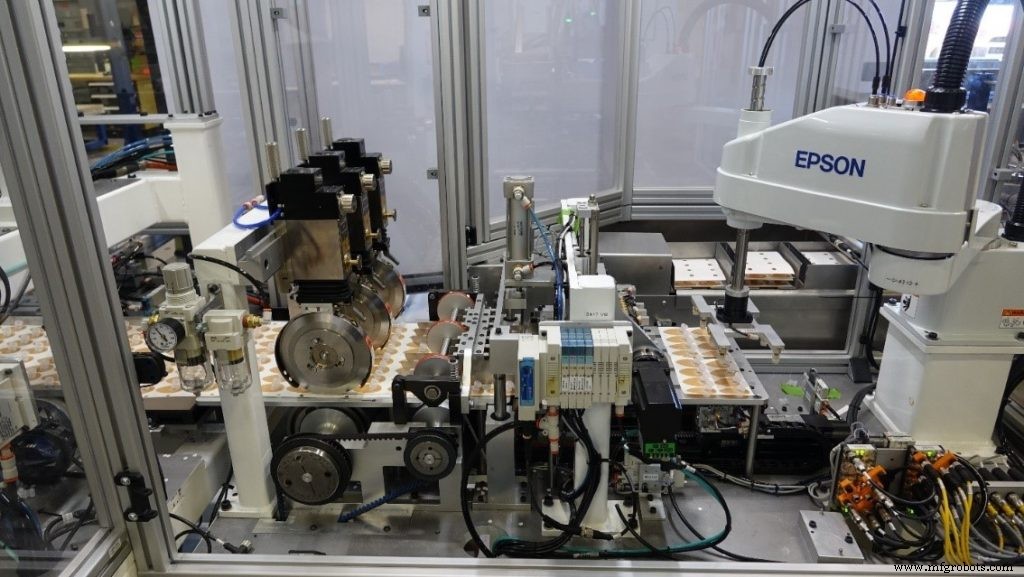
- Four-axis SCARA robots: SCARA robots move in the X, Y, and Z planes, with a fourth theta axis at the end of the Z plan to rotate the end-of-arm tooling, creating a circular work envelope.
- Delta robots: Delta robots can move freely within their workspace in the X and Y directions, with limited motion in the Z plane.
How Do Assembly Robots Work?
Every robotic assembly operation is tailored to the specific part, application, and production requirements. However, despite the unique qualities and capabilities each automated assembly system entails, it’s not uncommon for an assembly robot to be integrated with some type of parts feeding system, machine vision technology, tooling, and/or grippers.
Parts feeding systems, such as SDC’s proprietary, automated Flex Feeder, are often used to feed parts or components to the robot for assembly. To identify and sort the components, ensure proper placement, and inspect the finished product, vision systems are commonly integrated into the robotic assembly system as well. Additionally, specialized tooling or grippers are often attached to the end of the robotic arm to allow it to manipulate, handle, and attach parts and components to complete the assembly.
Applications for Robotic Assembly
Whether you’re manufacturing automotive assemblies, consumer products, medical devices, or some other type of product, assembly robots are ideal for tasks demanding speed, precision, and accuracy. Different robotic assembly applications include but are not limited to:
- Part identification: Identify and validate parts based on shape, size, color, barcode, and other features.
- Part sorting: Sort and select parts based on features like shape, size, color, barcode, and more.
- Bin picking: Select parts presented from a bin.
- Tool changing: Automatically change end gripper configurations for different parts and sizes.
- Part fastening or joining: Mate parts and assemblies by performing functions, such as screwing, dispensing, welding, or inserting.
Benefits of Robotic Assembly
Assembly robots offer human-like dexterity while providing greater control, accuracy, and precision at a faster rate than manual processes allow. Some of the many advantages of using robotics in your assembly operations include:
- Increased productivity: The high-speed capabilities of assembly robots enable manufacturers to meet desired cycle times and provide faster time-to-market.
- Improved efficiency: By eliminating or reducing manual labor and providing faster changeover times, assembly robots optimize workflows for a streamlined assembly process.
- Increased product quality: Robotic systems can be programmed to identify correct components, ensure proper placement, and inspect the finished assembly to ensure a quality final product every time.
Experts in Robotic Assembly
At SDC, we evaluate every new project and integrate the best robotic technology for the application. As robotic integrators for FANUC, Epson, Yaskawa/Motoman, and many more, our controls engineering team has extensive experience and training to successfully recommend, implement, and program the optimal assembly robot for your part and application. Contact SDC today to discuss your upcoming assembly project. In the meantime, check out some of our past projects.
Industrial robot
- Cutting Rework Costs in Manufacturing: Strategies for Efficiency and Quality
- Wrench Time: Definition, Importance, and Measurement
- How IIoT & Industrial Robotics Drive Factory Transformation
- Laser Ablation in Aerospace Manufacturing: Precision Material Removal Explained
- Connected Manufacturing: What It Is & Its Key Benefits
- Robotic Welding Cells Explained: Features, Benefits, and How to Choose the Right One
- The Role of Dunnage in Manufacturing: Protecting Products During Transport
- Kanban Explained: Boost Lean Manufacturing Efficiency
- The Future of Manufacturing: How Robotics and 3D Printing Will Lead the Transformation
- Manufacturing Robots: Faster, More Accurate, Growing Rapidly