



How Remote Monitoring, Programming, and Predictive Maintenance Transform Industrial Robotics
Remote monitoring, remote programming, and predictive maintenance solutions empower manufacturers to cut downtime, boost robot cell performance, and safeguard business continuity.
Embedded in the broader landscape of digital manufacturing, Industry 4.0, and IIoT, these technologies fuse digital insight with physical operations, delivering measurable savings in time, cost, and risk.
Although interest was already growing pre‑pandemic, the COVID‑19 crisis accelerated adoption. Social‑distancing mandates, work‑from‑home orders, and persistent labor shortages forced plants to rethink how they maintain robots and sustain operations.
Traditional setups rely on on‑site personnel for performance checks and reprogramming—both of which are challenged when staff numbers dwindle. Remote solutions are engineered to bridge those gaps.
The global production‑monitoring market is projected to rise from USD 4.0 billion in 2018 to USD 6.4 billion by 2023, a 9.8% CAGR, according to Markets & Markets.
Unplanned downtime costs manufacturers roughly USD 50 billion annually, with equipment failure responsible for 42% of those outages. Such interruptions inflate maintenance and repair expenses dramatically.
Below, we outline the core benefits of these systems and highlight real‑world examples from A3 partners.
NOTE: While this discussion focuses on industrial robots, the same principles apply to other machinery and devices.
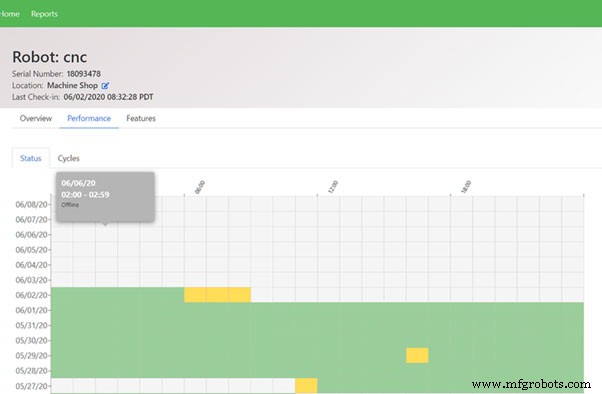
Sample of a production history chart generated by the Productive Analytics software. CREDIT: Productive Robotics
Remote Monitoring
Remote monitoring lets you view robot performance from any tablet, laptop, or smartphone. You can track key performance indicators (KPIs) such as uptime, downtime, and cycle time in real time and over history.
These data points guide adjustments to robot cells or settings, driving higher productivity, throughput, and quality while enhancing business continuity.
When a robot fails, remote monitoring can trigger instant alerts to the right personnel, enabling rapid diagnosis and minimizing costly downtime.
In 2020, Productive Robotics, Inc. launched Productive Analytics, a cloud‑based, real‑time status platform for its OB7 collaborative robots. The tool offers live operating status and production history, helping users optimize output, spot errors, reduce downtime, and monitor robot activity from anywhere.
Remote Programming
Remote programming extends beyond monitoring by allowing engineers to write, edit, and deploy robot programs without being on site. This eliminates travel costs and speeds up responses to application changes or failures.
From a single location, an engineer can supervise and program multiple robots, simplifying operations and opening new revenue streams for integrators.
Predictive Maintenance
Predictive maintenance identifies impending failures before they happen, unlike reactive maintenance that only addresses problems after they occur.
According to a Reports & Data study, the predictive maintenance market grew from USD 1.90 billion in 2019 to an expected USD 21.20 billion by 2027, a staggering 28.9% CAGR.
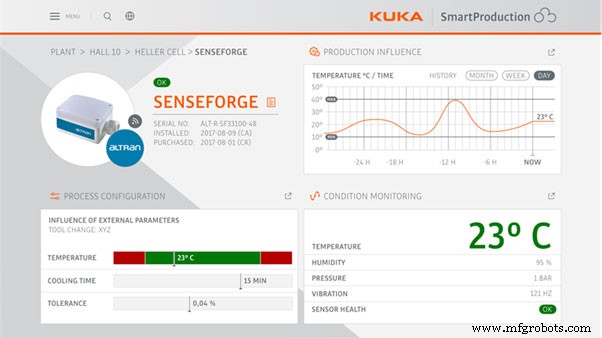
KUKA’s SmartProduction provides comprehensive insights that boost performance, equipment effectiveness, and maintenance predictability. CREDIT: KUKA
KUKA’s SmartProduction digitizes entire cells and production lines, creating an interoperable network where micro‑services and big data converge to enhance efficiency, quality, and flexibility. Key condition and performance data are accessible via PC, notebook, or smartphone, eliminating the time and cost traditionally tied to maintenance.
A Deloitte Analytics Institute study found that advanced predictive analytics can raise productivity by 25%, equipment uptime by up to 20%, reduce breakdowns by 70%, and cut maintenance costs by 25% on average.
Further Reading:
- Know before the cable breaks (LAPP USA)
- Getting Started with AI-Based Predictive Maintenance (A3 Archives)
Industrial robot
- Your Comprehensive Predictive Maintenance Checklist: Boost Efficiency, Cut Downtime & Drive ROI
- How Predictive Maintenance Drives Efficiency and Cuts Downtime
- Optimizing Maintenance: Cost‑Effective Predictive Strategies for Manufacturing Leaders
- Cloud Maintenance: Unlocking Efficiency, Reliability, and Cost Savings
- Overcoming the 3 Biggest Obstacles to Successful Predictive Maintenance
- Unlocking Business Value: The Key Benefits of Predictive Maintenance Software
- Top 11 Robot Programming Essentials Every Beginner Should Master
- How to Know the Right Moment to Invest in Robot Programming Tools
- Maximize Your Robot’s Longevity with Expert Maintenance Practices
- Top 3 Benefits of Remote Monitoring for Manufacturing Efficiency