



Upgrade to Robotic Deburring for Enhanced Quality & Efficiency
Regardless of the size of the components produced, making a machined part “assembly ready” by eliminating rough edges (burrs) caused by drilling or cutting is crucial. While most, if not all, manufacturers understand the importance of surface finishing, there are still those that have yet to implement an optimized process, such as robotic deburring, on their production lines to improve product quality and throughput.
For those companies that are still “on the fence” about transitioning from a manual process to an automated one, or for manufacturers that are looking to make a change to robotic deburring, here are a few things to keep in mind:
Numerous Benefits are Attainable
Fast, capable and precise robots excel at monotonous and hazardous tasks like deburring, offering some attractive benefits:-
Higher Quality – highly precise and repeatable, a robot provides greater accuracy for increased product quality. This is extremely important for safety critical parts (i.e., jet engine components), where even a burr that is only a fraction of an inch could have costly consequences. With the proper process developed, parts deburred by robots are consistent – part to part and day to day. Robot programming compliance facilitates this, allowing for tight tolerances and very consistent finishing.
-
Increased Throughput – capable of performing at maximum speed 24/7 without the fatigue a human worker would experience, a robot can work endlessly at a faster pace to complete a production run.
-
Optimized Tool Management – with deburring, tool wear is a bit of an issue. Automating the process, allows the robot controller to monitor tool life and utilize a beacon visual or audible signal to alert the operator that it is time for a tool changeover.
-
Better ROI – typically, a robot can make more parts in the same amount of time as a human, leading to a shorter payback period and greater return on investment (ROI) over the course of the robot life cycle.
-
Improved Safety – as mentioned, deburring can be a tedious task that takes its toll on worker safety. Work injuries caused by repetitive motion are common. Plus, there is the potential for hearing damage from noisy machines or eye injury caused by metal spray. By automating secondary finishing processes, companies have the chance to protect workers and to possibly lower insurance rates.
Various System Options Available
Traditionally, robotic deburring happens one of two ways: 1) Part to Process – a robot brings parts to a grinder router tool or sander, or 2) Process to Part – a robot manipulates the process tool to a fixtured part. With this in mind, other considerations for choosing the best system for the job must be weighed:
Workpiece Characteristics
From material type (steel, titanium, aluminum, etc.) and part size (thickness, width, length, etc.), to the need for coatings (i.e., cladding or paint), there are many part attributes and process requirements to consider that will help guide machine configuration and abrasive type.
- Abrasive Type – each shop should have a detailed production plan, outlining design, manufacturing and inspection requirements for each part. More specifically, the desired condition and look of part edges should be specified. This will also help determine the type of system and abrasive tool. From belts and brushes, to discs and more, there are multiple standard tools available for use. While belts excel at removing vertical burrs on various sized parts, discs and brushes are well-suited for removing burrs from small workpieces. Custom grinding tools can also be made.
-
Multiple Tasks – occasionally, a system will need to be able to complete multiple tasks (i.e., cutting and deburring, sanding and polishing, etc.). Thus, multiple spindles or spindles that can change tools will be used.
-
Lubricants – depending on the metal type being used, a wet or dry grinding process will be implemented. Ideal for carbon steel, dry grinding systems are typically more affordable and require less maintenance. Used frequently on aluminum and other dissimilar metals, wet grinding systems spray cutting fluids (coolants in the form of gels, pastes, aerosols, etc.) to reduce friction, heat and highly flammable dust particles.
-
Factory Workflow – having a good handle on factory workflow can help determine the best robot or system for the job. As always, it is important to strategically map how new equipment will fit with existing automation, and to implement it in such a way that it enhances current operations and avoids shop floor traffic jams.
Technology Breakthroughs Opening the Door
While implementing a robotic deburring system has been limited to mid- to high-volume production with low mix parts in the past – due to high initial capital cost and limitations in system flexibility – smart and adaptive robotic technologies are emerging, as robot manufacturers and software developers are constantly upgrading platforms to reflect the latest technologies.
More affordable robots, along with intuitive programming options are prompting smaller manufacturers (that were only performing manual deburring) to take another look at robotic automation for multi-point applications like trimming, deburring, and laser cutting.
Robust Technologies Address Production Needs
Process to Part Solutions
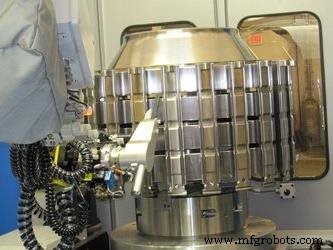
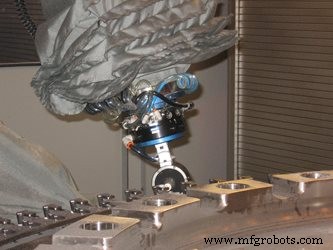
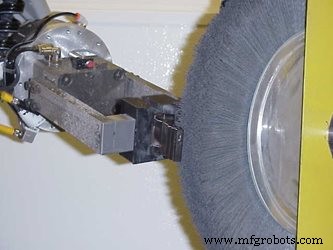 Photos: ACT Robots
Whether a straight deburring or a hybrid deburring/polishing process is needed, companies like ACT Robots (Bristol, CT) specialize in the deburring of small and large parts alike, providing multiple options to address diverse needs. More specifically, ACT provides open and closed loop deburring or surface finishing process solutions.
“Successful application of the surface finishing process to customer parts not only requires knowledge of robotic system integration, but also it entails extensive experience in surface finishing, precise control of multiple process parameters, and part metrology or scanning techniques in open or closed loop processes,” says Mark Zamaria, Vice President, Engineering of ACT Robots. “The capability for testing and process development of customer parts is also highly important.”
In the open loop process, repeatability of the robot (combined with process parameter control and abrasive media wear management) provides consistent output for parts with the same incoming conditions. Closed loop process incorporates part scanning or measurement systems such as an edge profile scanner, laser sensors, profilometers or eddy current probes to check results and recalculate process parameters to compensate for irregular part conditions.
Part to Process Solutions
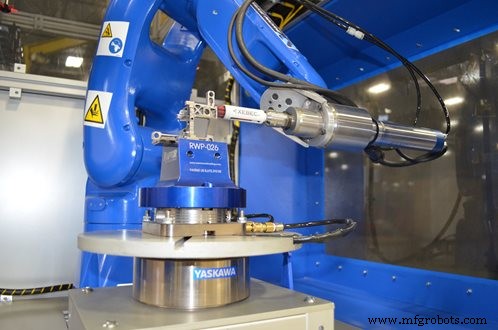
Ellison Technologies (Los Angeles, CA) is dedicated to helping machine shops leave “no burr left behind” and has created RoboBurr - a lean, turnkey robotic solution that is designed to eliminate burrs, while providing shops with the flexibility to utilize skilled workers to their fullest potential. Furthermore, “RoboBurr is designed with the mindset of helping customers improve their processes, throughput, safety and OEE,” says Jeff Lage, President of Ellison Technologies. “Repetitive motion and eye injury remain some of the highest number of injuries annually in machining still today, RoboBurr eliminates these challenges while improving productivity.”
Our Experts are Here for You
As with any capital purchase, there are a lot of facets to consider with deburring. Our experienced team of specialists and engineers can assist you in choosing the most cost-effective and agile solution that meets your specific production and financial goals.
Industrial robot
- Maximizing ROI in Robotic Welding Through IIoT-Driven Process Optimization – Part 4
- Robotic Welding: Boosting ROI by Tackling Labor Shortage & Enhancing Safety
- Robotic Welding ROI: Boosting Uptime & Efficiency for Manufacturers – Part 2
- Maximizing ROI with Robotic Welding: Insights for Manufacturers – Part 1
- Robotic Deburring: Boosting Productivity & Delivering Tangible ROI for Manufacturers
- RoboDK, DIY‑Robotics, and ATI Industrial Automation Release Plug‑and‑Play Deburring Cell
- Effective Deburring Techniques: Applications & Process Types
- Save 90% on Sheet Part Costs with Robotic Incremental Forming
- Robotic Part Testing & Inspection: Enhancing Quality & Throughput
- Robotic Deburring: Enhancing Production Efficiency and Product Quality