



Chatbots 101: Design Process, Architecture, and Practical Insights
The first chatbot, ELIZA, was created in 1960 by MIT professor Joseph Weizenbaum (born 1923, died 2008). ELIZA introduced the idea that a computer could simulate conversation, laying the groundwork for modern conversational AI. Since then, chatbots have evolved into sophisticated tools used across industries. Examples include Charlie, Cleverbot, Fred, Jenney AI, SimSimi, and many proprietary systems developed by companies such as Hedgehog Log (2007), Dog Town Media (2011), MobiDev (2009), Fusion Informatic (2000), On Graph Technologies (2007), and Optisol Business Solutions (2006).
What Is a Chatbot?
A chatbot is software that facilitates human‑to‑machine dialogue across platforms—mobile apps, websites, messaging services, and more. While often labeled as “smart bots,” conversational AI, or interactive agents, these systems rely on a structured dialogue interface rather than a human operator. Common motivations for adopting chatbots include boosting productivity, providing entertainment, fostering social connection, and satisfying user curiosity. Use cases span transactional bots, informational bots, entertainment bots, art bots, and game bots, while malicious variants—hackers, spammers, and impersonators—pose significant security risks.
How Do Chatbots Work?
Chatbots communicate via conversational user interfaces (CUI) embedded in popular messaging platforms such as Facebook, WhatsApp, Skype, Instagram, and custom websites. Their “brain” consists of three core components: a knowledge base, a library of stock phrases, and a conversation memory module. When a user inputs text, the system parses keywords, matches intent, and retrieves the most relevant response.
AI‑Powered Chatbots
Artificial intelligence chatbots use natural language processing (NLP) to understand and generate human‑like responses. Examples include Spotify’s music‑search bot, Whole Foods’ recipe assistant, and many others that operate seamlessly across mobile and web channels.
Types of Chatbots
Chatbots generally fall into two categories:
| S.NO | AI Chatbot | Fixed Chatbot |
| 1. | The AI chatbot is not predefined. | The fixed chatbot follows predefined scripts. |
| 2. | Unlimited access to customer services. | Limited customer service interactions. |
| 3. | Responds intelligently with appropriate answers. | Delivers scripted responses from a library. |
| 4. | Uses NLP to answer queries. | Does not use NLP. |
| 5. | Decodes messages quickly and accurately. | Decoding is slower and less precise. |
| 6. | Also called an intelligence chatbot. | Also called a rule‑based chatbot. |
Chatbot Design Process
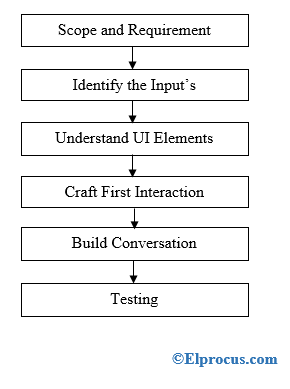
Designing a chatbot involves seven essential steps:
- Define scope and requirements.
- Identify user inputs (text, voice, images).
- Analyze UI elements—CLI, GUI, MDI, FBI, NLI.
- Craft the initial interaction.
- Build conversational flows.
- Test across devices and platforms.
- Iterate based on feedback.
Chatbot Architecture
A typical architecture includes an intent classifier, entity recognizer, candidate response generator, and response selector. The system processes user messages through these components to deliver an accurate reply.
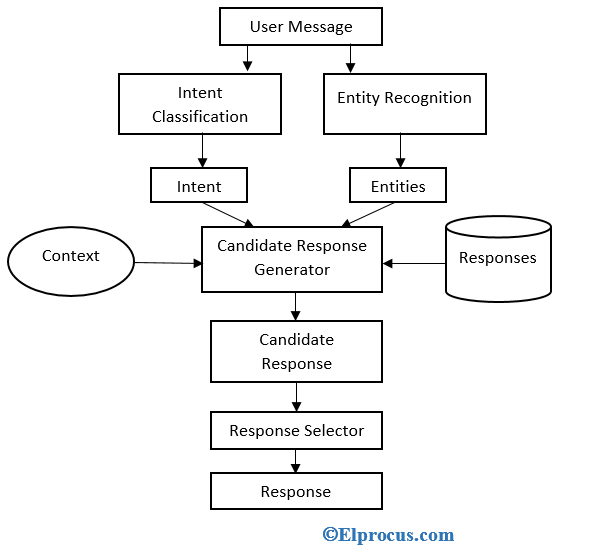
- Intent: The user’s goal (e.g., “Good Bye” ends a chat; “Find a Chinese restaurant” seeks a location).
- Entity: Contextual modifiers (system, developer, session).
- Candidate Response Generator: Uses algorithms to propose possible replies.
- Response Selector: Chooses the most suitable reply for the user.
Challenges
- Security and data privacy.
- Understanding user sentiment in voice interactions.
- Supporting specialized languages.
- Handling non‑standard dialects.
Advantages
- Lower operational costs.
- 24/7 availability.
- Continuous learning and improvement.
- Simultaneous handling of multiple users.
- User‑friendly interfaces.
- Reduced human effort.
Disadvantages
- Initial setup can be time‑consuming.
- Complex interfaces may overwhelm users.
Applications
- Entertainment: Jokebot, Quotebot, Dinner Ideas Bot, Ruuh, Zo, Genius.
- Health: Webot, Meditatebot, HealthTap.
- News & Weather: CNN, Poncho.
Chatbots continue to elevate customer service across industries. As messaging dominates digital communication, businesses increasingly deploy chatbots to streamline interactions and drive growth. Can you build a chatbot without coding? With today’s low‑code platforms, it’s possible—and the next step is to start experimenting.
Embedded
- Control Unit Explained: Components & Design in CPUs
- Embedded System Design: Steps, Principles, and Real‑World Applications
- JVM Explained: What It Is and Its Architecture
- Robotic Process Automation Explained: Benefits & How It Transforms Industry
- Generative Design Explained: How AI Optimizes Engineering Solutions
- Honing: Process, Parameters, Types, and Key Advantages for Superior Surface Finish
- The Modern Manufacturing Process: Key Techniques and Innovations
- Understanding Structural Steel Design: Foundations, Principles, and Modern Applications
- Understanding Architecture Design: Principles, Practices, and Impact
- Holistic Design: A Comprehensive, Sustainable Approach to System Creation