



Safeguard Off‑Site Firmware Programming for Your Embedded Devices
When your embedded system remains a niche product, you can manage every step in-house. But once demand surges, high‑volume manufacturing typically shifts to a contract manufacturer (CM). One critical CM responsibility is programming the microcontroller firmware into each device.
In such scenarios, protecting your intellectual property and preventing over‑production become paramount. Roughly 10 % of electronic goods worldwide are counterfeit, and a significant share originates from CMs producing unauthorized copies.
IP in embedded systems manifests in two main forms: the hardware schematics and the firmware code. Even if a CM can duplicate the PCB layout, the device is useless without the proprietary firmware. When a CM has unrestricted access to both, the original developers must rely on the CM’s integrity and reputation.
At the recent Embedded World Conference in Nuremberg, SEGGER unveiled Flasher SECURE, a production programming solution that tackles IP theft and over‑production risks head‑on.
(Source: SEGGER)
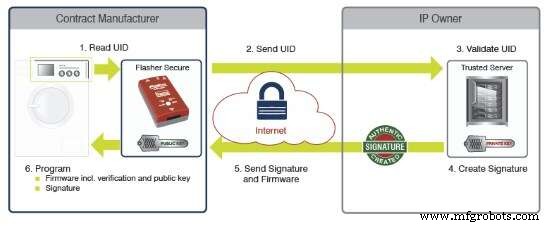
Flasher SECURE operates on a proven principle: each microcontroller carries a unique identifier (UID). The firmware IP owner supplies the CM with the Flasher SECURE platform, while the actual firmware resides on a secure, trusted server under the IP owner’s control.
During programming, Flasher SECURE reads the device’s UID and forwards it to the trusted server. The server validates the UID and returns a cryptographic signature alongside the firmware. Flasher SECURE then writes both into the microcontroller.
Upon power‑up, the firmware immediately verifies the UID against the stored signature. Only a match allows the device to operate; otherwise, the firmware can refuse to run or trigger a custom response. This ensures the firmware runs exclusively on authorized hardware.
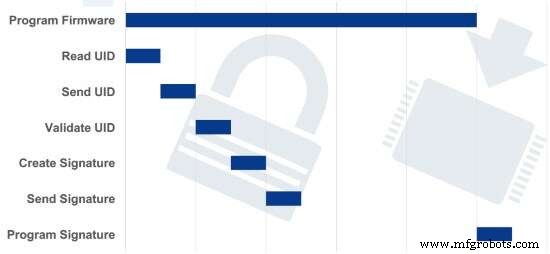
Speed is essential. SEGGER designed Flasher SECURE so the firmware is fetched from the server only once—when programming the first unit. The retrieved firmware is cached locally for all subsequent devices.
(Source: SEGGER)
For each following unit, Flasher SECURE streams the UID to the trusted server while programming. The server immediately generates a fresh signature, which is written to the device in near real‑time, adding negligible overhead to production.
If the firmware detects it is running on a counterfeit system, the response can be tailored. Options include a simple warning message, disabling functionality, or, in more advanced setups, transmitting diagnostic data back to the IP owner for investigation. While the latter approach can be powerful, it should be applied judiciously, especially in safety‑critical applications.
Ultimately, the choice of counter‑measures depends on your product’s risk profile and business objectives. A clear warning may suffice for many cases, but a more proactive strategy can deter counterfeiters and protect your brand integrity.
Embedded
- Secure Your IIoT System with Custom Cryptography Libraries
- Embedded System Programming: Languages, Architecture, and Applications
- Embedded System Design: Steps, Principles, and Real‑World Applications
- Embedded C Unions Explained: Efficient Memory Sharing & Messaging
- Why Barcoding Is Essential for Pharmaceutical Product Integrity
- ERP Systems: The Backbone of Industry 4.0 Data Integration
- Secure Your Business Edge in the Data-Driven Economy
- Unlock Production Value with OEE: Boost Efficiency & Continuous Improvement
- Comprehensive Guide to Premier Industrial Agricultural Products
- The Global Production Stage: How Manufacturing Drives Our Economy