



Harnessing BLE and Cellular LPWAN for Scalable IoT Deployments

Tarun Thomas George, co‑founder and COO of Cavli Wireless, explains how Bluetooth Low‑Energy (BLE) and cellular LPWAN can work together to meet the demands of modern IoT deployments.
Launched in 2009, BLE has become the foundation for low‑power IoT applications, while the 2017 introduction of Bluetooth Mesh by the Bluetooth SIG expanded its reach by enabling resilient, multi‑hop networking.
Evolution of Bluetooth Technology
Initially used for audio streaming and file transfer, Bluetooth has matured into a ubiquitous technology powering smartphones, wearables, smart TVs, and more. It operates on the unlicensed 2.4 GHz ISM band, making it accessible and easy to deploy. Today, Bluetooth is a key pillar of wireless communications for the IoT.
The Bluetooth Special Interest Group (SIG), a global community of over 35,000 members, continues to develop the protocol, ensuring it stays relevant to industry needs.
BLE for the Internet of Things
Key Advantages
BLE, introduced in Bluetooth 4.0, is tailored for short bursts of data from sensors, offering low power consumption, extended range, higher throughput (up to 2 Mbps), and mesh networking support. These features make BLE ideal for Industrial IoT and medical devices where energy efficiency is paramount.
BLE is backward compatible with classic Bluetooth, allowing new devices to support both standards and ensuring seamless integration with existing ecosystems.
Mesh Networking
Unlike traditional Bluetooth topologies that rely on a central hub, BLE Mesh enables every node to communicate directly with its peers, creating an almost unlimited, fault‑tolerant network. This topology enhances coverage, robustness, and eliminates single points of failure.
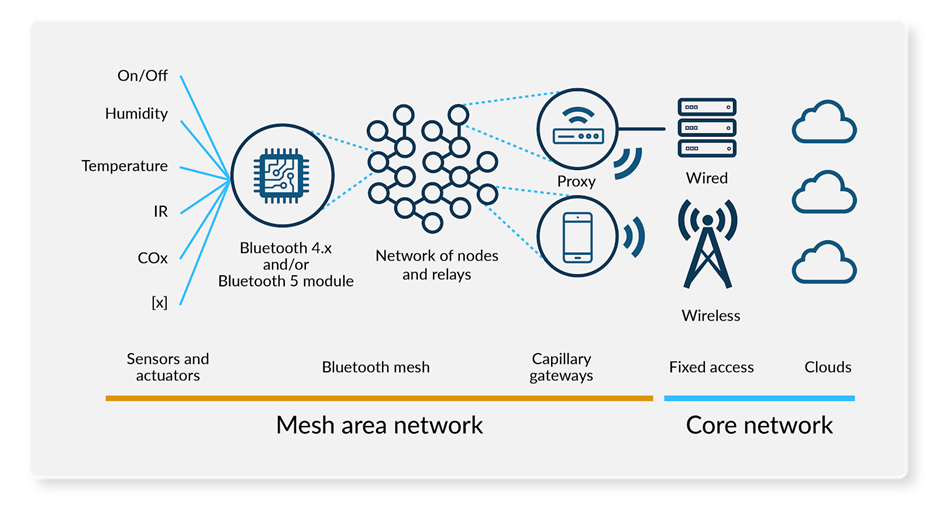
Integrating BLE with Cellular LPWAN
While BLE excels in low‑power, short‑range scenarios, its limited range and bandwidth can restrict broader deployments. Cellular LPWAN technologies—such as NB‑IoT and LTE‑M—offer long‑range, high‑throughput connectivity with robust security and simple global deployment.
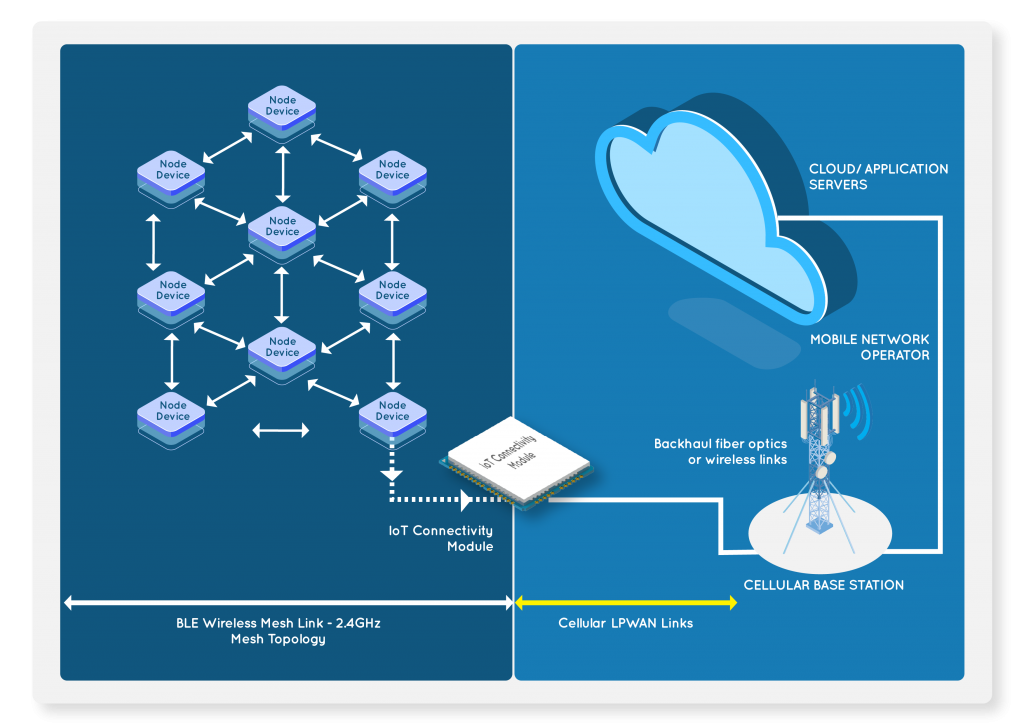
By combining BLE mesh networks with a single cellular gateway, enterprises can create a hybrid architecture where BLE nodes exchange data locally, and the gateway relays aggregated data to the cloud. This approach reduces per‑device costs and leverages the strengths of both technologies.
A prime example is smart metering: multiple meter nodes form a BLE mesh, while a cellular gateway captures the aggregated readings and forwards them to the utility’s cloud platform. Only one device needs cellular connectivity, minimizing infrastructure expenses.
Conclusion
For the next wave of IoT solutions, hybrid connectivity—leveraging BLE’s low‑power mesh and cellular LPWAN’s long‑range reach—is essential. This synergy enables smaller, more efficient, and cost‑effective devices, opening doors to use cases that were previously infeasible.
Author: Tarun Thomas George, co‑founder & COO of Cavli Wireless.
Internet of Things Technology
- XLE: The Future of Bluetooth Low Energy Asset Tracking
- Bluetooth vs. Bluetooth Low Energy: How They Differ & Why It Matters for IoT (2021 Update)
- How Bluetooth LE Range Shapes Industrial Asset Tracking – Facts & Solutions
- How Bluetooth LE & XLE Power Energy‑Efficient, Accurate Industrial Asset Tracking
- AirFinder Bluetooth LE & XLE: Top IoT Solutions for Industrial Asset Tracking
- Bluetooth Low Energy vs. XLE in IoT Asset Management: Key Differences Explained
- Harnessing Cellular IoT and Bluetooth LE: A Synergistic Approach for Next‑Gen Connectivity
- u‑blox Launches SARA‑R5 LTE‑M/NB‑IoT Modules: 5G‑Ready, Ultra‑Secure, Low‑Power for Long‑Term IoT Deployments
- AIoT: Harnessing the Synergy of Artificial Intelligence and the Internet of Things
- Industrial IoT: Key Building Blocks Driving Industry 4.0