



Ultra‑Wideband vs. Bluetooth Low Energy: Choosing the Right RTLS for Your Business
Real‑time location systems (RTLS) are evolving rapidly, yet many operations leaders find themselves overwhelmed by the array of options. Ultra‑wideband (UWB) has emerged as a powerful contender, especially after its integration into popular smartphones. To determine whether UWB can replace Bluetooth Low Energy (BLE), we first examine how each technology works and compare their strengths and weaknesses.
What is UWB?
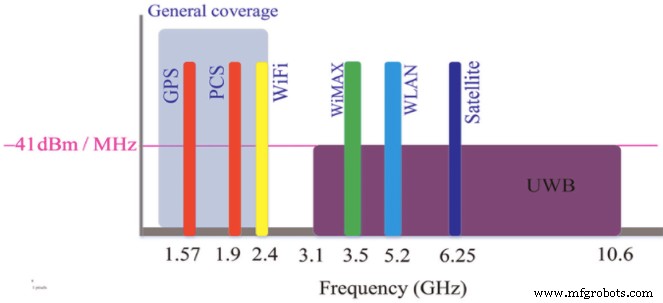
UWB is a continuously scanning radar that operates across a broad band of low‑powered radio frequencies—from 3.1 GHz to 10.6 GHz—providing a bandwidth of at least 500 MHz. Despite this wide range, UWB’s power level is extremely low, peaking at –41.3 dBm/MHz. This ensures minimal interference with other devices while enabling highly accurate short‑range positioning. UWB tags can determine relative position and motion with an accuracy of 10–30 cm and support data rates up to 110 Mbit/s—enough for multiple concurrent video streams.
How UWB Works
UWB positioning relies on two primary techniques:
- Time‑Difference‑of‑Arrival (TDoA): Tags broadcast short pulses to multiple, time‑synchronised anchors. Anchors forward reception timestamps to a central RTLS server, which calculates the tag’s location from at least four anchors.
- Two‑Way Ranging (TWR): A single tag and anchor exchange nine messages to compute distance. While highly accurate, TWR consumes more energy, making TDoA the preferred method for battery‑constrained tags.
What is BLE?
Bluetooth Low Energy is a variant of classic Bluetooth that operates in the 2.4 GHz ISM band using frequency‑hopping spread spectrum. BLE devices remain in low‑power sleep mode until a connection is initiated, with active connection times of only a few milliseconds—versus ~100 ms for classic Bluetooth. A single battery can power a BLE tag for up to five years, and typical range is 30 m (up to 77 m with a single antenna). BLE is widely used for industrial monitoring, health devices, and proximity marketing.
How BLE Works
BLE avoids interference in the crowded 2.4 GHz band by hopping across 80 one‑megahertz channels up to 1,600 times per second. Traditional BLE asset tracking relies on beacon proximity: signal strength (RSSI) estimates distance to the nearest beacon. Accuracy improves with higher beacon density, enabling “just‑right precision.”
Recent innovations—such as Link Labs’ patented phase‑ranging firmware—add sub‑meter accuracy to standard BLE tags, narrowing the gap with UWB while retaining BLE’s low cost.
Advantages & Disadvantages
| Feature | UWB | BLE |
|---|---|---|
| Accuracy | 10–30 cm | Sub‑meter (up to 30 cm with phase‑ranging) |
| Power Consumption | Higher—requires more frequent battery replacement | Very low—batteries last years |
| Data Rate | 110 Mbit/s | Lower—sufficient for telemetry |
| Deployment Cost | Higher—needs more anchors | Lower—uses existing BLE infrastructure |
| Maintenance | Higher—more components | Lower—fewer parts |
Which Technology Should You Choose?
The decision hinges on your specific requirements. If centimeter‑level precision and high‑throughput data are critical—e.g., for asset tracking in manufacturing or autonomous vehicles—UWB is the superior choice. For cost‑constrained environments where sub‑meter accuracy suffices—such as retail analytics or general asset monitoring—BLE, especially with phase‑ranging, offers an excellent balance.
To determine the optimal solution for your operations, contact one of our Link Labs experts and discuss your unique use case.
Internet of Things Technology
- Three Ways Bluetooth Low Energy Drives Manufacturing Efficiency
- 5 Essential Insights into Bluetooth Low Energy for Asset Tracking
- XLE: The Future of Bluetooth Low Energy Asset Tracking
- Why Bluetooth Low Energy Is the Smart Choice for Real‑Time Location Systems
- Bluetooth vs. Bluetooth Low Energy: How They Differ & Why It Matters for IoT (2021 Update)
- Bluetooth LE vs. XLE: Maximizing Range and Accuracy for Commercial Asset Tracking
- Bluetooth Low Energy (LE) for Industrial RTLS: How XLE Drives Asset Tracking
- Bluetooth Low Energy vs. XLE in IoT Asset Management: Key Differences Explained
- Bluetooth LE Outperforms UWB for Indoor Asset Tracking: Cost, Battery Life & Accuracy
- BGM220: A Secure, Precertified Bluetooth Low Energy Module for Ultra‑Low‑Power IoT