



BGM220: A Secure, Precertified Bluetooth Low Energy Module for Ultra‑Low‑Power IoT
Silicon Labs has refined its BGM220x family into a 6 × 6 mm module that delivers fully upgradeable, globally pre‑certified software and rapid firmware support, cutting time‑to‑market for developers.
The BGM220 supports Bluetooth Low Energy 5.1, 5.2 and Mesh, boasting a compact footprint and exceptionally low power consumption that maximises battery life. It enables manufacturers to embed end‑to‑end security—including a root‑of‑trust—directly into their microcontroller units.
With a legacy spanning Mesh, Thread, Zigbee, Z‑Wave, and Bluetooth, Silicon Labs remains a leading provider of IoT wireless modules. Matt Saunders, VP of Marketing and Applications, notes that the January launch of the BG22 has already attracted a wide spectrum of use cases. According to the Bluetooth SIG’s 2020 market update, BLE is the fastest‑growing Bluetooth radio, achieving a 26 % CAGR.
BGM220 is offered in PCB (BGM220P) and SiP (BGM220S) packages, targeting asset tags, beacons, portable medical devices, fitness trackers, and low‑power mesh nodes. The slightly larger BGM220P variant is optimised for superior wireless performance and an expanded link budget, delivering longer range.
Bluetooth Low Energy for IoT
Traditional protocols such as Bluetooth Classic, ZigBee, and Wi‑Fi were not designed for ultra‑low power, prompting many OEMs to adopt proprietary solutions that limited device flexibility and interoperability. The Bluetooth Special Interest Group addressed this gap by introducing BLE, which operates in the 2.4 GHz ISM band with a 1 Mbps bandwidth and is engineered for intermittent, low‑volume data transfer.
BLE’s architecture minimizes power draw by allowing the host processor to spend the majority of time in low‑power mode, only waking to transmit brief data bursts. The controller handles connection establishment and packet de‑duplication, further reducing host overhead.
These optimisations enable maintenance‑free IoT sensor nodes that can run for months or even years on a single coin‑cell battery, without the need for recharging or replacement.
“The most critical parameters vary by application, but battery life, physical size, and security are universally important,” says Saunders. “A low‑power RF design and compact silicon footprint give developers tangible advantages, and robust security features are increasingly essential across all IoT domains.”
Bluetooth’s simplicity and ubiquity continue to make it the de‑facto standard for short‑range connectivity, especially in applications where devices communicate only intermittently, such as renewable‑energy‑powered sensors.
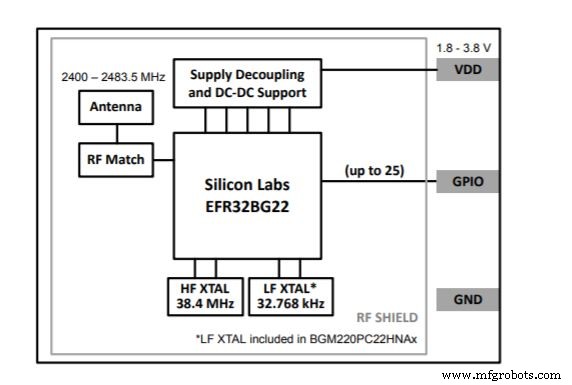
Figure 1: BGM220P block diagram. Combines an energy‑friendly MCU with a highly integrated radio transceiver in a PCB module.
The proliferation of IoT devices amplifies the need for robust cybersecurity. Microsoft’s “Stride” model enumerates common threats—including spoofing, tampering, repudiation, information disclosure, DoS attacks, and malware exploitation—underscoring the importance of secure design from the outset.
Bluetooth Module Options
SoCs offer maximum flexibility for developers requiring custom RF and software solutions, whereas SiP modules provide the smallest pre‑certified BLE footprint with minimal RF design effort. PCB modules strike a balance between cost and capability, offering many of the SiP advantages at a lower price point.
Security standards are becoming mandatory worldwide, making it imperative for IoT products to incorporate proven safeguards. Silicon Labs equips its portfolio—including the BGM220—with features such as Secure Debug, Secure Boot with Root of Trust, and Secure Boot Loader.
“We collaborate with security communities and third‑party experts to deliver cutting‑edge protections,” says Saunders. “Our Secure Vault suite adds hardware and software safeguards that keep devices secure today and enable OTA updates for tomorrow.”
The BGM220’s secure hardware includes AES‑128/256, SHA‑1, SHA‑2, ECC, ECDSA, ECDH, and a NIST‑compliant True Random Number Generator, all supported by an ARM Cortex‑M33 core and a 2.4 GHz high‑performance radio.
BGM220S and BGM220P support Direction Finding and can achieve up to ten years of battery life on a single coin‑cell. Silicon Labs is partnering with industry leaders to refine indoor asset tracking through precise direction‑finding capabilities.
Coexistence with other 2.4 GHz radios—such as Wi‑Fi—poses challenges that can degrade packet delivery and battery efficiency. Managed coexistence strategies mitigate these issues, ensuring optimal performance for both low‑power and high‑power radios.
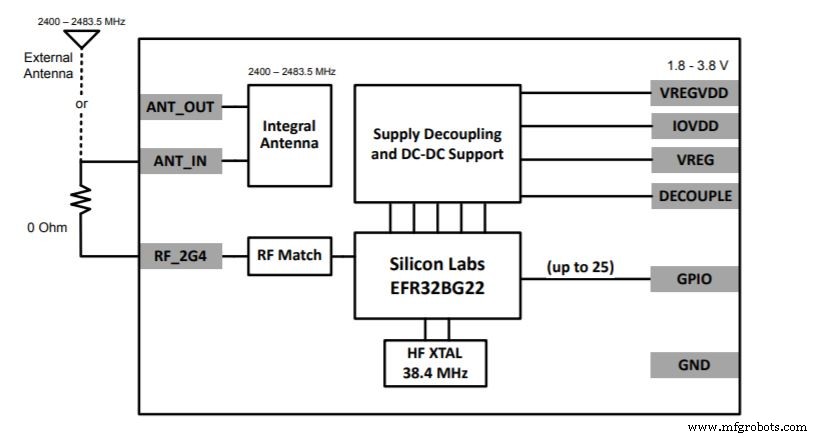
Figure 2: BGM220S block diagram. Combines an energy‑friendly MCU with a highly integrated radio transceiver and integrated antenna in a SiP module.
Connectivity is a cornerstone of IoT, and BLE’s flexibility, power efficiency, and security make it the preferred choice over proprietary protocols. As the IoT landscape evolves, these modules provide the reliability and safety that modern applications demand.
© 2026 Silicon Labs – All rights reserved.
Embedded
- Three Ways Bluetooth Low Energy Drives Manufacturing Efficiency
- 5 Essential Insights into Bluetooth Low Energy for Asset Tracking
- Why Bluetooth Low Energy Is the Smart Choice for Real‑Time Location Systems
- Bluetooth vs. Bluetooth Low Energy: How They Differ & Why It Matters for IoT (2021 Update)
- Bluetooth LE vs. XLE: Maximizing Range and Accuracy for Commercial Asset Tracking
- Bluetooth Low Energy vs. XLE in IoT Asset Management: Key Differences Explained
- Ultra‑Wideband vs. Bluetooth Low Energy: Choosing the Right RTLS for Your Business
- Silicon Labs Introduces Pre‑Certified Wireless Gecko Modules Supporting Bluetooth Mesh, Zigbee, Thread, and BLE
- Panasonic PAN1762 BLE 5.0 Module Now at Mouser – Ultra‑Low‑Power, High‑Range, Ready for IoT & Mesh
- u‑blox Powers AddMobile’s Asset Tracking with BLE Beacons for Construction Sites