



Industrial IoT Communication: 6 Proven Infrastructure Protocols

Selecting the right Industrial IoT (IIoT) communication infrastructure is a complex, time‑consuming, and costly process. Evaluating the plethora of commercial options can quickly become a multi‑month project for engineering teams. Our goal is to streamline that decision‑making by presenting six widely adopted IIoT protocols—AMQP, CoAP, DDS, MQTT, ZeroMQ, and RTI Connext DDS—and highlighting their key strengths in architecture, communication patterns, transport mechanisms, data handling, quality of service (QoS), and security.
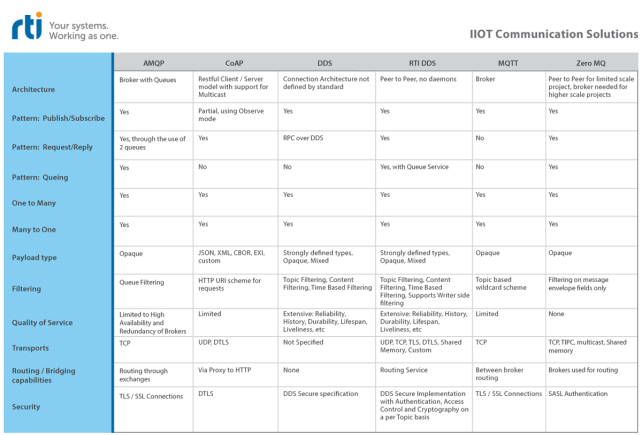
- Download the printable PDF version here.
1. Architecture
IIoT middleware typically follows one of two architectural patterns: peer‑to‑peer or broker‑based star. The choice influences efficiency, determinism, and fault tolerance.
- Peer‑to‑Peer – Direct application communication eliminates intermediate nodes, reducing CPU overhead and latency. Deterministic delivery is easier to achieve because data travels only between the source and destination.
- Broker‑Based – All traffic routes through a central broker, simplifying data routing, monitoring, and management. Brokers offer built‑in tools for traffic visualization and often support redundancy to mitigate single‑point failures. However, this architecture introduces additional latency and a single point of failure unless redundancy is implemented.
2. Communication Patterns
Robust communication pattern support is essential for scaling from a single project to an entire product line. The following patterns are most common in industrial deployments:
- Publish/Subscribe – A subscriber receives updates automatically after a one‑time subscription.
- Request/Reply (RPC) – A client sends a request and waits for a corresponding response.
- Queueing / Point‑to‑Point – Messages are stored in a queue and delivered to a single consumer, ensuring one‑to‑one delivery.
- One‑to‑Many – A single producer broadcasts data to multiple subscribers.
- Many‑to‑One – Multiple producers feed data into a single consumer.
3. Transports & Routing/Bridging
Most IIoT middleware relies on TCP for reliable delivery, which is suitable for critical flows but can add unnecessary overhead for lightweight sensor data. Advanced protocols like DDS support UDP with built‑in reliability, allowing selective best‑effort or guaranteed delivery per topic. ZeroMQ and DDS also offer shared‑memory transports for ultra‑low latency inter‑process communication.
Routing across networks and bridging to enterprise services (ESBs, web APIs) is a core feature of modern middleware, ensuring seamless integration with legacy and cloud systems.
4. Data Type & Filtering
Data representation varies across protocols. Some transmit raw bytes, others use text formats like XML or JSON, which can inflate packet size and consume bandwidth. DDS introduces strongly typed data models, separating schema from payload to eliminate per‑message overhead. This enables efficient on‑the‑fly filtering at the middleware level—particularly useful when a single publisher serves many subscribers with differing data requirements.
5. Quality of Service
Not all data streams require the same delivery guarantees. Sensors may tolerate occasional packet loss, whereas alarms demand strict delivery and liveness detection. DDS is unique in offering per‑topic QoS policies that cover reliability, history, deadline, liveliness, lifespan, time‑based filtering, durability, ownership, and more. MQTT, while simpler, provides three QoS levels (0: at most once, 1: at least once, 2: exactly once). Other protocols provide limited QoS, often tied to broker configuration.
- DDS QoS Policies: Reliability, History, Deadline, Liveliness, Lifespan, Time‑Based Filter, Durability, Reader/Writer Lifecycle, Latency Budget, Transport Priority, Ownership, Resource Limits, Partition, Destination Order, User/Group/Topic Data.
- MQTT QoS Levels: 0 – At most once, 1 – At least once, 2 – Exactly once.
6. Security
Securing IIoT data is paramount. Most protocols encrypt traffic with SSL/TLS and offer authentication mechanisms. DDS stands out by allowing fine‑grained security—authentication, access control, encryption, decryption, data tagging, and logging—at the topic level, aligning with the OMG DDS Security specification. ZeroMQ adds SASL authentication, while MQTT and AMQP provide TLS and username/password support.
Download the printable PDF version
Armed with this concise comparison, you can focus your evaluation on the protocols that align with your application’s specific needs. Good luck!
Internet of Things Technology
- MQTT vs. DDS: Choosing the Right M2M Protocol for IoT
- How Industrial IoT Sensors Drive Modern Factory Efficiency
- 7 Real‑World Industrial IoT Applications Transforming Automation
- Industrial IoT Platform (IIoT): Transforming Manufacturing with IXON Cloud
- Future Outlook: Advancing Industrial IoT for Production Excellence
- AWS IoT Solutions Design Best Practices
- From Farm to Fridge: How Industrial IoT Drives Efficiency and Profitability
- Data Lake vs. Big Data: Choosing the Right Approach for Industrial Applications
- Top 5 Must‑Read Industrial IoT Articles from July 2020
- Top 7 Industrial IoT Applications Powering Market Growth