



How Industrial IoT Sensors Drive Modern Factory Efficiency
In modern industrial plants, sensors form the backbone that supplies real‑time data to controllers, monitoring systems, and operational technologies.
Beyond process control, sensors enable quality assessment, asset tracking, and worker safety. Cloud‑based analytics and AI now turn sensor data into cost savings through process optimization and predictive maintenance. When connected to the internet, this data can support supply‑chain coordination and global production management.
Today’s factories use a wide array of sensors—illumination, temperature, motion, position, presence, vision, force, flow, and chemical composition. For every process or environmental condition, there’s a suitable sensor from broad‑portfolio vendors like TE Connectivity or specialists such as Aceinna.
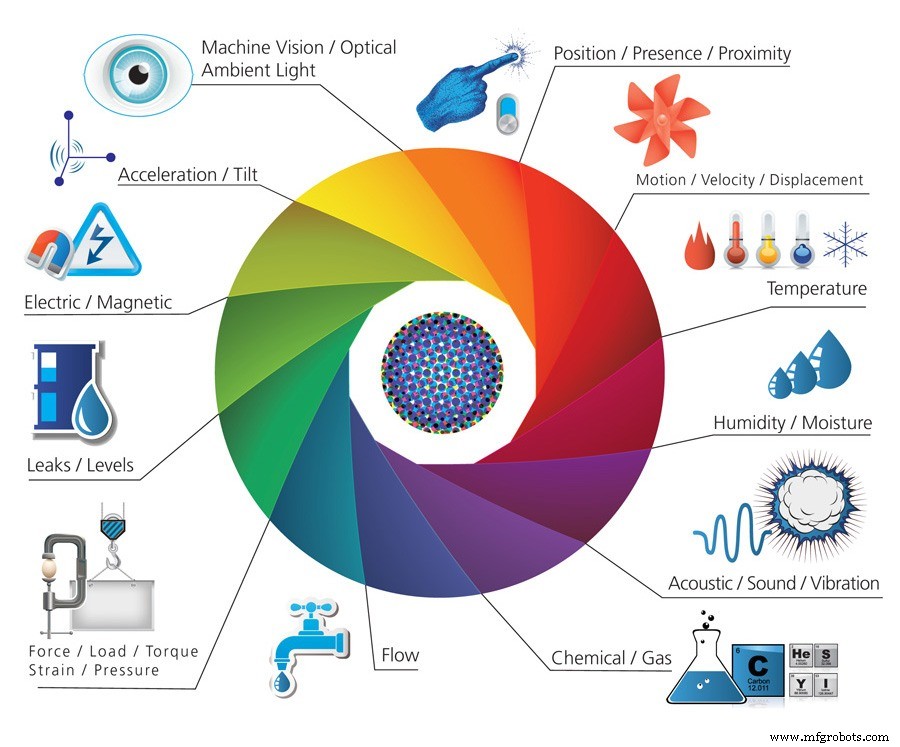
There is a wide variety of sensor types used in the industry that need connection to the IoT. (Image: Postscapes)
Historically, sensor data stayed local—confined to a single facility or machine. Low‑cost, wide‑area connectivity now lets operators tap into sensor streams from anywhere on the planet. This accessibility has unlocked countless applications, with predictive maintenance becoming a flagship use case. Remote cloud servers run sophisticated analytics to assess machine health in near‑real time, flagging urgent repairs before failures occur. Other opportunities—supply‑chain visibility, global production coordination, and more—are emerging rapidly.
Connecting a sensor to the internet is not trivial, especially with legacy systems. Industrial sensors speak diverse protocols, whereas the web requires TCP/IP, necessitating protocol conversion. A hub or gateway often consolidates data from multiple devices. The data then needs a destination, typically a cloud service for storage, retrieval, and processing.
Connectivity is bidirectional. Internet access opens remote configuration and control, but it also introduces security demands. Ensuring the integrity of transmitted data and incoming control commands is critical—see EE Times: The Day When the Industrial IoT Gets Hacked. Authentication, provisioning, and ongoing monitoring are additional requirements that arise when sensors become internet‑connected. An IIoT sensor therefore blends edge hardware with cloud services, and the implementation varies by context. Fortunately, a wide spectrum of products and services helps designers navigate these choices.
Legacy sensor systems are prime candidates for IIoT upgrades. Industrial equipment often lives for decades, leaving a massive installed sensor base awaiting internet connectivity. A common starting point is adding smart radio modules—such as those from Link Labs—that interface with existing sensors and provide protocol conversion plus connectivity. Options include Wi‑Fi, Bluetooth, LoRaWAN, and cellular. Once connectivity is established, developers choose from cloud providers and industrial analytics platforms.
For new designs, developers can follow a legacy‑style approach: select a sensor, add a controller for interface and security, then a radio for network access, and finally a cloud service. However, many platform‑based solutions reduce this complexity. The M2.COM platform, jointly developed by Arm, Advantech, Bosch Sensortec, Sensirion, and Texas Instruments, exemplifies this trend. Its standardized form factor and interfaces let developers pick a compatible sensor and wireless module from a wide vendor range, plug them together, install the platform’s IoT software agent, and then build application code that works across multiple cloud ecosystems.
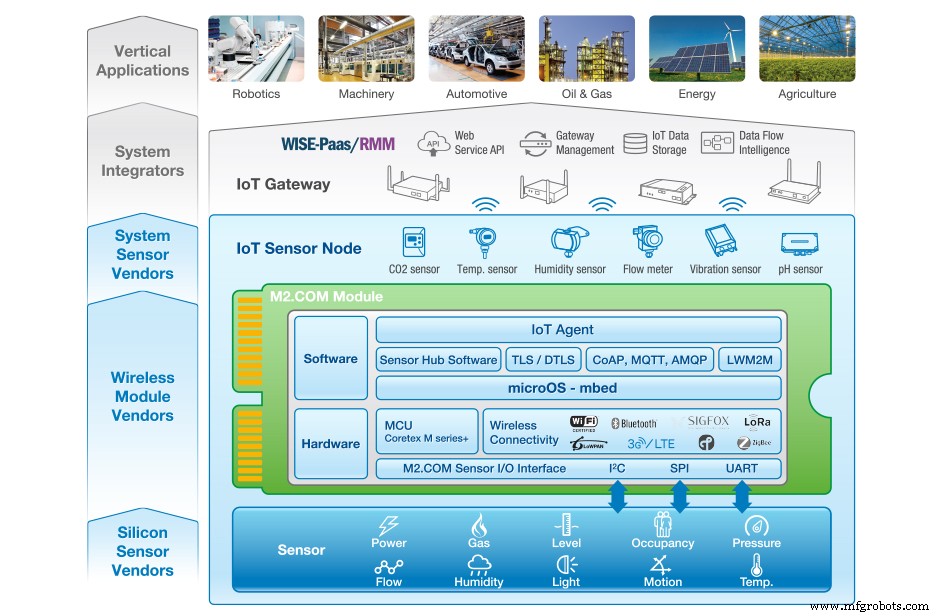
Assembling an IIoT sensor system is simpler when using standardized building blocks, such as with the M2.COM platform. (Image: M2.COM)
Internet of Things Technology
- Leveraging Blockchain for Trusted Industrial IoT Data: Case Study & Design Guidance (Part 2)
- Blockchain in Industrial IoT: Foundations and Applications – Part 1
- Optimizing IIoT Connectivity with the Industrial Internet Reference Architecture
- Securing the Industrial IoT: A Practical Roadmap
- The Fourth Industrial Revolution: How Industry 4.0 Is Reshaping Manufacturing
- 6 Industrial IoT Solutions Driving Efficiency and Insight
- Ensuring Data Compliance in the Internet of Things
- Future Outlook: Advancing Industrial IoT for Production Excellence
- Democratizing the Internet of Things: Next‑Gen Satellite IoT Brings Universal, Affordable Connectivity
- Unlocking the Value of IoT Data: Secure, Insight‑Driven Strategies