



Optimizing IIoT Connectivity with the Industrial Internet Reference Architecture

Today, the Industrial Internet Consortium (IIC) released the Industrial Internet Reference Architecture (IIRA). The IIC, the largest IoT consortium with over 170 members (iiconsortium.org), focuses exclusively on industrial systems. The first public release of the IIRA provides a high‑level systems architecture that spans business goals to system interoperability, establishing key technical guidelines and defining what is feasible—and what is not—in industrial connectivity.
At Real‑Time Innovations (RTI), we see the IIRA’s connectivity architecture as a game‑changer. “Connectivity” is the biggest hurdle for the emerging Industrial Internet of Things (IIoT). The IIRA adopts a distributed “data bus” approach that simplifies interoperability while delivering top performance, reliability, and security.
The Power of a Common Architecture
IIoT is fundamentally about building distributed systems that communicate intelligently. The IIRA’s goal is to enable all components to perform, scale, evolve, and operate optimally through a shared architecture.
To realize this, we need a common architecture that spans computing capabilities, interoperates across vendors, and bridges industries. Over time, common technologies replace bespoke systems. However, incremental adoption and integration of existing technology are equally critical. The IIC architecture blends multiple connectivity technologies into a unified future, supporting the vision of a highly connected world.
This interoperability challenge is where RTI excels. We participate in 15 standards and consortia spanning naval systems, avionics, power, medical devices, unmanned vehicles, consumer electronics, industrial control, and broadcast television. The IIC draws on that experience to inform its architecture.
The Integration Challenge
When connecting many systems, the classic “N‑squared” interconnect problem emerges. Each pair of systems must match protocol, data model, communication pattern, and QoS parameters such as reliability, data rate, and timing deadlines. While a bridge can solve a single pair, scaling to N systems would require N² bridges—a prohibitive approach.
One solution is to constrain all systems to a single set of standards, as seen with the European Generic Vehicle Architecture (GVA) and Germany’s Industrie 4.0. This simplifies integration but limits scope, leaving many industry‑specific requirements unmet and making legacy integration difficult.
At the other extreme, a single Enterprise Service Bus (ESB) offers a one‑way translation that avoids the N‑squared problem. However, ESBs are centralized, slow, and ill‑suited for the high‑speed, fine‑grained demands of industrial applications.
The IIRA Connectivity Core Standard
The IIRA adopts a middle path. It introduces a “Connectivity Core Standard” that is distributed rather than centralized. Some endpoints connect directly to the core; others connect via gateways that translate to the core standard. This eliminates the N‑squared problem while maintaining speed and reliability.
All legacy and lower‑performance connectivity technologies are bridged to the core through a single gateway per standard, reducing the number of transformations to N, the number of connectivity standards.
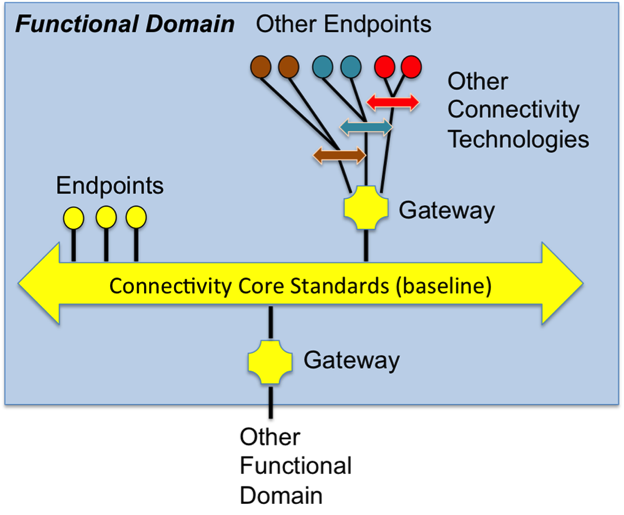
The core must support rapid data discovery, robust exchange patterns, and comprehensive QoS—delivery reliability, ordering, durability, lifespan, and fault tolerance—to meet the stringent demands of industrial applications that may require microsecond delivery or millions of data values.

Security must be tightly integrated with the architecture. The core’s patterns—publish/subscribe, multicast, dynamic plug‑and‑play discovery—must be mirrored by security mechanisms. When security is treated as another QoS parameter, it can be applied or updated without code changes, providing powerful, flexible protection.
Security extends beyond the core; gateways can secure any other connectivity technology used in the ecosystem.
DDS as a Core Standard
While the IIRA does not prescribe a specific standard, the Data Distribution Service (DDS) fits naturally. DDS offers automated discovery, all required communication patterns, QoS settings, and integrated security, making it an ideal candidate for the core standard.
DDS’s proven track record—power systems, medical imaging, air traffic control, SCADA, and defense—has shaped the IIRA’s design, providing confidence in its scalability and resilience.
Thank You!
I would like to thank the teams that built the IIRA. This large effort was supported by many companies, with RTI leading the connectivity, distributed data, and interoperability work. Congratulations on the first release.
Internet of Things Technology
- Leveraging Blockchain for Trusted Industrial IoT Data: Case Study & Design Guidance (Part 2)
- Blockchain in Industrial IoT: Foundations and Applications – Part 1
- Industrial Internet Reference Architecture v1.8 Released: Introducing the Layered Databus Pattern
- Industrial‑Grade Connectivity Architecture for the IoT
- Revolutionizing Industrial IoT Connectivity: DDS Architecture That Cuts Costs & Boosts Reliability
- The Fourth Industrial Revolution: How Industry 4.0 Is Reshaping Manufacturing
- Connectivity by Design: Unlocking Unified Data for Digital Twins and Real‑Time Decision‑Making
- How Industrial IoT Sensors Drive Modern Factory Efficiency
- Industrial Internet: Revolutionizing Asset Management Through Connectivity, Analytics, and User Experience
- Industrial IoT & Smart Pneumatics: Accelerating Predictive Maintenance in Manufacturing