



Industrial‑Grade Connectivity Architecture for the IoT
The Industrial Internet of Things (IIoT) demands unprecedented velocity, variety, and volume of data exchange. Connectivity must be real‑time, tamper‑resistant, and resilient across mobile, disconnected, and intermittent links. It must also accommodate the diverse needs of thousands of devices—streaming telemetry, state replication, alarms, configuration updates, initialization, and remote commands—far beyond what conventional network solutions can provide.
Standards bodies and system designers are driving the adoption of connectivity protocols such as the Data Distribution Service (DDS). DDS delivers the scalability, low‑latency, and security required for industrial environments, while fostering an open, interoperable ecosystem. The result is faster time‑to‑market, flexible design choices, and architectures that evolve with the IoT landscape.
Accelerated Integration
Key to any IIoT deployment is interoperability. A robust connectivity framework shortens integration cycles for complex devices and subsystems, ultimately paving the way for true plug‑and‑play compatibility.
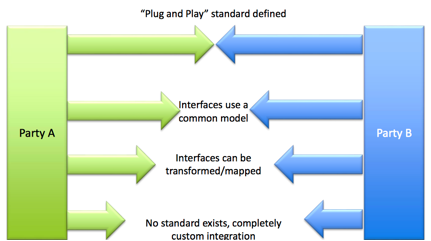
Current industry standards target mid‑level, syntactic interoperability: all endpoints share a common data format and syntax. This foundation enables the deployment of flexible connectivity gateways.
Versatile Connectivity Gateways
Gateways act as translators between heterogeneous devices and protocols. They allow legacy systems and diverse connectivity technologies to coexist, support hierarchical topologies, and group endpoints into logical subsystems.
Decoupled Applications and Data
Industrial systems operate autonomously, demanding a data‑centric architecture. Just as databases liberated applications from rigid data structures, a data bus decouples data from application logic, enabling modular, independent components and fostering innovation through standardized APIs.
In the IIoT, a data bus can autonomously optimize data delivery, scale independently of application code, and be managed with greater agility.
Core Building Blocks
Unlike human‑driven enterprise IT, which revolves around events, transactions, queries, and jobs, the IIoT’s core primitives are data streams, commands, status updates, and configuration changes. Automation triggers on data or state changes rather than human decisions, making real‑time, data‑driven communication essential.

Internet of Things Technology
- Selecting the Optimal IIoT Connectivity: Frameworks vs. Transports
- Optimizing IIoT Connectivity with the Industrial Internet Reference Architecture
- Revolutionizing Industrial IoT Connectivity: DDS Architecture That Cuts Costs & Boosts Reliability
- Connectivity by Design: Unlocking Unified Data for Digital Twins and Real‑Time Decision‑Making
- Implementing HTTP Connectivity for IIoT Edge Devices: A Raspberry Pi DHT-12 Tutorial
- IXrouter: Seamless Edge‑to‑Cloud Connectivity for Industrial IoT
- How IoT Connectivity Drives Business Disruption in a Post‑COVID Economy
- Five Emerging Connectivity Trends Shaping Modern Industry
- Edge Computing Demystified: Architecture & Enterprise Deployment Strategies
- Single‑Pair Ethernet: Reliable Industrial Connectivity