



Connectivity by Design: Unlocking Unified Data for Digital Twins and Real‑Time Decision‑Making
Just as the bloodstream fuels each organ in the human body, information and data are the lifeblood of every function in your organization. Yet many companies remain poorly connected, preventing data from flowing freely between systems. The result: isolated, under‑utilised, and under‑nourished systems.
Data silos are the visible symptom of this disconnection, leading to wasted time, duplicated effort, and poor decision‑making. Employees often recreate data from outdated caches, missing the real value of shared, up‑to‑date information.

Data is the lifeblood of your organization. (Source: Bentley Systems)
The Need for Unified and Aggregated Information
Solving the silo problem starts with improving connectivity across systems. Industry 4.0 and digital twin initiatives demand unified, aggregated data that bridges new and legacy sources, creating a cohesive, high‑performance ecosystem.
“Connectivity by design” means embedding inter‑operability into every solution and software architecture. Systems should discover, inherit, evaluate, and share intelligence across components, enabling real‑time monitoring, analysis, and control from the sub‑unit to the entire ecosystem. This glue accelerates digital transformation.
Open Always Wins
Open architecture frees you from vendor lock‑in. Data can be imported, exported, and used across any cloud or on‑premises environment, ensuring you retain full control over access and ownership.
Open standards eliminate proprietary barriers, guaranteeing seamless interoperability between multi‑vendor devices. Peer reviews become effortless, collaboration thrives, and innovation speeds up—often at a fraction of the cost—while maintaining robust data integrity.
Openness Depends on Standardization
Most IT landscapes are a mix of new, legacy, on‑premises, and cloud applications that will coexist for years. Real‑time data exchange across this heterogeneous, geographically dispersed stack is essential for complex, cross‑functional business scenarios.
Standards that foster openness and interoperability include:
- ISO 15926 – data integration and exchange for capital projects, ensuring seamless hand‑over between systems.
- ISO 18101 – guidelines for interoperability among systems of systems, hardware, software, and components, evolving from MIMOSA CCOM.
- OPC‑UA (Unified Architecture) – a core protocol for Industry 4.0 and IIoT, enabling platform‑independent data exchange between machines, devices, and systems.
- RAMI 4.0 – a standardized model that defines a service‑oriented architecture, network communication protocols, data privacy, and cyber‑security measures.
By adopting these open interoperability standards, vendors collaborate to expose their systems, giving users a complete, real‑time view of assets and data.
Edge or Cloud, the Best of Both Worlds – as Long as They Are Connected
Edge computing brings ingestion, filtering, and initial processing to the device, reducing latency and bandwidth demands. It feeds refined data to cloud platforms that centralise and aggregate information, often forming a digital twin of the facility.
SCADA systems exemplify remote monitoring and control, while cloud platforms offer centralized analytics. Both approaches have merits—cloud for scalability and comprehensive analytics, edge for low latency, cost savings, and privacy.
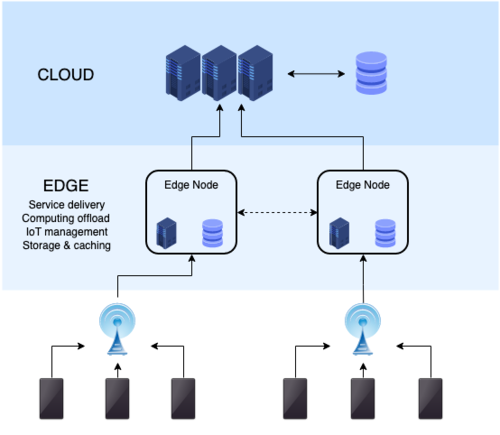
Edge devices in a hyper‑connected environment. (Source: Bentley Systems)
In a truly open ecosystem, decision makers receive a complete, timely, accurate, and trustworthy performance picture—something impossible when data remains siloed.
Moreover, IIoT feeds must be integrated with legacy asset registries, work schedules, performance, reliability plans, and maintenance data to unlock their full value for stakeholders.
Business Outcomes and Decision‑Making
Consider a drilling operation that uses sensor data—vibration, temperature, angular velocity—to predict drill‑head wear. Real‑time analytics compare live signals to historical patterns and similar rigs, enabling proactive replacement and minimizing downtime.
Predictive insights can trigger supply‑chain automation: purchase orders, logistics, and workforce scheduling align with the predicted replacement window. All data—from time‑series signals to asset registry and maintenance logs—are aggregated to support informed, data‑driven decisions.
Combining cloud and edge computing with engineering models, reliability analysis, and supply‑chain data delivers optimal outcomes. Connected data provides real‑time context, linking asset performance directly to key business metrics.
People, Process, and Data Connectivity
“Connectivity by design” also means connecting people and their interaction with data. A strategy that integrates business processes, culture, and analytics turns data into actionable intelligence—automated or human‑driven—at the right moment.
Bentley’s iTwin Connected Data Environment
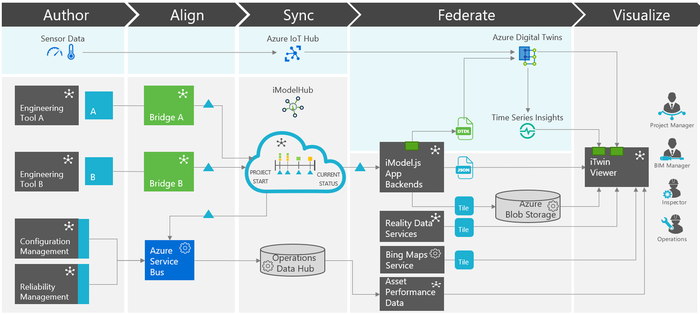
Bentley’s iTwin Connected Data Environment. (Source: Bentley Systems)
The diagram illustrates how business processes acquire and aggregate data to feed a real‑time digital twin. CAD tools (Bentley, AVEVA, Hexagon) deliver models that, via ISO 15926‑based bridges, transform into iModel BIS schemas. Aggregated engineering data then becomes visualisable and analyzable.
Operational data—configuration, reliability, and maintenance—flows into a CCOM‑compliant model and the operations data hub. Combined with engineering geometry and IIoT feeds from Microsoft Azure IoT Hub, users receive a holistic, real‑time digital twin.
A digital twin is an evolving, data‑rich representation of a physical asset, process, or system, enabling continuous performance monitoring and decision support.
Why Open, Why Connected, Why Now?
True openness means more than a buzzword; it requires vendor‑switching capability and native support for open‑source and open‑interoperability standards such as ISO 15926 and ISO 18181. These standards simplify third‑party integration and accelerate development.
Open source and open data empower the creation of a complete, high‑fidelity digital twin that captures every phase—from design and construction to operations and maintenance.
Open and connected strategies are not endpoints—they are embedded corporate strategies that give users effortless, reliable access to their data, driving measurable value across the organization.
Internet of Things Technology
- Ensuring Continuous Health of Your IIoT Systems
- Industrial‑Grade Connectivity Architecture for the IoT
- Optimizing IIoT Connectivity with the Industrial Internet Reference Architecture
- Common Pitfalls in New Systems: How to Avoid Early Failures
- How Industrial IoT Sensors Drive Modern Factory Efficiency
- Implementing HTTP Connectivity for IIoT Edge Devices: A Raspberry Pi DHT-12 Tutorial
- Strengthening Security in Automotive Systems: Safeguarding the Future of Connected Vehicles
- How to Seamlessly Integrate the Industrial IoT: A Practical Guide
- AWS IoT Solutions Design Best Practices
- Five Emerging Connectivity Trends Shaping Modern Industry