



Revolutionizing Industrial IoT Connectivity: DDS Architecture That Cuts Costs & Boosts Reliability

Traditional connectivity solutions can inflate development costs for industrial IoT projects over time.
If you feel like you’re constantly reinventing the wheel with each new application, you may be clinging to outdated approaches. A modern, purpose‑built connectivity architecture—specifically one tailored for today’s connected‑device landscape—is essential.
The Internet was originally designed to link people, regardless of location or computing environment. Industrial IoT, in contrast, connects devices and systems that operate continuously. Outages or failures can have severe consequences, and data timeliness is critical—delayed answers can become incorrect ones.
The Data Distribution Service (DDS) standard was created to support real‑time, always‑on environments. In modern industrial IoT, DDS enables ubiquitous connectivity with a shared data model and an open databus. Seamless data sharing is possible regardless of proximity, platform, programming language, physical network, transport protocol, or topology.
FREE Whitepaper – DDS at a Glance
A Generic Use Case: DDS in the Industrial IoT
Over a dozen DDS implementations have embedded the standard into hundreds of system designs across healthcare, transportation, communications, energy, industrial, defense, and other sectors. Many of these domains share a common connectivity scenario: users need both local and remote access to a diverse array of intelligent devices and systems.
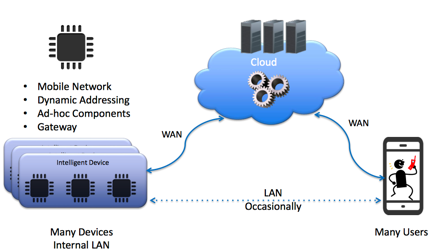
In a connected home, devices might include smart thermostats, lighting controllers, and security cameras. In the energy sector, the same DDS model lets operators monitor turbines across multiple sites. In healthcare, it can encompass bedside and laboratory devices, granting doctors and clinicians access via cloud or on‑site LANs.
Between devices and the cloud (WAN links), DDS offers an ideal solution with:
- Stateful interactions
- Intelligent connect/disconnect handling and the ability to resend only relevant data upon reconnection
- Bus‑level intelligence that removes application overhead
- Multiple data‑flow patterns to meet current and future requirements
- Publish‑subscribe, data‑driven architecture
- Scalability, performance, resilience, and security
Within endpoint devices, DDS is widely adopted. It enables the creation of smart devices that operate reliably and meet stringent safety and longevity standards in industries such as healthcare and automotive. In the cloud, DDS supports diverse connectivity options and promotes long‑term solution viability.
These connections do not directly interface with the human users who rely on the systems. For user‑to‑cloud WAN links, traditional web technologies—web sockets and HTTP—remain appropriate.
Across all other scenarios, DDS is gaining traction by saving developers time and delivering systems that scale and accommodate real‑time, data‑centric environments.
To learn more about DDS, download our free whitepaper, Connext DDS at a Glance, today!
Internet of Things Technology
- Industrial Internet of Things (IIoT): What It Is, Why It Matters, and How It Drives Industrial Transformation
- Fog Computing: The Future of Industrial IoT for Real‑Time, Reliable Operations
- Architecting Connectivity in the Industrial Internet of Things
- Optimizing IIoT Connectivity with the Industrial Internet Reference Architecture
- Choosing the Ideal Programming Language for Industrial IoT Solutions
- Edge Cloud Computing: The Essential Backbone for IoT’s Rapid Growth
- The IoT Ecosystem: From Devices to Tangible Business Value
- Top 4 Challenges Facing the Industrial Internet of Things (IIoT)
- 5 Key Challenges Facing the Internet of Things Today
- Securing Industrial IoT: Practical Strategies for Cyber‑Physical Systems