



Fog Computing: The Future of Industrial IoT for Real‑Time, Reliable Operations

Along I‑280 on the San Francisco Peninsula, a sign declares the highway the “World’s Most Beautiful Freeway.” The beauty comes alive when fog rolls over the hills, cooling the valley and creating the region’s famed mild climate. This natural phenomenon illustrates a powerful idea for the Industrial Internet of Things (IIoT): just as fog provides localized, gentle cooling, a nearby “fog” layer can deliver localized computing that keeps industrial systems responsive, reliable, and secure.
What is Fog Computing?
In weather science, fog is essentially cloud that has condensed near the ground. In IIoT, fog refers to cloud‑like technology positioned close to devices—often on the factory floor, in a hospital ward, or inside an autonomous vehicle. The goal is the same: to place compute, storage, and intelligence where it can react quickly and reduce the burden on distant data centers.
Industry bodies such as the Industrial Internet Consortium (IIC) and the OpenFog Consortium are working to standardize this concept. They agree that the success of the traditional cloud—elasticity, scalability, and robust services—must extend to edge locations while also addressing real‑world constraints like latency, reliability, and security.
Example: Connected Medical Devices
Hospital error is the third leading cause of death in the United States. According to the National Patient Safety Foundation, roughly 250,000 lives are lost annually due to miscommunication or system failures in clinical settings. Even with stringent protocols and alarm‑fatigue training, technology can bridge the gap between human limitations and patient safety.
The Integrated Clinical Environment (ICE) standard seeks to create an intelligent, distributed platform that unifies medical devices—ventilators, monitors, infusion pumps—into a single supervisory system. This “supervisor” continuously analyses data streams, filters out false alarms, and can autonomously intervene, for example by stopping an overdose infusion.
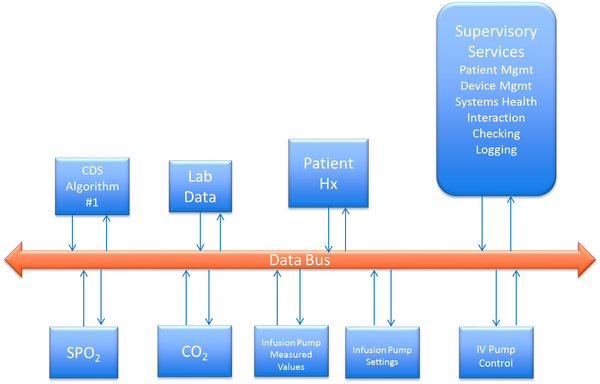
- The supervisor fuses oximeter, capnometer, and respirator data to reduce false alarms and halt drug infusions when necessary. The Data Distribution Service (DDS) “databus” guarantees real‑time, reliable delivery among components.
However, real hospitals house thousands of beds and devices that move between rooms. Devices must discover each other, maintain data consistency, and guarantee timely delivery—all while operating over mixed wired and wireless networks. This complexity demands a layered fog architecture that aggregates and routes data securely and efficiently.
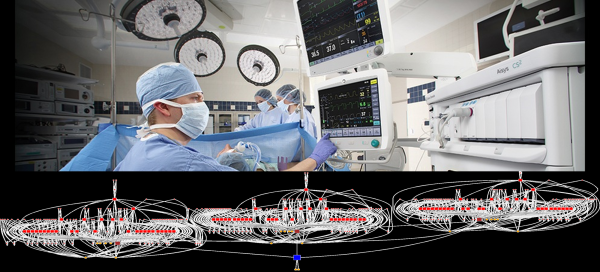
- A realistic hospital network features thousands of patients and devices. Fog routing nodes—red dots—serve as local gateways, ensuring each data packet reaches the correct downstream system or staff member.
Fog computing is indispensable here because decisions often hinge on sub‑millisecond latency. Cloud‑only solutions would introduce unacceptable delays and rely on external connectivity that may fail during critical moments.
Example: Autonomous Vehicles
Autonomous driving is poised to reshape transportation, economy, and daily life. A McKinsey study estimates that 30% of U.S. jobs could be altered or displaced by autonomous trucks and cars. These vehicles must process vast sensor data—camera, lidar, radar—while executing high‑speed control loops.
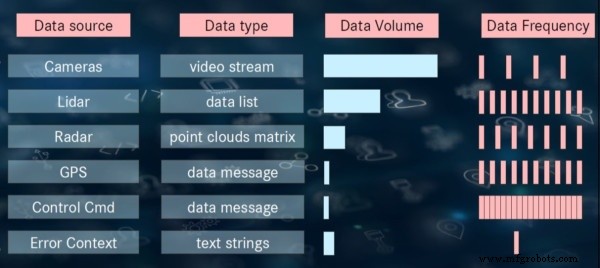
- In an autonomous car, the fog layer fuses video, lidar, and control signals, delivering precisely the right information to each subsystem at the right moment. This hybrid of embedded performance and cloud intelligence is the essence of fog.
Each vehicle comprises dozens of complex modules—vision, mapping, navigation, control—that must interoperate with strict timing guarantees. Fog routing nodes isolate each module’s internal data, expose only necessary interfaces, and enforce security policies—all while enabling redundancy and rapid failover.
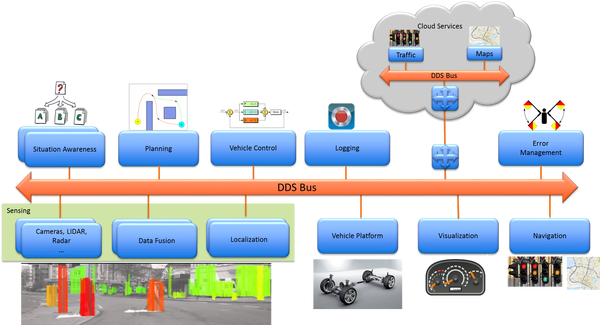
- The architecture shows how fog nodes integrate individual car subsystems into a cohesive platform that can also connect to broader cloud services for mapping updates and fleet management.
How Fog Computing Works
Connectivity is the linchpin. Enterprise networking alone cannot deliver the low latency, deterministic performance, and redundancy required by IIoT. The solution lies in data‑centric connectivity, exemplified by the Data Distribution Service (DDS).
DDS treats data as the primary element of communication. It dynamically discovers publishers and subscribers, matches data types, and enforces Quality of Service (QoS) parameters—reliability, deadline, bandwidth—directly at the data level. Because it operates peer‑to‑peer, DDS eliminates server bottlenecks and enables rapid, scalable integration.
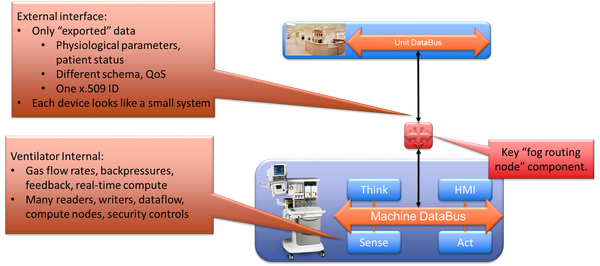
In a fog environment, a routing node acts as a boundary that maps internal data models to external ones, controls what information flows upward, and provides a single security domain. This abstraction simplifies application development and ensures that each subsystem remains isolated yet interoperable.
.png)
- Fog routing nodes encapsulate complex subsystems, exposing only essential data while enforcing QoS and security policies. Redundant instances can run in parallel to guarantee continuity.
RTI has delivered DDS‑based fog solutions in over 1,000 projects, including NASA’s launch‑control SCADA, Siemens offshore wind farms, GE Healthcare imaging systems, and autonomous vehicle prototypes for Audi and others. Their experience demonstrates the resilience, scalability, and real‑time performance that fog can provide.
The key benefits of a databus approach include:
- Reliability: Peer‑to‑peer delivery and built‑in redundancy mean that even brief network outages do not disrupt critical functions.
- Real‑time: Latencies measured in milliseconds or microseconds are achievable, essential for safety‑critical applications.
- Interface scale: Automatic discovery and enforcement of data contracts reduce manual integration work, enabling large teams to collaborate without version drift.
- Data filtering: Applications receive only the data they need, lowering network load and processor usage.
- Architectural coherence: Data‑centricity is built into the system’s core, making it a sustainable foundation for next‑generation IIoT designs.
Organizations poised to adopt fog computing should consider a data‑centric architecture early in their design cycle to reap these advantages.
The Foggy Future
Like the California fog that moderates the climate, a strategically positioned cloud can transform industrial operations. Fog computing brings powerful analytics and control closer to the source of data, enabling elastic, reliable, and real‑time performance across industries—from healthcare and transportation to energy and agriculture.
As IIoT continues to permeate every sector, fog will become the default layer that bridges edge devices and the global cloud, ensuring that safety, efficiency, and innovation are never compromised by distance.
Internet of Things Technology
- Industrial Internet of Things (IIoT): What It Is, Why It Matters, and How It Drives Industrial Transformation
- Revolutionizing Industrial IoT Connectivity: DDS Architecture That Cuts Costs & Boosts Reliability
- Choosing the Ideal Programming Language for Industrial IoT Solutions
- Why IPv6 Is Critical for the Future of IoT
- The Internet of Things and 5G: Driving the Future of Connected Vehicles
- Industrial IoT: Empowering Small & Medium Manufacturers – Part 2
- Industrial IoT: Empowering Small and Medium Manufacturers – Part 1
- Top 4 Challenges Facing the Industrial Internet of Things (IIoT)
- Industrial IoT & Smart Pneumatics: Accelerating Predictive Maintenance in Manufacturing
- Securing Industrial IoT: Practical Strategies for Cyber‑Physical Systems