



Industrial Internet Reference Architecture v1.8 Released: Introducing the Layered Databus Pattern

After a year and a half since its first release, the Industrial Internet Reference Architecture (IIRA) now arrives in version 1.8. The update brings refinements, new features, and the most significant addition: a Layered Databus Architecture Pattern. RTI contributed this pattern to the Implementation Viewpoint, having seen it deployed across hundreds of organizations that leverage DDS. It is now one of the three core implementation patterns highlighted in the new IIRA.
What exactly is a databus? According to the IIC’s Vocabulary document, a databus is a data‑centric information‑sharing technology that creates a virtual, global data space. Applications read and update data through a publish‑subscribe mechanism. Key characteristics include: (a) direct application access to operational data; (b) the databus interprets and filters data; and (c) it enforces Quality‑of‑Service (QoS) rules such as rate, reliability, and security.
For DDS practitioners this description is familiar. While a lower‑level protocol like MQTT can provide basic messaging, DDS supplies the advanced QoS, data handling, and security capabilities required for a full‑featured databus.
Across the hundreds of IIoT systems built on DDS, a consistent architectural pattern emerges: multiple databuses stacked by communication QoS and data‑model needs. Typically, a databus sits at the edge—within smart machines or subsystems such as turbines, vehicles, oil rigs, or hospital rooms. Above the edge, one or more databuses integrate these subsystems, enabling communication between them and with higher‑level control centers or back‑end systems. The control‑center layer—often a cloud environment—may host the top‑tier databus, which in turn supports data historians, user interfaces, high‑level analytics, and other advanced applications. From this highest layer, it is straightforward to locate any data publication at any lower layer, facilitating seamless integration with business and IT systems.
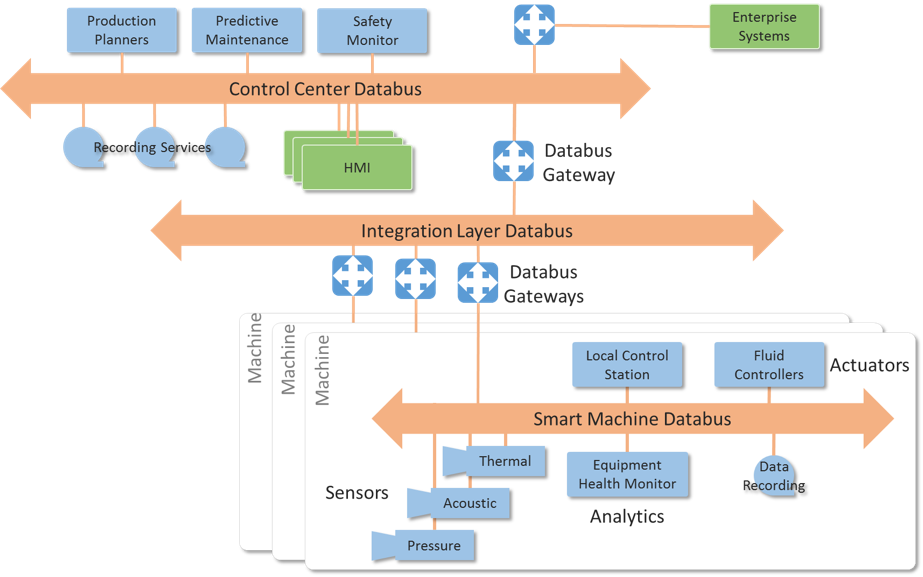
The Layered Databus Architecture Pattern: one of three implementation patterns in the newly released Industrial Internet Reference Architecture v1.8.
Why adopt a layered databus architecture? The updated IIRA outlines these benefits:
- Rapid device‑to‑device integration with millisecond or microsecond delivery times
- Automatic data and application discovery within and across databuses
- Scalable integration for hundreds of thousands of machines, sensors, and actuators
- Built‑in redundancy for extreme availability and resilience
- Hierarchical subsystem isolation that supports complex system designs
For a deeper dive into the databus concept and how it compares to a traditional database, see our earlier post on databus versus database.
Alongside the IIRA release, the IIC will soon publish the Connectivity Framework, a foundational document that sets out core connectivity standards for the Industrial Internet.
Internet of Things Technology
- Optimizing IIoT Connectivity with the Industrial Internet Reference Architecture
- Revolutionizing Industrial IoT Connectivity: DDS Architecture That Cuts Costs & Boosts Reliability
- How the Internet of Things Is Reshaping Businesses: A Dual Perspective
- The Fourth Industrial Revolution: How Industry 4.0 Is Reshaping Manufacturing
- Harnessing Data in the Internet of Reliability: Strategies for Effective Management
- Industrial Internet: Revolutionizing Asset Management Through Connectivity, Analytics, and User Experience
- Top 4 Challenges Facing the Industrial Internet of Things (IIoT)
- Industrial IoT & Smart Pneumatics: Accelerating Predictive Maintenance in Manufacturing
- Harnessing Industrial IoT for Growth: Beyond Cost Savings
- Leveraging PLM Software to Drive Industrial IoT Adoption