



Industrial IoT & Smart Pneumatics: Accelerating Predictive Maintenance in Manufacturing
While the Internet of Things has promised to revolutionize manufacturing, real‑world adoption of industrial IoT solutions is progressing slower than many experts anticipated.
Why is widespread industrial IoT uptake, particularly in pneumatic systems, still limited?
For maintenance teams, the solution is straightforward: an IoT platform can capture real‑time data from equipment and verify that each component operates within its normal parameters. This clarity makes end‑users strong advocates for IoT deployment.
Manufacturers, however, face a different challenge. With numerous clients demanding IoT features, OEMs ask: "How do we implement this? Which products enable it? What metrics should we monitor?"
Pneumatic systems already offer diagnostic functions—monitoring voltage levels, detecting short circuits, and identifying I/O faults. Today’s advances add sensors that capture actuator dynamics. Yet many operators face a critical question: 'We have all this data—how do we translate it into actionable insights?' This data‑to‑knowledge gap remains the main hurdle.
The current emphasis is on transforming raw data into actionable intelligence that can trigger real‑time responses or predict failures. Take Emerson Aventics’ ST4‑2P programmable sensor—an established product that measures cylinder travel distance and piston velocity. By interpreting this data, we can monitor internal cushions and shock absorbers, ensuring they remain within specification. Statistical interpolation allows operators to confirm cylinder performance or detect anomalies promptly.
These metrics are accessible via PLCs, and a gateway such as the Aventics Smart Pneumatics Monitor can aggregate and analyze the data, turning raw readings into clear, actionable information about machine health.
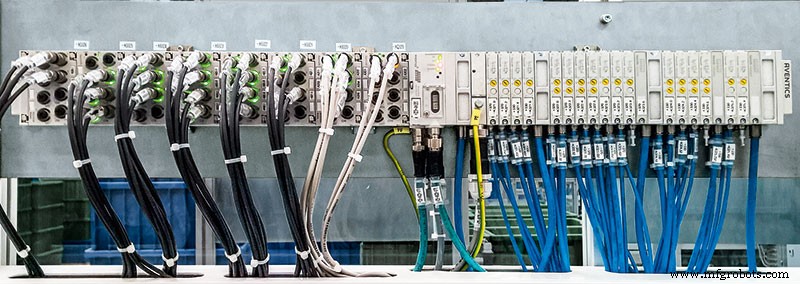
OEMs working with pneumatic components such as the Emerson Aventics pictured here can develop an IoT architecture to ensure appropriate sensors are in place and are sensing the right things to help keep a machine running full‑time.
Consider energy consumption: by measuring inlet air pressure and flow, operators can establish a baseline for each valve. If subsequent flow deviates from that baseline, it signals a fault—perhaps a dislodged tube or worn cylinder seals. Identifying the anomaly is only the first step; how manufacturers act on this data distinguishes successful IoT integration.
OEMs and component suppliers must jointly tackle issues revealed by data. Our IoT strategy goes beyond a plug‑and‑play solution; it involves consultative design. Together with OEMs, we craft a tailored IoT architecture that positions the right sensors and ensures continuous, reliable machine operation.
Successful implementation hinges on collaboration among component makers to integrate pneumatics seamlessly. On the factory floor, pneumatics, drives, controllers, and I/O systems must communicate reliably. Ensuring data flows correctly—whether stored locally on a web server or transmitted to the cloud—is essential for effective IoT solutions.
Returning to energy efficiency, the most effective strategy is to shut down the compressor when it’s not needed. While we don’t manufacture compressors, smart pneumatics can feed the compressor controller with a 12‑hour air demand forecast. The controller can then shut the compressor off during low‑demand periods, achieving tangible energy savings through coordinated component communication.
Clients are gradually embracing advanced analytics and data sharing, but the conversation now extends beyond power and air connections to encompass network topology, security protocols, and VPN configurations—elements previously overlooked in machine design discussions.
Integrating IT early in the design process is now critical. Design teams must collaborate with IT specialists to define connectivity, data volumes, destinations, and security measures, ensuring robust, compliant data flow—an oversight that was unnecessary in earlier eras.
The culmination of these efforts is a fully autonomous maintenance ecosystem. Our goal is 100% uptime for pneumatic circuits and machines. While wear and scheduled replacements are inevitable, real‑time data empowers predictive maintenance—foreseeing component failure before it disrupts production.
An illustrative use case is forecasting valve wear. Leveraging lifecycle benchmarks and B10 cycle credits, sensor data can pinpoint when a valve approaches 75 million cycles, prompting preemptive replacement and preventing downtime.
Sensors can also detect subtle changes in cycle speed that signal shock absorber degradation. The system can raise an alarm, auto‑email suppliers, and even generate a purchase order, enabling timely replacement and minimizing production interruption.
Ultimately, data‑driven insights should yield self‑diagnosing machines that operate without failure, keeping operators informed and production uninterrupted.
Mark Densley, Director of Business Development, Emerson Automation Solutions’ Factory Automation division.
Internet of Things Technology
- Industrial Internet of Things (IIoT): What It Is, Why It Matters, and How It Drives Industrial Transformation
- Connext DDS in Industrial IoT: 5 Key Insights for Reliability, Security, and Scalability
- How the Internet of Things Is Reshaping Businesses: A Dual Perspective
- How IoT is Driving the Next Generation of Manufacturing
- IoT Essentials: A 2015 Reference Guide for Professionals
- Industrial IoT: Driving Digital Transformation and New Business Value
- Hyperconvergence and IoT: Unlocking Edge Computing Power (Part 1)
- Smart Core Network Slicing for IoT and MVNOs: Unlocking 5G Potential in 3G/4G Networks
- Top 4 Challenges Facing the Industrial Internet of Things (IIoT)
- Harnessing Industrial IoT for Growth: Beyond Cost Savings