



Choosing the Ideal Programming Language for Industrial IoT Solutions
RedMonk’s January 2015 Programming Language Ranking provides a snapshot of the industry’s most widely used languages:
- JavaScript
- Java
- PHP
- Python
- C#
- C++
- Ruby
- CSS
- C
- Objective‑C
As an industrial IoT developer, you’re likely familiar with several of these. The right choice depends on your application’s requirements, your team’s expertise, and the target hardware platform. Fortunately, you don’t need to abandon a preferred language to build scalable, interoperable IoT systems. RTI Connext DDS supports the vast majority of these languages, giving you design flexibility without sacrificing performance, reliability, or security.
Connext DDS offers native support for Java, C#, C++, and C. Experimental RTI integrations enable Python and JavaScript to stream data directly from the RTI DDS Databus. For web developers, the RTI Web Integration Service bridges PHP and CSS applications to Connext DDS, ensuring seamless connectivity across the stack.
RTI Connext DDS runs on the most common desktop and embedded operating systems—Linux, Windows, macOS, VxWorks, QNX, Integrity, LynxOS, AIX, and Solaris. It supports both x86/x64 desktop CPUs and embedded processors such as PowerPC and ARM.
A typical DDS‑based industrial IoT system may combine diverse hardware, operating systems, and languages. 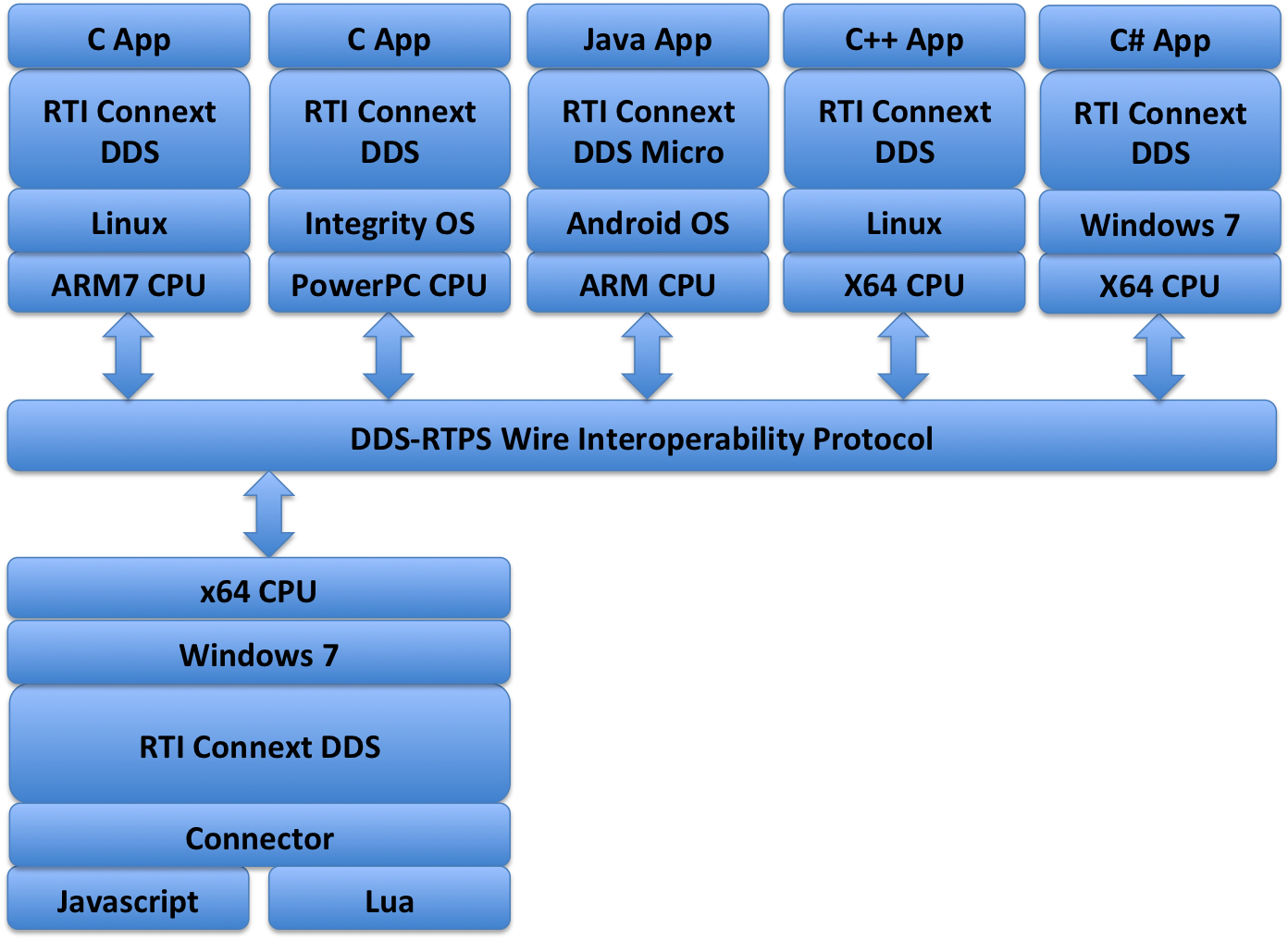
By building on Connext DDS, you guarantee interoperability across heterogeneous environments. For example, a sensor powered by ARM7 hardware and firmware written in C running on an RTOS can publish data via Connext DDS Micro. That data can then be consumed by a Windows desktop application, a Java app on an Android tablet, and a C++ program on a hardened PowerPC board running VxWorks—all without language or platform friction.
In short, you can develop your industrial IoT application in any language you prefer, but selecting a connectivity framework that spans the entire stack—from edge to cloud—is crucial. RTI Connext DDS delivers unmatched language compatibility and end‑to‑end reliability across the full spectrum of industrial IoT platforms.
Internet of Things Technology
- Industrial Internet of Things (IIoT): What It Is, Why It Matters, and How It Drives Industrial Transformation
- Fog Computing: The Future of Industrial IoT for Real‑Time, Reliable Operations
- Architecting Connectivity in the Industrial Internet of Things
- Revolutionizing Industrial IoT Connectivity: DDS Architecture That Cuts Costs & Boosts Reliability
- Industrial IoT: Empowering Small & Medium Manufacturers – Part 2
- Top 4 Challenges Facing the Industrial Internet of Things (IIoT)
- Securing Industrial IoT: Practical Strategies for Cyber‑Physical Systems
- Why Urethane Outperforms Other Materials in Industrial Applications
- Top Hydraulic Disc Brakes for Industrial Applications – 2020 Guide
- Essential Industrial Robot Applications Leveraging 3D Laser Vision Systems