



The Future of Automotive Testing: Integrating HIL Systems with RTI DDS

We partner with leading automotive teams to reveal the next generation of vehicle systems. Below, discover how Audi is redefining test infrastructure to keep pace with evolving car technology.

Modern cars contain 40–50 Electronic Control Units (ECUs) in an economy model and well over 100 in premium models. Historically each ECU served a single function, but today many handle multiple responsibilities. This functional integration reduces the number of ECUs and cabling, improving fuel economy, lowering CO₂ emissions, and delivering richer in‑vehicle features. Consequently, automotive test systems must evolve from monolithic setups to distributed, interconnected environments.
Audi’s pre‑development department is pioneering a real‑time bus based on RTI DDS to meet these demands. The goal: a modular HIL platform that mirrors the vehicle’s function‑centric architecture.
Consider these examples of functional integration:
- The legacy "air‑bag computer" now belongs to a comprehensive safety module that performs automatic crash detection (Audi pre‑sense), automated braking, seat‑belt pre‑tension, window and roof closure, and seat repositioning.
- Separate radio, navigation, and rear‑seat entertainment ECUs have merged into a single "main entertainment unit."
- Body‑electronics ECUs—headlights, interior lights, climate control—are unified into a "body control module" that also supports adaptive lighting, LED headlamps, parking assistance, and rain‑sensing wipers.
ISO 26262, the automotive functional safety standard, now embraces a function‑centric system view. Functional safety covers end‑to‑end communication, requiring safety reviews to include non‑E&PS components that the E&PS controls or monitors. This regulatory shift further drives the move toward distributed HIL toolchains.
Historically, a single HIL vendor supplied an all‑in‑one bench. Today, Audi is assembling heterogeneous benches: each subsystem uses the best‑in‑class solution from different vendors, connected through a real‑time HIL‑Bus. This architecture delivers flexibility, scalability, and confidence for next‑generation vehicles.
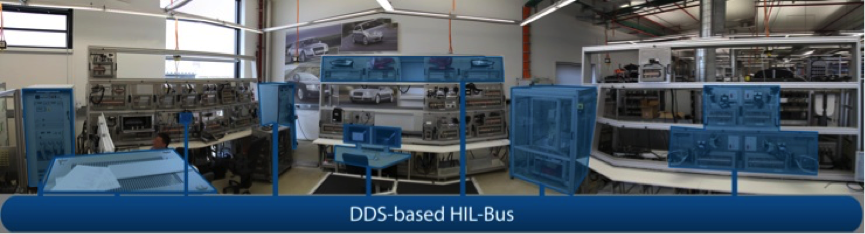
Vehicle communication has shifted from dedicated wire‑based links to data‑oriented buses like CAN and FlexRay. Audi applies the same bus‑centric philosophy to HIL testing, creating a HIL‑Bus that carries state information across distributed benches.
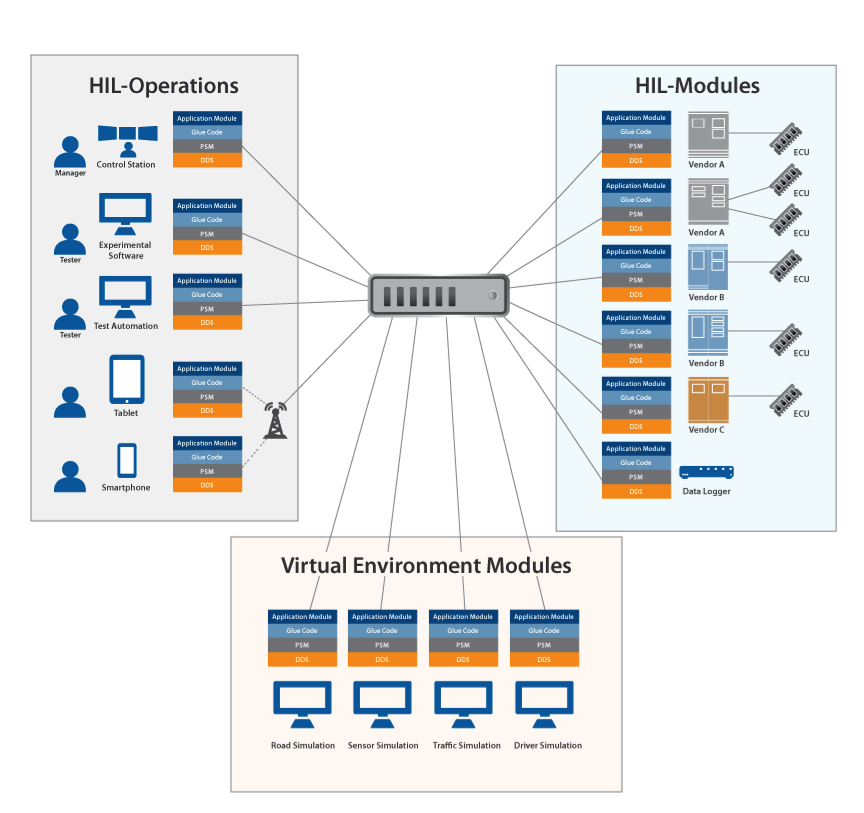
RTI Connext DDS, with its robust implementation and Open Community Source license, serves as the backbone of this bus. The OCS model allows HIL‑Bus partners free access to RTI Connext DDS, accelerating industry adoption and enabling dedicated focus on integration and quality.
Complementing this, Audi promotes open standards such as ASAM XIL‑API, which facilitates seamless integration of automated test orchestration and experimental manual testing tools.
Audi collaborates with multiple HIL vendors to mature the HIL‑Bus ecosystem, positioning it as the optimal solution for end‑to‑end functional system testing.
For deeper insight into HIL‑Bus testing, read the joint Audi/RTI article by Bettina Swynnerton of RTI and Constantin Brueckner, published in ATZ Elektronic (July 2014).
Learn more about ASAM XIL‑API at asam.net.
Learn More:
Connectivity in Autonomous Systems
Internet of Things Technology
- How 3D Printing Drives Innovation, Efficiency, and Customization in the Automotive Industry
- Industry 4.0: Materialise’s Blueprint for the Networked Factory
- Industry 4.0 in Maintenance: A Practical Guide to the Future of Asset Management
- AI Chipsets: Solving Today’s and Tomorrow’s Industry Challenges
- How Industrial Robots Revolutionize Automotive Manufacturing
- CNC Machining: Precision Solutions for the Automotive Industry
- How 3D Printing Is Revolutionizing the Automotive Industry
- Revolutionizing Automotive Manufacturing with Advanced Automation Solutions
- Carbon Fiber’s Bright Future: Key Roles in Wind, Aerospace, and Automotive Industries
- North American Automotive Industry Drives Record Robot Sales Surge