



AI Chipsets: Solving Today’s and Tomorrow’s Industry Challenges
Semiconductors power the digitally pervasive modern world. Artificial Intelligence (AI) is poised to enhance a broad spectrum of technologies—from autonomous vehicles to advanced analytics. Combining AI with silicon is the logical next step for semiconductor firms looking to embed intelligence into every device that requires processing power, says Gerry Christensen, founder and CEO of Mind Commerce.
AI chipsets also underpin the industry’s shift toward heterogeneous computing, where multiple processor types coexist in a single system to deliver performance gains while conserving energy. In many cases, AI accelerators solve problems that traditional CPUs cannot tackle efficiently.
Major players such as ARM are integrating machine‑learning engines into their SoCs to accelerate mission‑critical tasks like facial recognition for public safety and homeland security. The same silicon can boost machine‑translation workloads, demonstrating the versatility of AI‑enabled SoCs that combine CPUs, GPUs, and dedicated inference cores.
Device‑centric firms—Qualcomm and Huawei—are racing to launch the first AI‑chipsets for smartphones. Both companies recognize that emerging network paradigms—Mobile Edge Computing and 5G—will drive a surge in data traffic, especially for latency‑sensitive applications such as virtual reality. Smartphone makers cannot afford to be the bottleneck in data processing.

Huawei’s latest design claims the ability to process 4,500 images per minute—more than twice the speed of its predecessor—reducing overall latency for next‑generation public‑safety applications, such as vehicle‑to‑person interaction. Smartphones that ingest sensor data from on‑board vehicle cameras can detect pedestrians about to cross a street, enabling proactive safety measures.
Unmanned aerial vehicles equipped with AI chipsets will make smarter, sensor‑driven decisions. This capability will be transformative for verticals like precision agriculture, where a 30‑minute adjustment in pesticide spraying can mean the difference between a profitable harvest and a loss.
AI processors also play a critical role in drone safety, helping aircraft avoid overhead powerlines or automatically return to base before an approaching storm.
The vast majority of AI‑chip use cases intersect with the Internet of Things. A 2018–2023 study on AI chipsets for wireless networks, cloud, and big‑data analytics projects that IoT‑related solutions will account for 83 % of the global AI‑chip market by 2023. The IoT‑device segment alone represents a $8.7 billion ($7.49 billion) opportunity in 2023.
| $ million | 2018 | 2019 | 2020 | 2021 | 2022 | 2023 | CAGR |
| IoT Device | 917 | 1230 | 2067 | 3658 | 6039 | 8719 | 56.9% |
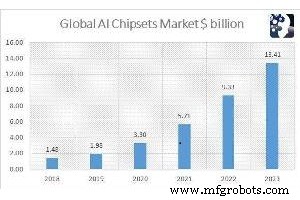
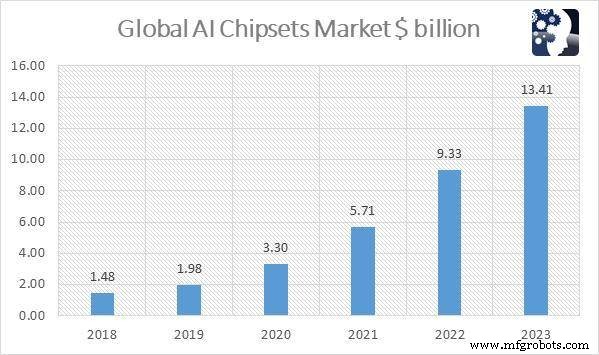
Driven by demands ranging from home entertainment to homeland security, the overall AI‑chipset market is projected to hit $13.4 billion ($11.53 billion) by 2023.
AI chipsets also accelerate big‑data and advanced analytics, particularly in IoT contexts such as supply‑chain monitoring and logistics. Multi‑processor AI silicon learns from the environment, users, and machines to surface hidden patterns, predict actionable insights, and trigger context‑aware actions.
| $ million | 2018 | 2019 | 2020 | 2021 | 2022 | 2023 | CAGR |
| Material Movement | 56 | 73 | 116 | 186 | 290 | 394 | 47.6% |
Global AI Chipsets Market by Manufacturing Application 2018 – 2023
This will translate into the next wave of on‑device based analytics, which will be important for many industry verticals such as manufacturing in which AI‑chipset supported decisions for material movements will represent a $394 million ($339.05 million) global opportunity by 2023.
The overall outlook for AI chipsets is bright as artificial intelligence as a whole is increasingly integrated in many areas including internet search, entertainment, commerce applications, content optimisation, and robotics. The long‑term prospect for AI Chipsets is that they will become embedded in many different other technologies and provide autonomous decision making on behalf of humans, both directly, and indirectly through many processes, products, and services.
The author of this blog is Gerry Christensen, founder and CEO of Mind Commerce.
Internet of Things Technology
- The Future of Automotive Testing: Integrating HIL Systems with RTI DDS
- How Digital Transformation is Reshaping the Paper Industry's Future
- Carbon Fiber: Driving Innovation and Efficiency in Aerospace
- Machine Vision: Driving Industry 4.0 and the Industrial IoT
- Gartner Forecasts AI’s Next Chapter: Opportunities, Risks, and Adoption Hurdles
- Smart Gas Monitoring: Key Safety Benefits for the Oil & Gas Sector
- IoT in 2024: Emerging Trends & Future Outlook
- IMTS 2018: How Industry 4.0 is Revolutionizing Tool Holding
- Semiconductor Evolution Unveiled: Past, Present, and Future – Expert Q&A
- Industrial Robot Arms Revolutionizing the Meat Industry