



Robotics in the 21st Century: Distributed Systems, Telepresence, and Space Exploration
Robotics in the 21st Century: Distributed Systems, Telepresence, and Space Exploration
Modern robotics is inherently distributed. A complex robot consists of a blend of autonomous, semi‑autonomous, and human‑controlled modules that must operate in tight synchrony. In telerobotics, the goal is to give operators a visceral sense of presence at the robot’s location by streaming video and haptic feedback back to them.
For the European Space Agency (ESA), this capability is critical for missions on other planets or in deep space. Operators could sit on a space station—or even on Earth—and remotely control equipment thousands of kilometers away.
Telepresence is achieved through a combination of haptic force feedback and augmented‑reality video. The richer the sensory information, the more natural the operator’s perception, leading to higher precision and safer remote control.
One of the most daunting obstacles is the communication link. Real‑time control loops in robots rely on low‑latency, reliable data streams, but the link between an operator and a distant robot is often subject to high latency, packet loss, and even brief disconnections—especially over deep‑space or broadband internet connections. This link must be treated as an integral part of the control system, with both ends constantly aware of its state to maintain safety and stability.
ESA’s multidisciplinary team—comprising mechatronics, computer vision, control theory, and software engineering experts—adopted a data‑centric approach. By modeling system state, video frames, and control signals as data, we naturally integrated link status into the overall system state. This led us to evaluate the Data Distribution Service (DDS), already used by NASA for space communications. Our investigation revealed that DDS can support real‑time teleoperation over even the most challenging links, opening new frontiers in space robotics.
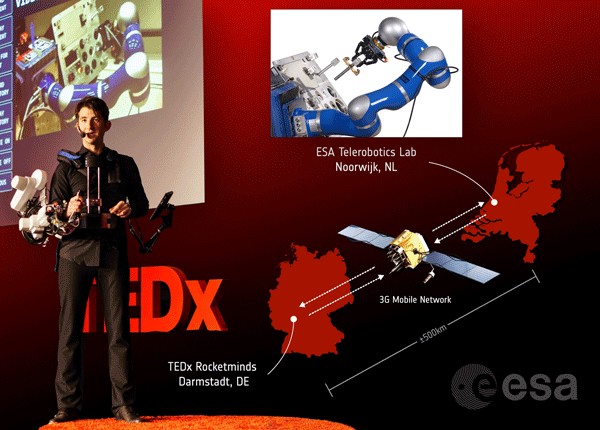
During a TEDx RheinMain RocketMinds event in May 2014, I remotely controlled a Kuka robot arm located over 500 km away using our EXO‑1 exoskeleton prototype. The task—placing a metal pin in a hole with a tolerance of <0.5 mm—was performed over an Internet‑based 2G WAN connection, mimicking the latency and packet loss typical of space links. Despite 15‑second delays and significant data loss, DDS maintained seamless communication for haptic feedback, control loops, and live video, demonstrating that precision telerobotics is achievable even under extreme conditions.
In 2014, NASA astronaut Barry Wilmore conducted the first ever robotic force‑feedback experiment in space—Haptics‑1—on the International Space Station. This milestone confirmed the feasibility of haptic teleoperation beyond Earth’s atmosphere.
First time #haptic feedback is used in space, ever! Today @Space_Station#haptics-1 is being successfully conducted! pic.twitter.com/30zD5GzGqs
— ESATelerobotics (@ESATelerobotics) December 30, 2014
If you have a story about using Connext DDS that you'd like to share, email us at blogadmin@rti.com.
Internet of Things Technology
- How Live TV Will Transform: The Computing‑Driven Future of Broadcast
- Engineering the Future: Hands‑On Robotics Education with TI's RSLK
- Soft Robotics: The Next Frontier in Assistive and Autonomous Systems
- Robotics: Driving Productivity and Revitalizing Manufacturing for the Future
- Revolutionizing Quality Control with Low‑Code & No‑Code Software
- Robotics in Manufacturing: A Proven Evolution of Efficiency and Innovation
- Yaskawa Motoman: Leading Robotics Solutions for Modern Manufacturing
- Fanuc Robotics: Leading Innovations in Industrial Automation
- KUKA Robotics: Pioneering Innovation in Industrial Automation
- ABB Robotics: Leading Innovation in Industrial Automation