



Engineering the Future: Hands‑On Robotics Education with TI's RSLK
Back in college, an instructor might say: “Study pulse‑width modulation theory; refer to page 1,453 of your textbook.” That’s a textbook approach. Or they could challenge you to apply the theory by programming a robot to navigate a maze in record time. Which would you prefer?
I chose the latter. Two years ago I partnered with Texas Instruments to create the TI Robotics System Learning Kit (TI‑RSLK), a curriculum‑driven kit for university classrooms that introduces Embedded Systems and Applications—an essential course in most electrical and computer engineering programs.
The TI‑RSLK is designed to give students hands‑on experience while building competence in integrating the hardware and software that constitute any electronic system.
During development I asked whether we could explain complex systems and engineering concepts in a more engaging way—one that excites learners, connects theory to practice, and is fun and interactive.
The latest kit features the SimpleLink™ MSP432P401R microcontroller LaunchPad™, line‑infrared and bump sensors, a TI‑RSLK chassis board, and a free curriculum comprising 20 modules (including starter code, hands‑on activities and labs).
Students construct and test a robot that can tackle tasks ranging from maze navigation (Figure 1) to autonomous racing, object retrieval, obstacle avoidance, or line following. Advanced modules explore Wi‑Fi® protocols, enabling robot‑to‑robot communication, Wi‑Fi® remote control, and even Bluetooth® connectivity.
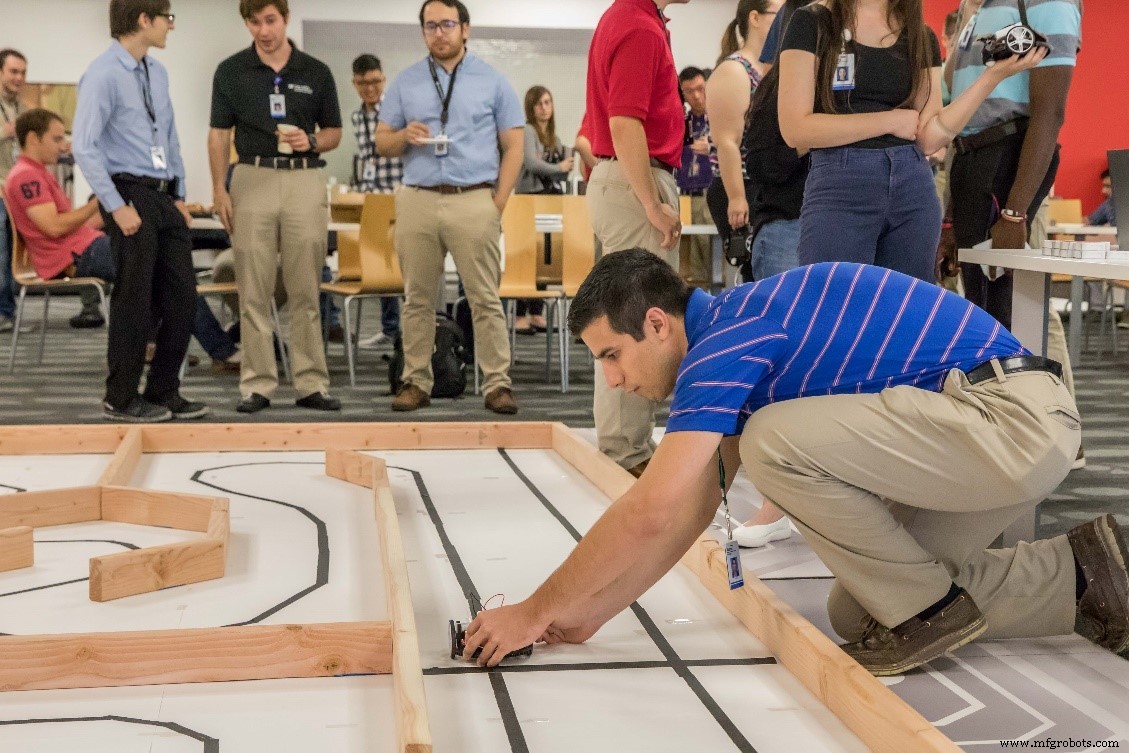
Figure 1: An engineering student tests the TI‑RSLK in a maze (Source: Texas Instruments)
The TI University team collaborated closely with Jon Valvano, a distinguished embedded‑systems educator at the University of Texas, to craft both the kit and curriculum. Valvano’s passion for enhancing student learning and his hands‑on teaching style—using industry‑standard tools—ensures that students receive a relevant, real‑world learning path.
Effective system integration and systems thinking are critical in engineering practice. The choices engineers make in hardware and software selection shape solution effectiveness. Today’s high‑tech workforce demands the ability to view a problem holistically, decompose it, and devise solutions. Design cycles now span multiple disciplines, requiring teams that deliver sophisticated products. Engineers must therefore be systems thinkers capable of understanding complex concepts across disciplines.
The TI‑RSLK’s educational approach teaches students the ‘whys’ of engineering, not just the ‘hows.’ By troubleshooting when a robot fails, students learn debugging, root‑cause analysis, and iterative improvement. When students encounter code failures or malfunctioning hardware, they no longer give up; instead they develop resilience and problem‑solving skills—crucial for a successful engineering career.
I’ve witnessed firsthand how robots keep students engaged and inspire creativity. Last summer, TI interns tested the TI‑RSLK in a mini‑competition where participants optimized maze completion time, accuracy, or entered a creative category. A standout project turned the kit into a mobile trash‑can game: the robot scored shots into a trash can while roaming, blending entertainment with engineering.
Systems thinking coupled with hands‑on learning is essential for training the engineers of tomorrow. When industry experts and academia collaborate to develop relevant curricula, the result is a win‑win for educators and learners alike. As students learn to apply practical knowledge creatively, the possibilities for solving today’s engineering challenges become limitless.
Embedded
- How Live TV Will Transform: The Computing‑Driven Future of Broadcast
- Robotics in the 21st Century: Distributed Systems, Telepresence, and Space Exploration
- Soft Robotics: The Next Frontier in Assistive and Autonomous Systems
- Robotics: Driving Productivity and Revitalizing Manufacturing for the Future
- Shaping Tomorrow: The Evolving Role of Maintenance Engineers in Modern Factories
- Weaving the Digital Thread: Building Tomorrow’s Electric Vehicles
- Revolutionizing Tool Engineering with Robotics
- Exploring the Future of Robotics: Innovation Beyond Factories
- Robotic Thermal Spray: Advanced Heat Protection for Modern Manufacturing
- Enhancing Lab Efficiency: KLA‑Tencor Adopts Robotics Solutions in Milpitas