



Edge Computing Demystified: Architecture & Enterprise Deployment Strategies
Organizations face significant challenges deploying IoT infrastructures and discovering insights from the vast amounts of device-generated data.
While the popular image of edge computing suggests that it means any processing outside of core corporate systems, it is also somewhat ambiguous. Working on a laptop, for example, could theoretically be considered “edge computing.”
For enterprise purposes, there needs to be a more exacting definition of what edge computing entails, and what part of the architecture it affects. For the final word on most technology definitions, many people look to NIST, the National Institute of Standards & Technology. NIST has something to say about edge computing as well, pointing to a paper on the topic published by IEEE, which characterizes the edge as the Internet of Things and mobile realm, extending inward to virtualization and data centers hypervisor.
See also: Center for Edge Computing and 5G
The other authority on all things IT, Gartner, defines edge as “part of a distributed computing topology where information processing is located close to the edge, where things and people produce or consume that information.”
A separate Gartner definition takes it a step further, defines it as a “computing model that enables and optimizes extreme decentralization, placing nodes as close as possible to the sources and sinks of data and content. As a decentralized approach, it is a perfect complement to the hyperscale cloud providers’ tendency towards centralization, where they take advantage of huge economies of scale.”
The other piece of understanding edge computing is how it fits into an architecture. This is critical, as enterprises a roadmap of what technologies are being brought in to support their business plans, how these solutions fit together, and the standards and formats that are to be applied. An edge computing reference architecture can provide enterprises with powerful edge data processing, enhanced IoT device management, and integration with BI services.
However, edge architectures is an area that is still a work in progress, note the authors of a paper from the German Research Center for Artificial Intelligence. The ideal architecture, they note, consists of an additional edge computing tier between cloud and IoT devices for computing and communication. “The data produced by the devices themselves are not directly sent to the cloud or back-end infrastructure, but initial computing is performed on this tier. This tier is used to aggregate, analyze, and process the data before sending it into the upper layer, the infrastructure.
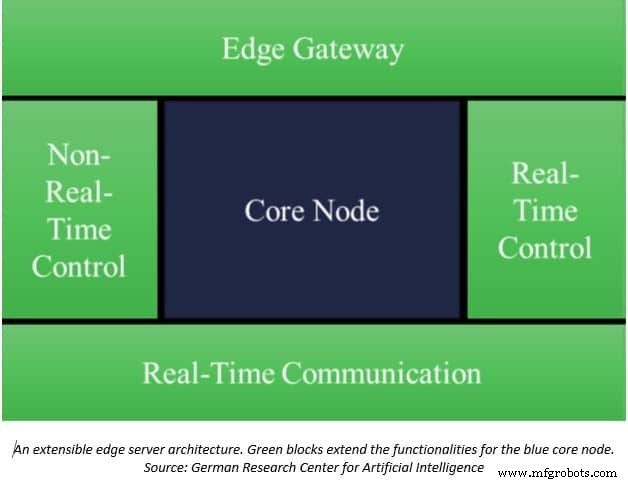
An edge architecture needs to be adapted to the nature of the enterprise it is built around. For example, in a recent post, Intel and SAP teamed up to provide a glimpse of IoT edge computing architecture that expands the reach of existing core enterprise applications. “Despite the potential of IoT, organizations face significant challenges for deploying IoT infrastructures and discovering insights from the vast amounts of device-generated data,” the document’s authors point out. The reference architecture includes the following components:
- Data acquisition and device control: An architecture should enable “data acquisition and ingestion from various sources—such as industrial sensors that are part of the operational domains—and provides control from a single dashboard. Data from these various sources is ingested into the controlling entities using various protocols.”
- Data security features between sensors, gateways, and the cloud: An architecture needs to provide “security-enabled capabilities along the entire data path with key, certificate, and identity management using Intel® hardware-based technologies, the security features allow devices to differentiate data as private or shared. The security-enabled flow can allow data to reach only the device for which it is intended.”
- More secure, hands-free device onboarding: “New devices, such as physical gateways and qualified sensors, can be automatically onboarded and provisioned, eliminating extra deployment tasks while improving security.”
- Edge-data collection, storage, and analysis: “Enterprise IoT solutions need an edge platform with robust offline capabilities to collect, store, and analyze data.” a platform should provide “domain-specific insights, real-time events and actions, reliable dashboards, and local business-process execution at the edge.”
Internet of Things Technology
- Edge Computing: The Architecture Driving Tomorrow’s Intelligent Networks
- From Edge to Cloud: Mastering IoT Data Pipelines
- Edge Computing & IIoT: Transforming Industrial Data Strategy
- Harnessing Blockchain & Edge Computing to Revolutionize Supply Chain Efficiency
- Edge Computing: The New Heartbeat of the Cloud Era
- 5G: Preparing for Exponential Data Growth in Telecom
- Driving Innovation: How Edge Computing Is Transforming the Automotive Industry
- Edge Computing & 5G: Powering Enterprise Transformation
- Harnessing Edge Analytics: Empowering IoT Edge Architecture for Real‑Time Insight
- Edge Computing: Transforming Smart Production with Local Data Processing