



From Edge to Cloud: Mastering IoT Data Pipelines

The Internet‑of‑Things (IoT) can transform a wide array of tasks—from predictive maintenance of household appliances to intelligent traffic signals that ease congestion.
According to Pinakin Patel, MapR’s Solutions Engineering lead, most IoT scenarios begin with sensor data flowing from edge devices to a centralized analytics engine, which then triggers responses—often right back at the edge.
While the input‑process‑output model is standard, IoT deployments can strain data‑management systems due to massive data volumes and the latency that comes with worldwide distribution.
Bigger IoT data
Aggregating data from consumer devices—wearables, smart thermostats, and the like—is familiar; the bulk arises from sheer device count rather than individual data output.
New challenges emerge when devices produce megabytes or gigabytes per second, such as real‑time video, audio, or LIDAR streams that can outpace conventional storage solutions.
Infrastructure must evolve: high‑volume streams will saturate existing bandwidth, necessitating robust architectures—think vehicles, medical equipment, and offshore rigs. Once in the cloud, AI and ML become essential for extracting insights and orchestrating automated actions.
Healthcare example
Abstract discussions can obscure reality; each IoT use case has unique drivers and needs. Let’s examine concrete scenarios to illustrate typical challenges.
Early detection and treatment of chronic illnesses—like heart disease—can save lives and cut costs. Key hurdles are care coordination and averting hospital admissions. Pilot programs deploy affordable sensors that stream vital signs and ECG readings over cellular networks to cloud‑based applications.
These diagnostics platforms evaluate real‑time vitals and ECGs alongside patients’ historical medical records. Data flows combine live streams, archival data, individual patient metrics, and benchmark datasets compiled from vast repositories of prior scans.
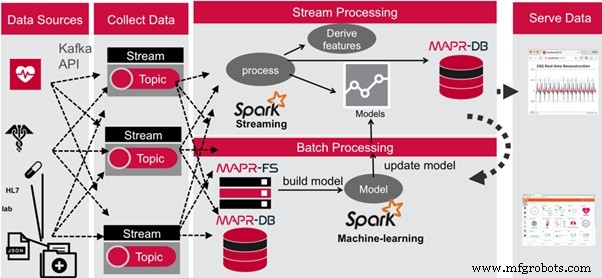
Clinicians need a workflow that gathers, aggregates, and learns across a broad device cohort to spot critical events. Detecting anomalies—such as overdosing or imminent cardiac incidents—demands edge‑side intelligence for rapid response.
Researchers developed a platform that unifies stream and batch processing within a single data fabric, enabling consistent data handling, fine‑grained access control, and scalable, high‑performance intelligence.
Automotive example
The same data‑fabric strategy is applied elsewhere, such as Mojio’s Connected Car platform, which unites automotive, insurance, and telecom stakeholders. Mojio targets 500,000 vehicles in its first rollout, delivering tailored behavioral, diagnostic, and contextual data.
Mojio’s telematics capture speed, steering, and braking to assess driver fatigue and trigger alerts. Aggregated long‑term driving data can guide users toward more fuel‑efficient habits and enable insurers to quantify risk.
Convergence and fabrics
Both healthcare researchers and automotive engineers are pioneering next‑gen applications. Their shared foundation includes cloud‑scale data stores, robust databases, and integrated persistent streaming—empowering developers to architect, build, and deploy solutions previously unattainable.

Collectively, these components form a converged data platform, increasingly adopted across diverse IoT scenarios. Such platforms deliver high‑IOPS, low‑latency file fabrics for compute‑intensive workloads and enable real‑time analytics that ingest, store, analyze, process, and act—all without duplicating data.
When IoT data traverses edge, cloud, and back, organizations must abandon legacy monoliths and embrace convergence to scale innovative use cases.
The author of this blog is Pinakin Patel, head of Solutions Engineering for MapR.
About the author
Pinakin Patel is the head of Solutions Engineering for MapR. He has more than 25 years of experience in the world of data and how organizations extract value from this critical business resource.
Internet of Things Technology
- Web‑Enabled DDS: Bridging IoT, Cloud, and Real‑Time Connectivity
- How IoT’s Surge is Driving the Shift to Edge Computing
- How IoT and Cloud Computing Shape the Future of Enterprise Data
- Edge Computing & IoT Strategy Insights from IoT World 2019
- Three Powerful Ways Cloud Computing Enhances IoT Deployments
- Harnessing Cloud Power for IoT: Unlocking Seamless Connectivity & Data Insights
- Harnessing Edge Computing for IoT, AI, and Emerging Technologies
- How IoT and Edge Computing Complement Each Other
- Edge Computing & 5G: Powering Enterprise Transformation
- Harnessing Edge Analytics: Empowering IoT Edge Architecture for Real‑Time Insight