



Empowering Every Link in Tomorrow’s Supply Chain
Modern supply chains are evolving at breakneck speed. Globalization, the rise of servitization, and shifting customer expectations demand unprecedented agility. Economic sustainability is no longer a buzzword—it’s the new competitive edge. Achieving it hinges on robust stakeholder relationships, end‑to‑end visibility, and a fresh performance lens. All of this is only possible with seamless information flow and connectivity, driven by sensors, machine learning, data lakes, and predictive analytics.
Supply Chains: Today and Tomorrow
Enterprises are shedding reactive, forecast‑dependent models. Many have already transitioned, yet asset‑tracking platforms still deliver fragmented insight. Hybrid IoT ecosystems, built on disparate technologies, fall short of delivering full coverage, scalability, and actionable intelligence. The excess data they generate adds complexity and cost, stifling productivity and eroding customer satisfaction.
Patrick Dixon, a leading supply‑chain futurist, notes: “The current model is old‑fashioned, restrictive, and stifling innovation. Companies must embrace radical change—co‑operation and collaboration—to cut costs and boost efficiency.”
Managing assets across global networks demands a holistic, all‑or‑nothing approach. Selective upgrades won’t cut it. It requires next‑generation connectivity that outstrips legacy wireless standards. While Wi‑Fi, RFID, and GSM/GPS serve niche roles, they were never engineered to link vast numbers of IoT edge devices securely and efficiently. Rising energy costs, regulatory pressure (e.g., CO₂ reduction mandates), and heightened security threats further push managers toward solutions that contextualize operations within the broader economy, environment, and society. End‑user expectations have also evolved: price is no longer the sole decision driver.
A Broader Approach to Managing Assets Across Value Chains
Supply chains are shifting from inward focus to customer‑centricity. The modern chain connects customers to suppliers, enabling managers to weave external market intelligence into their decisions. Aligning SCM, CRM, and ERP systems unlocks this vision, allowing resources to be reprioritized and decisions to be data‑driven.
John Gattorna, Professor of Supply‑Chain Management at Macquarie Graduate School of Management, Sydney, stresses: “Companies must learn from the wider business world and consider the human element of supply.”
The old push‑sale model has faded. B2Bs and consumers now dictate price, manufacturing, and support—what we call the pull‑sales model. Sustainability, a multifaceted challenge, demands better systems and metrics. MIT Sloan Management Review’s recent study outlines a three‑point framework for measuring supply‑chain sustainability:
- Context: Capture chain‑wide metrics, set science‑based goals, and benchmark against forecasts.
- Collaboration: Build goal‑based, mutually beneficial relationships across the chain to reduce hotspots, build capacity, and share a unified analytics platform.
- Communication: Enable seamless data flow and orchestration between stakeholder systems, focusing on shared KPIs.
A recent Oracle study, "The Shape of Tomorrow’s Supply Chains," found that 36% of surveyed supply professionals believe collaboration is the key to success—surpassing legislation (32%) and technology (13%). Cross‑boundary asset management solutions are thus essential for sustainable, reciprocal partnerships.
Technology to the Rescue (No, Really!)
Technology is the catalyst that unlocks data, turns it into insight, and enhances end‑to‑end visibility. Real‑time asset tracking is pivotal for stakeholder collaboration. Oracle reports that 48% of respondents want predictive software to model the impact of their own or suppliers’ decisions, while 41% are interested in smart containers or RFID that track product movement and energy usage. These tools empower enterprises to build profitable partnerships.
Quick Look: Automotive
Automotive supply chains are expanding in scale and scope. Connected‑vehicle telematics, infotainment, and onboard computers add new layers of complexity to parts sourcing, manufacturing, assembly, and distribution. As monitoring demands grow, distinguishing cause and effect becomes harder. Sophisticated analytics are required to quantify environmental impact—from vehicle production down to individual component sourcing, energy use, and water consumption.
Edgar Blanco, Executive Director at the MIT Centre for Transportation and Logistics, warns: “Companies could be counting processes in a never‑ending chain.”

Cloudleaf Sensor Fabric™ delivers cross‑boundary visibility, real‑time monitoring, and granular control across the entire value chain. Its RF‑agnostic connectivity links assets in motion—patented enterprise‑grade endpoints and gateways forming an intelligent mesh that supplies position and condition data to cloud analytics. Each sensor creates a unique digital fingerprint, conveying an asset’s status relative to its neighbors and environment.
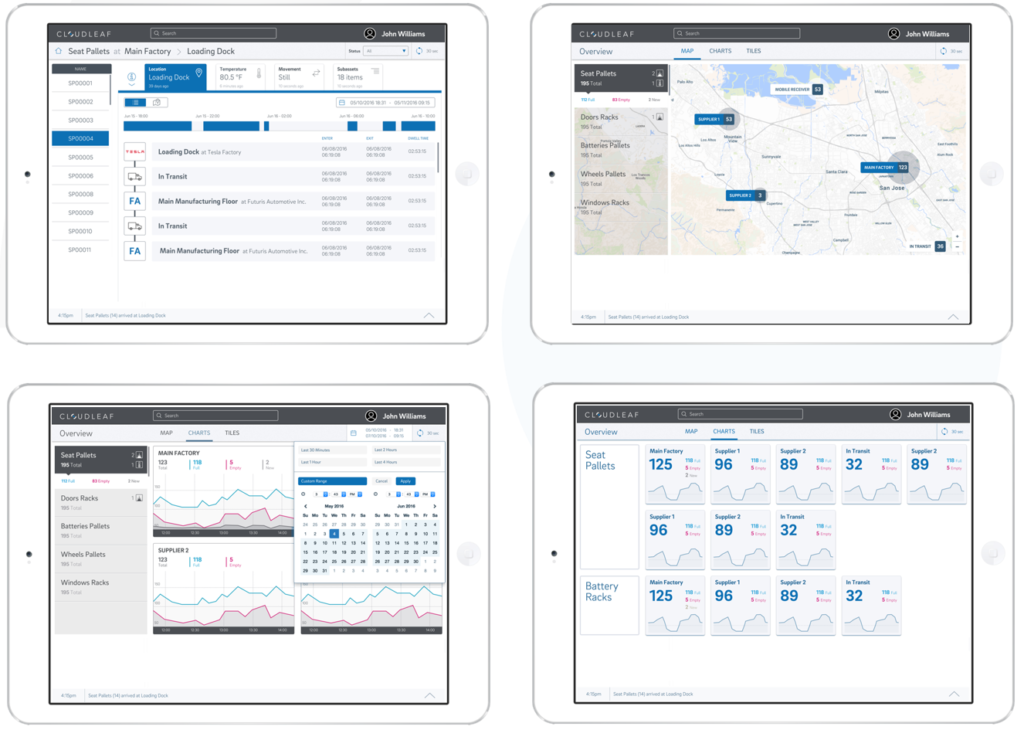
Plant managers can orchestrate inventory containers, sub‑assemblies, and high‑value tools worldwide with ease. Sensor Fabric is secure, scalable, and fully managed, boasting a zero‑implementation footprint that avoids disruption. Deploy the system in the morning, and data streams in the afternoon. It’s more than sensors and connectivity—it’s about fostering relationships among partners, suppliers, and customers. IoT technologies, methodologies, and tools are expanding plant managers’ horizons, unlocking deeper understanding of complex, globally connected supply chains.
About Cloudleaf
For enterprises ready to accelerate digital transformation, Cloudleaf is redefining IoT deployment and delivery. Our approach turns the once‑challenging IoT landscape into a seamless, high‑performance asset‑tracking ecosystem.
- Follow us on Twitter
- Connect on LinkedIn
- Read our Medium posts
Media Contact
Nitesh Arora, Head of Marketing
+1-415-315-9273
nitesh.arora@cloudleaf.io
Internet of Things Technology
- How AI Is Transforming Global Supply Chains
- How Smart Supply Chains Transform Manufacturing Efficiency
- 3D Printing the Strongest Link: Carbon‑Fiber Chain Tests for Industrial Loads
- Discovery’s IoT Solution Transforms Supply Chain Management
- Elevate Your Supply Chain: A Strategic Management Blueprint
- Revolutionizing Healthcare Supply Chains: Unlocking AI’s Full Potential
- Transforming Supply Chains: Unlocking Value Through Fulfillment and Digital Innovation
- Strategic Supply Chain Resilience: Essential Disruption Planning
- Nanomaterials Supply Chain Matures, Enabling Advanced Composite Technologies
- Understanding Supply Chain Management: Key Concepts & Benefits