



Robust Cloud‑Based Software Updates for IoT Devices
Keeping both resource‑constrained edge devices and powerful controllers or gateways up to date is essential in virtually every IoT deployment.
Software update capabilities are the frontline defense that protects connected devices from the evolving threat landscape that emerges the moment they connect to the internet. A Linux‑based, web‑connected device that never receives a security patch is effectively a suicide mission for its operator.
Beyond security, updates enable agile hardware development. Features can be rolled out incrementally, turning a minimum‑viable product into a continuously evolving platform. Customers appreciate devices that can receive new functionalities over time, and manufacturers can unlock new revenue streams by monetising feature extensions—such as apps—without redesigning or re‑shipping hardware.
Device Connectivity Choices
When planning an update strategy, the first decision is whether devices should connect directly to the update service or do so indirectly through a device‑connectivity layer (e.g., Bosch IoT Hub, AWS IoT, IBM Watson IoT, Azure IoT Hub). Bosch IoT Rollouts supports both approaches, and here’s why that flexibility matters.
Direct connectivity isolates the update channel from other data streams, allowing each to evolve independently. This separation keeps the update API stable even when the business channel undergoes rapid change—a common scenario in early‑stage IoT solutions where devices may stay offline for months or even years after manufacture.
It also isolates business logic from the update process on the device. In complex stacks—such as an IoT gateway running an OSGi runtime—an update client sharing the same runtime as mission‑critical bundles could fail if the runtime becomes unstable. Keeping the update process separate mitigates that risk.
Of course, two channels mean additional implementation effort on the device and can increase traffic or battery consumption. Nevertheless, many engineers find the maintainability benefits outweigh the extra complexity.
Indirect connectivity consolidates all traffic into a single channel managed by the cloud‑connectivity layer. This simplifies the device firmware and allows the use of mature device‑management protocols (LWM2M, OMA‑DM, TR‑069) that already include an update sub‑protocol. Proprietary protocols defined by the manufacturer can also be accommodated.
In practice, engineers often postpone update integration until late in the project, defaulting to the indirect path and then dealing with the consequences after deployment. With Bosch IoT Rollouts, you can choose the approach that best aligns with your project’s maturity and complexity.
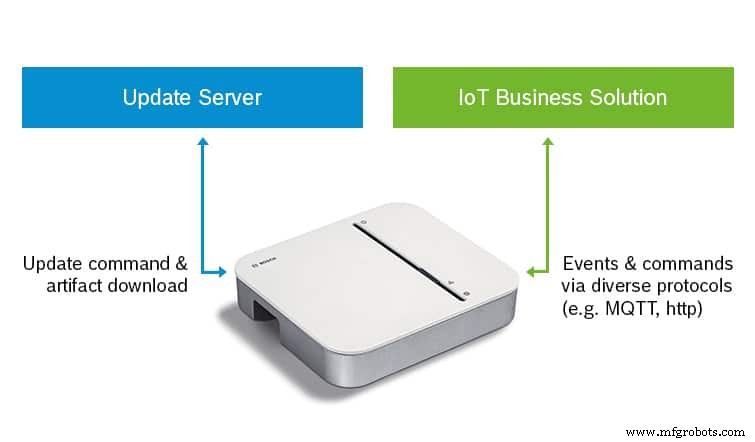
When deciding between direct and indirect, ask whether your priority is separation of concerns or architectural simplicity. Bosch IoT Rollouts supports both, enabling you to evolve your solution without locking yourself into a single pattern.
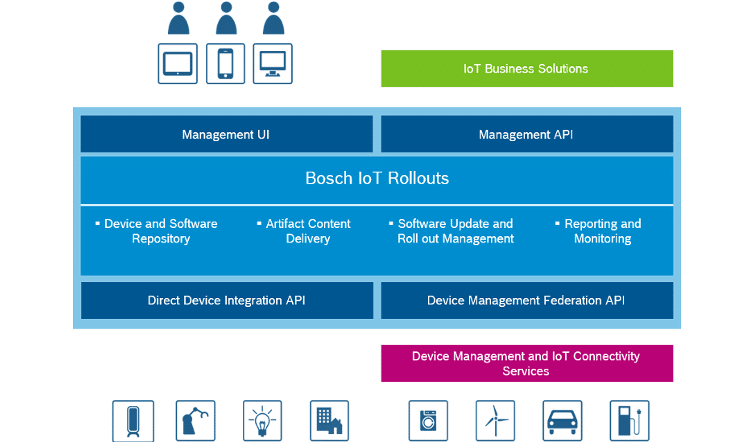
Another key decision is the transport protocol. Many solutions adopt MQTT with a custom overlay, while others leverage the proprietary protocols offered by connectivity layers. Standards like OMA‑DM v2 or LWM2M provide a robust framework, but they can introduce early‑stage complexity. A well‑chosen standard can let your device and update service operate out‑of‑the‑box without writing custom code.
Device authentication is critical for both paths. Wherever possible, use the same asymmetric mechanism (e.g., X.509 certificates) for both the update channel and the primary IoT channel—Bosch IoT Rollouts’ Direct Device Integration API supports this. If asymmetric credentials are infeasible for constrained devices, a central symmetric key store can bridge the gap.
Ultimately, no single architecture suits every IoT scenario. The good news is that a range of proven options exists, and each can be tailored to meet your security, agility, and operational requirements.
Internet of Things Technology
- Clearing the Confusion: Navigating Standards in the Industrial IoT Revolution
- Achieving ISO 26262 Certification for Automotive Software Components
- Over‑the‑Air Software Updates in IoT: Why SOTA Matters
- 5 Key Wireless Standards Powering IoT Connectivity
- How IoT Is Slashing Healthcare Costs and Boosting Outcomes
- Software AG Projects the Next Wave of IoT Growth
- Why Safety‑Critical Software Is Becoming a Cornerstone of the IoT Revolution
- 8 IoT Trends Forecasted for 2017: Expert Insights
- Software Testing for IoT Devices: Key Challenges & Solutions
- Cloud Software Evolution: Shaping Tomorrow’s Business