



Phase Ranging vs. Angle of Arrival: Choosing the Right RTLS Protocol
With the rapid expansion of the Internet of Things (IoT), organizations are increasingly deploying Real‑Time Location Systems (RTLS) to track assets, personnel, and equipment. Two cutting‑edge radio‑based technologies—Phase Ranging and Angle of Arrival (AoA)—are gaining traction. This article examines both methods, outlining their operational principles, advantages, limitations, and practical implications for RTLS deployments.
What Is Phase Ranging Technology?
Phase Ranging determines an asset tag’s position by measuring the round‑trip phase shift of signals sent from the tag to multiple beacons at several distinct frequencies. By interpreting these phase differences, the system infers the distance to each beacon with high precision. Because low‑power BLE radios can capture phase with excellent accuracy, Phase Ranging offers a cost‑effective alternative to time‑of‑flight approaches such as Ultra‑Wideband (UWB).
Once a tag has gathered ranges to at least four beacons (ideally more than six for optimal geometry), it can trilaterate its location. The entire process completes within a few hundred milliseconds, making Phase Ranging suitable for real‑time applications.
What Is Angle of Arrival (AoA) Technology?
AoA also relies on phase measurements, but it interprets them differently. Instead of estimating distance, the AoA locator—equipped with an antenna array—measures the angle of the incoming signal. By switching between antenna elements and comparing their phase shifts, the locator calculates the direction from which the signal originates. When multiple locators receive the same tag signal, the intersection of their bearing lines pinpoints the tag’s location.
Exploring the Differences
Below we compare Phase Ranging and AoA across key dimensions that influence RTLS performance and deployment.
Resolution
In an AoA system, resolution degrades with distance from the locator. Think of spokes on a wheel: the farther you move from the hub, the wider the gap between them. Consequently, AoA locators cannot be mounted on very high ceilings without sacrificing accuracy. Phase Ranging, by contrast, derives resolution purely from signal bandwidth and remains consistent regardless of range, allowing beacons to be placed anywhere to achieve the desired coverage and geometry.
Costs
AoA locators require a multi‑element antenna array, adding hardware complexity and expense. Phase Ranging systems can rely on simple omni‑directional antennas, reducing component costs and simplifying procurement.
Installation
AoA localization typically uses the MUSIC (Multiple Signal Classification) algorithm—a computationally intensive process that cannot run on tags or locators. Instead, samples must be sent to an edge processor or the cloud for processing, usually via wired Ethernet. This necessity for a backhaul network increases both cost and installation effort. Phase Ranging tags calculate their own position locally, requiring only a low‑power wide‑area network (LPWAN) for backhaul, which eliminates the need for cabling.
Multipath
Indoor environments frequently contain metallic surfaces that reflect radio waves. Phase Ranging inherently discriminates multipath because it measures arrival time, whereas AoA must rely on algorithms like MUSIC to identify the direct path—a task complicated by the highly correlated nature of reflected signals. Consequently, Phase Ranging is more resilient to multipath interference.
Accuracy
Accuracy is the most critical metric for any RTLS, yet it is also the most nuanced. For example, a warehouse test of Link Labs’ OnSite XLE Phase Ranging system produced the following cumulative distribution function (CDF) of location accuracy:
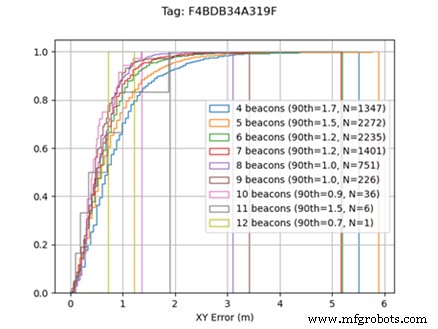
Y‑axis: percentiles (e.g., 0.5 = 50%); X‑axis: system accuracy in meters.
The 90th‑percentile accuracy—meaning the accuracy achieved 90% of the time—was approximately 1.2 m. Using the 50th‑percentile, the system achieved about 40 cm. When comparing accuracy claims, it is essential that vendors use the same statistical methodology; otherwise, a low percentile can mislead users into overestimating performance.
Phase Ranging Through AirFinder OnSite XLE
Given its lower cost, simpler installation, and robust accuracy, Phase Ranging is generally considered the superior choice for most RTLS applications. At Link Labs, our AirFinder OnSite Xtreme Low Energy (XLE) platform leverages Phase Ranging to deliver sub‑meter accuracy while preserving tag battery life and affordability. Book a demo today to see Phase Ranging in action.

Internet of Things Technology
- Understanding AC Phase Shift: How Waveforms Lead and Lag
- Real‑Time Location Services (RTLS): What It Is and How It Works
- Managing Capex Risk for RTLS Investments in Uncertain Times
- Designing Accurate RTLS Systems for Real-World Success
- Key Limitations of Wi‑Fi Real‑Time Location Systems
- Mastering Wireless Communication Range: How Power, Data Rate, and Interference Shape Connectivity
- Choosing the Right Encoder: A Deep Dive into Communication Protocols & Application Considerations
- Assessing the Security of Two-Way Quantum Direct Communication Protocols Against Undetectable Eavesdropping
- Enhancing Smart Home Connectivity: Building Truly Intelligent and Autonomous Devices
- SPI, I2C, UART: Communication Protocols & Their Applications