



Choosing the Right Encoder: A Deep Dive into Communication Protocols & Application Considerations
This article provides a comprehensive guide to selecting the optimal encoder for motor rotor tracking, examining key factors that influence the choice across diverse industrial applications.
As robotics, industrial drives, factory automation, and renewable energy systems increasingly rely on precise motor control, the demand for rotary encoders has surged. Insight Partners predicts a 10.2% CAGR in global encoder revenue through 2027, reaching an estimated $3.45 billion annually. Accurate, continuous rotor shaft tracking is essential for real‑time position, speed, and direction data—capabilities that an encoder delivers. However, selecting the right encoder requires a nuanced understanding of application requirements and operational constraints.
Absolute vs. Incremental Encoders
Encoders come in two primary forms: incremental and absolute. Incremental types determine position relative to a reference point, whereas absolute encoders assign a unique binary code to each shaft position (see Figure 1). Although incremental encoders are typically less expensive and simpler to implement, absolute encoders offer immediate state awareness—critical for safety‑critical or fail‑safe applications where the system must know the exact rotor position immediately upon startup.
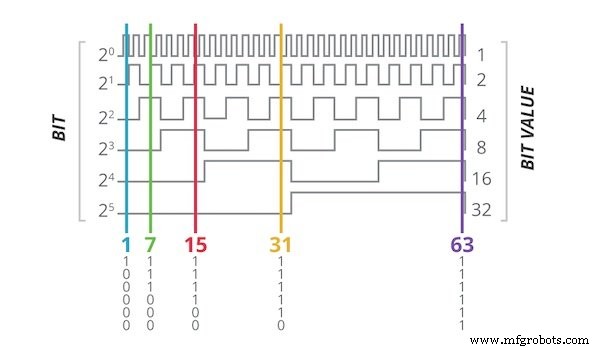
Figure 1. Each potential rotor position on an absolute encoder has a unique code.
Choosing the Encoding Mechanism
Encoders can employ optical, magnetic, or capacitive sensing. Optical encoders, while cost‑effective, suffer from line‑of‑sight issues in dusty, greasy, or vibration‑intense environments. Magnetic encoders eliminate line‑of‑sight problems but typically consume more power and offer lower resolution. Capacitive absolute encoders—such as those in CUI Devices’ AMT Series—combine dust and grease resistance, high vibration tolerance, and superior accuracy, making them increasingly popular in demanding industrial settings.
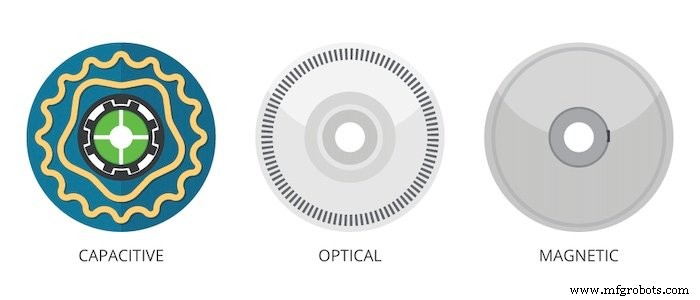
Figure 2. A comparison of the encoder disks for capacitive, optical, and magnetic encoders.
Integrating an Encoder: Interface Protocols
Once the encoder type is chosen, interfacing it with the host system is the next critical step. Common industrial protocols include RS‑485, SPI, and SSI. Understanding each protocol’s strengths helps match the interface to system requirements.
Serial Peripheral Interface (SPI)
SPI offers a bi‑directional, full‑duplex link that many microcontrollers support natively, enabling quick setup and high data rates. It is ideal for short (<1 m) connections where noise levels are manageable. For example, CUI Devices’ AMT22 Series supports a 2 MHz clock and delivers position feedback in just 1.5 µs. Additional commands—such as zero‑point setting or encoder reset—are also transmitted over SPI.
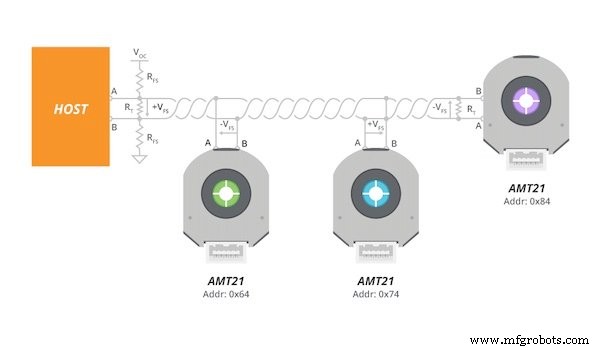
Figure 3. Example SPI configuration with shared clock signal, MOSI, MISO, and unique chip select line.
RS‑485
RS‑485 excels in long‑distance or high‑noise environments due to its differential signaling and common‑mode noise rejection. It requires no clock signal, allowing data rates up to 10 Mbps or higher on twisted‑pair cabling, depending on distance. Moreover, multiple encoders can share a single RS‑485 bus, supporting up to 64 devices with the AMT21 encoder’s 8‑bit protocol (two bits for command, six for address). Each encoder can respond to position requests within 3 µs.
Figure 4. An example of an RS‑485 configuration featuring multiple encoders connected to the host.
Synchronous Serial Interface (SSI)
SSI uses a shared clock and differential signaling, offering cost‑effective, noise‑resilient communication for medium‑length links. The AMT23 Series supports a three‑wire SSI interface with an integrated chip‑select line, simplifying deployment and allowing selective activation of individual encoders on the bus.
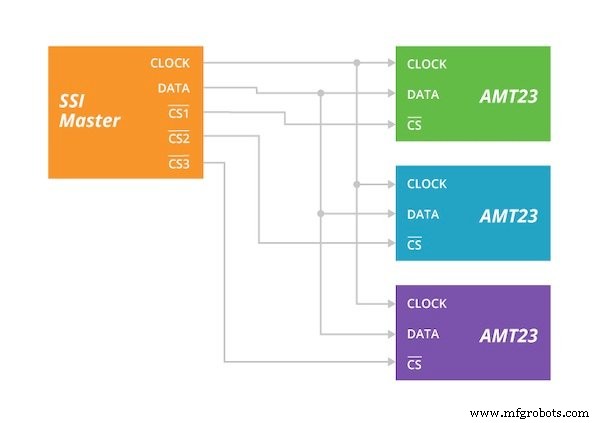
Figure 5. The three‑wire SSI configuration with chip‑select feature.
Conclusion
CUI Devices’ capacitive absolute encoders, coupled with a broad range of interface options, enable engineers to tailor solutions to their specific needs. For projects requiring long cable runs or harsh electromagnetic environments, RS‑485 is the recommended choice. When simplicity and rapid integration are paramount, SPI offers an excellent solution, especially with its widespread MCU support. For cost‑constrained, space‑limited designs, SSI provides a lean yet robust alternative.
Industry Articles are a form of content that allows industry partners to share useful news, messages, and technology with All About Circuits readers in a way editorial content is not well suited to. All Industry Articles are subject to strict editorial guidelines with the intention of offering readers useful news, technical expertise, or stories. The viewpoints and opinions expressed in Industry Articles are those of the partner and not necessarily those of All About Circuits or its writers.
Automation Control System
- Zirconium Applications: How This Rare Metal Shapes Modern Technology
- Zigbee vs. Wi‑Fi: Which M2M Technology Delivers the Best Balance of Power, Range, and Bandwidth?
- Accelerating Industrial Edge Vision with NXP’s i.MX 8M Plus Processor
- Expert Guide to Onsite Fuel Tanks for Construction Projects
- Top 6 Encoder Repair Tips to Minimize Downtime
- A Comprehensive Guide to Encoder Types for Precise Motor Control
- A Heartfelt Farewell: My 40-Year Journey in Publishing
- Top 5 Everyday Uses of Copper: From Kitchenware to Industry
- Sand Casting in Automotive: High Quality, Low Cost, and Volume Flexibility
- Top 15 Robotics Solutions Boosting Efficiency in the Electronics Sector