



Bluetooth Mesh: A Practical Protocol for Industrial IoT Connectivity
Bluetooth has become the leading wireless technology for IoT devices because it is both inexpensive and widely available. Its low‑power profile—transmitting at 0 dBm or less—and high data rate of 1 Mb/s make Bluetooth Low Energy (BLE) ideal for battery‑powered wearables that pair with smartphones. However, the short range that makes BLE so efficient also limits its use in industrial settings, where a robust backhaul infrastructure is required; the smartphone‑centric model simply does not scale.
The Bluetooth Mesh Standard is being developed to allow BLE devices to form a resilient mesh network that routes data to a gateway and onward to the internet. Although the specification is still evolving, it promises a low‑cost, battery‑friendly architecture that could transform industrial and enterprise deployments.
Limitations of Bluetooth Mesh
- Sensor distribution. Mesh networks thrive when sensors are evenly spread—think HVAC units or lighting fixtures. In lumpier deployments such as power monitors or paper dispensers, the short BLE range makes it difficult to maintain a reliable mesh.
- Isolated nodes. A sensor that sits beyond range of any neighbor cannot join the mesh, leaving isolated devices disconnected.
- Throughput constraints. Even a mesh has finite bandwidth; a high density of sensors can drain battery life as each node repeatedly relays data.
Link Labs’ Proven Architecture for Low‑Cost Industrial IoT
- Bluetooth to LTE‑M. A low‑power “reader” bridges BLE sensors to an LTE Cat‑M1 network. Typically 5–10 sensors share one LTE‑M bridge, which can be powered via a standard outlet and positioned close to the BLE field.
- Bluetooth to LoRa/Symphony Link. For sites where LTE‑M is cost‑prohibitive or coverage is weak, the reader forwards data over LoRa to a Symphony Link gateway. AirFinder’s RTLS solution uses this stack, combining inexpensive sensors with a “no‑IT‑integration” long‑range backhaul that can be back‑hauled over cellular or Ethernet.
AirFinder Architecture
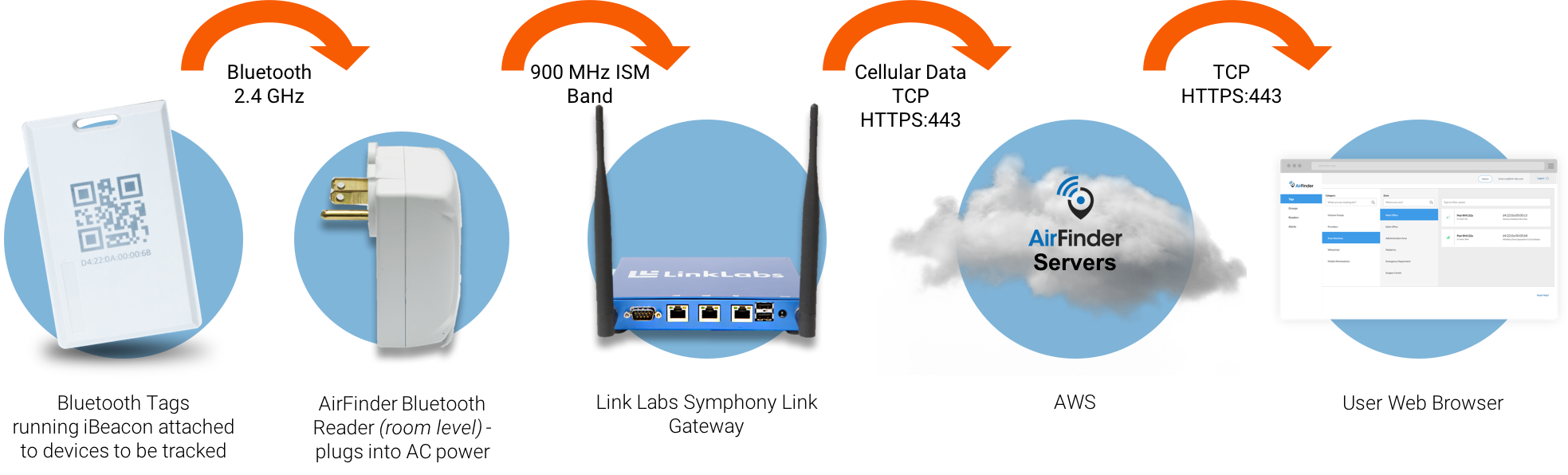
Key Take‑Aways:
- Bluetooth remains a powerful, cost‑effective connectivity option for IoT designers.
- Industrial or enterprise backhaul cannot rely on smartphones.
- Bluetooth Mesh is best suited for well‑distributed, controlled scenarios such as lighting control.
- Combining Bluetooth with a long‑range backhaul—LTE‑M or LoRa—is the preferred strategy for industrial IoT deployments.
Internet of Things Technology
- Cisco Tops Industrial Networking Market Share for Second Consecutive Year
- 5G for Industrial IoT: Transforming Connectivity and Automation
- AirFinder Bluetooth LE & XLE: Top IoT Solutions for Industrial Asset Tracking
- Bluetooth LE vs. ZigBee: Choosing the Right Low‑Power Protocol for IoT
- IXON Cloud IIoT Starter Kit – Plug‑and‑Play for Industrial IoT
- IXrouter: Seamless Edge‑to‑Cloud Connectivity for Industrial IoT
- Future Outlook: Advancing Industrial IoT for Production Excellence
- Bridging the Industrial IoT Talent Gap: Proven Strategies for Hiring, Training, and Culture
- Bridging the Industrial IoT Talent Gap: Proven Hiring & Training Tactics
- Bluetooth SIG Enhances Mesh Networking for Scalable IoT and Industrial Applications