



How IoT Boosts Productivity, Longevity, and Maintenance for Industrial Robots
How IoT improves productivity, increases lifespan and optimises maintenance of PLC robots
Robots and cobots have completely revolutionised manufacturing processes worldwide. IFR forecasts a 10% rise in industrial robotics in 2020. Companies adopt industrial robots for their rapid return on investment and steady efficiency gains – the robots are becoming the new dedicated employees.
They excel at repetitive, heavy or precise tasks such as palletising, delivering unmatched speed and accuracy. Modern industrial robots also feature human‑like memory, sensing, trainability and dexterity, enabling them to tackle more sophisticated jobs – assembly, packaging, testing and inspection.
These advancements increase the need to monitor robot health, optimise output and simplify control or programming. This is where the Internet of Robotic Things (IoRT) comes into play.
What is the Internet of Robotic Things?
The IoT and robotics communities are converging to form the Internet of Robotic Things (IoRT). IoRT refers to the integration of smart technology embedded in robots or surrounding devices that monitors events, collects sensor data, and uses intelligence to decide on actions that manipulate or control physical objects.
IoT is a network of internet‑connected devices that drive customer‑facing innovation, data‑driven optimisation, new applications, digital transformation, business models, and revenue streams across all industrial sectors.
IoT offers vast opportunities for industrial robots and collaborative robots (cobots), but why is it essential?
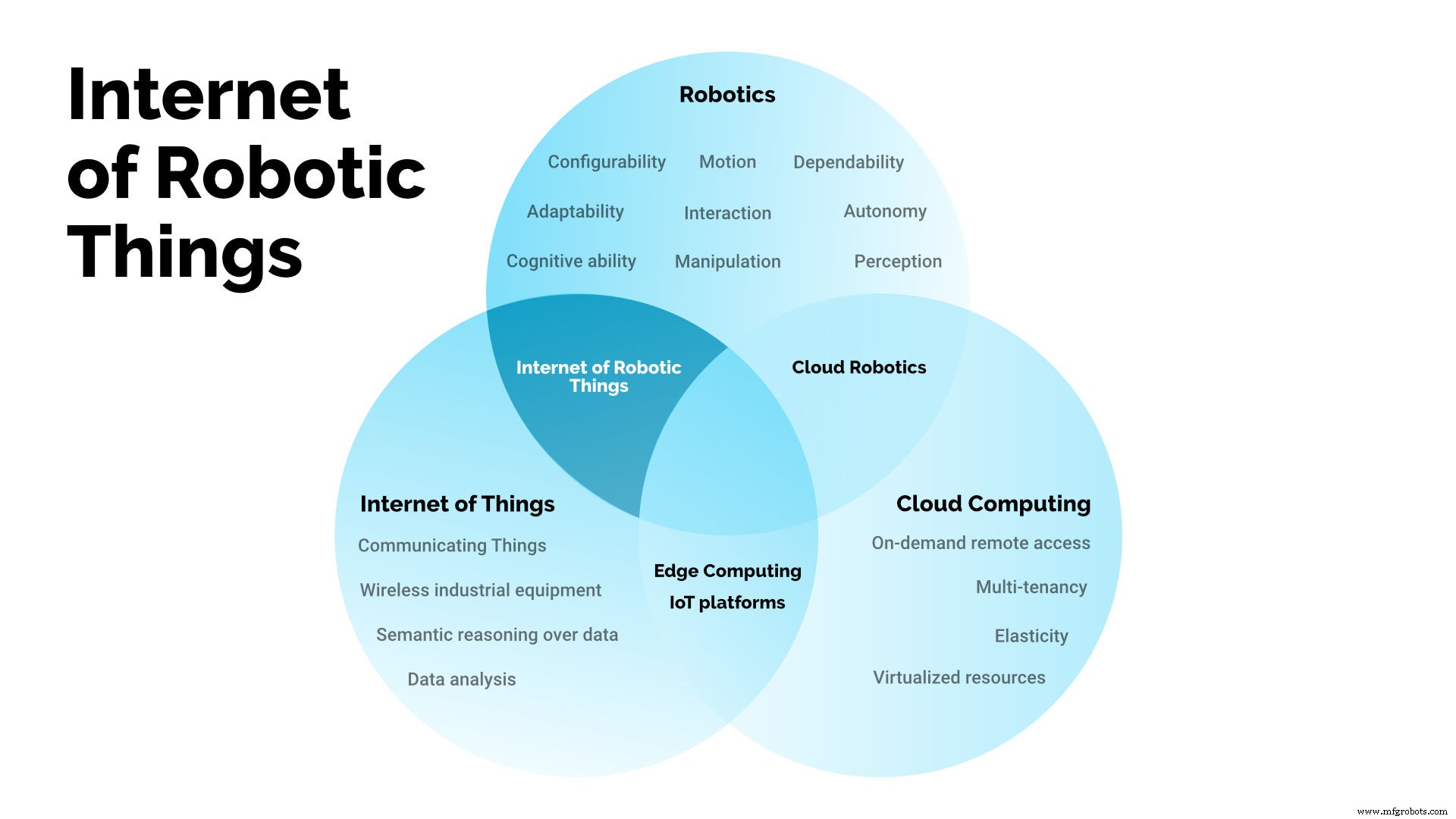
Internet of Robotic Things (IoRT)
Why IoT in industrial robotics?
IoT is the primary enabler of more productive and efficient robots. It allows you to:
- Connect services and collect data from PLC robots
Data from robots worldwide is captured via edge technology and transferred to a secure, global cloud environment. - Access robots remotely
Fast, secure access to robot controllers and connected equipment lets you respond to performance or unexpected issues from anywhere. Engineers can bring their expertise to the field without being on site. - Monitor robot condition
24/7 diagnostics accelerate reaction times, increase efficiency, and improve preparation for on‑site service calls. - Assess fleets
Identify the most demanding robots in your fleet and prioritise their service needs, reducing the risk of critical failures and extending equipment life. - Optimise robot assets
Periodic analysis reveals underperforming components or software, helping you avoid downtime and improve response times.
These examples illustrate how IoT is applied in robotics. Below are the benefits of an Industrial IoT platform for managing robots and cobots.
7 benefits of IoT for robots and cobots
Most industrial PLC robots are ready to connect, unlocking new possibilities in predictive, proactive and instant support.
Explore seven key benefits:
- Zero downtime
Preventive alarms and global access to your robots ensure unplanned downtime is virtually eliminated. - Remote robot arm monitoring
Instantly view the robot’s arm rotations via its web server on your PC or tablet. - Maintenance reminders
Receive notifications when maintenance is due, avoiding unprepared service visits. - Remote robot programming
Apply process changes from outside the factory using a secure VPN connection. - Operating time analysis
Collect data on active and standby periods to identify improvement opportunities. - HMI control on your smartphone
Use VNC technology to adjust the robot’s HMI from anywhere on your phone. - Real‑time data visualisation
A live dashboard generated from robot data simplifies operator decision‑making.
Conclusion: Implementing IoT in robotic automation increases productivity, extends robot lifespan, and optimises maintenance, benefiting engineers and operators alike.
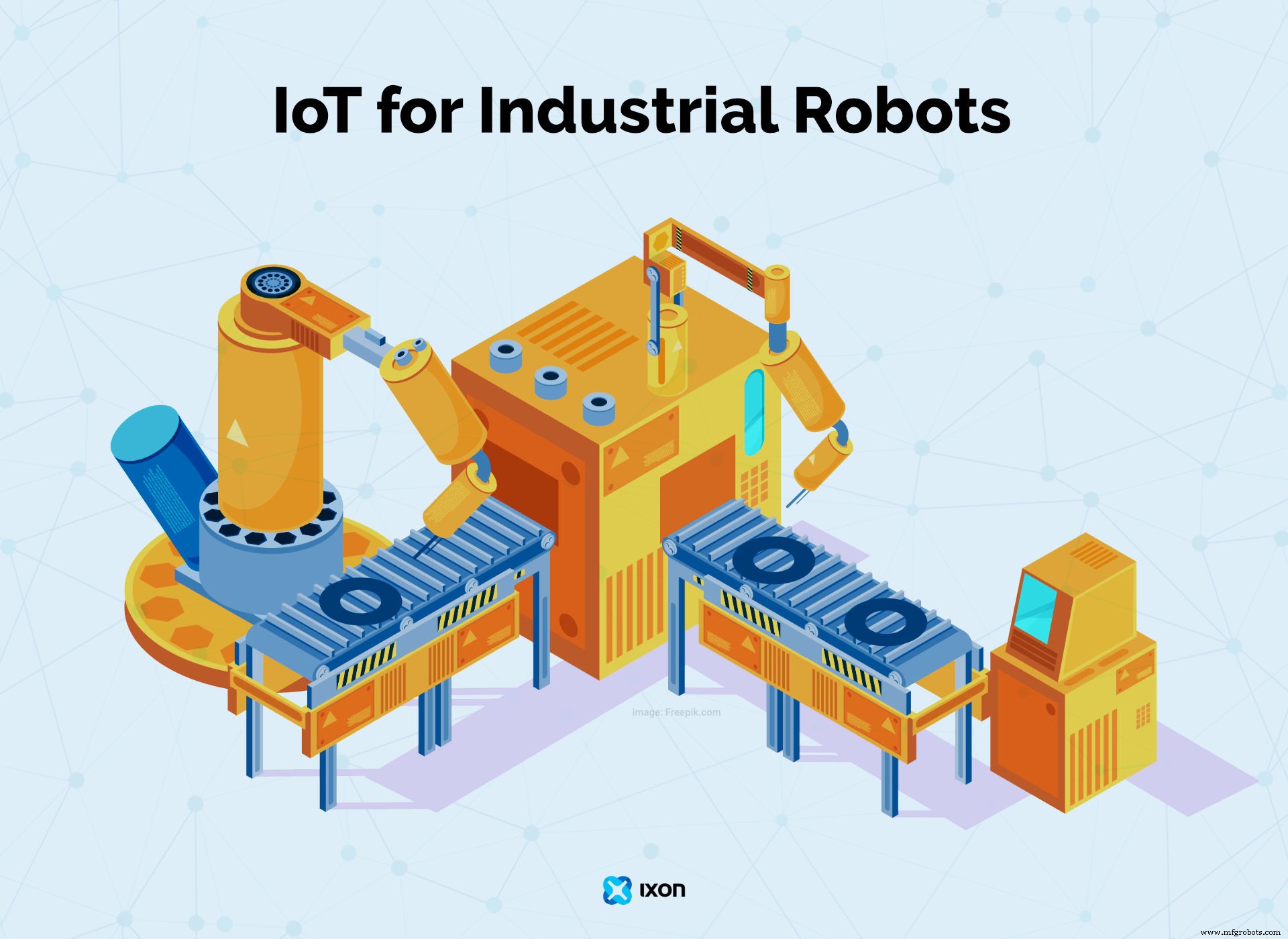
IoT for Industrial Robots
Examples of using IoT in industrial robotics
Smart Robotics employs IoT to secure cloud connections to their robots for remote support and delivers monthly software updates. Read their story here.
We can take control of the system and immediately help the customer find a suitable solution, even in China
Heico Sandee, Smart Robotics
Universal Robots partners with IXON to provide a comprehensive IIoT platform compatible with their robots. The partnership offers remote access via VPN, smartphone control of the teach pendant, alarming and notifications, and user‑friendly data dashboards. Explore the connector and learn how to set up remote access for UR+ cobots.
Ready‑to‑use IIoT platform for robots: IXON Cloud
IXON Cloud is the world’s first no‑code Industrial IoT platform, designed for leading machine builders. Create a free account, set it up, and immediately gain remote access and IoT capabilities for a wide range of robots and cobots, including UR+, FANUC, Mitsubishi, ABB, Yaskawa, Doosan, Saywer, Hanwha, and more. Contact us to confirm compatibility with your robot.
Enrich your robots with a customised cloud platform for optimal service and instant data insights. Use the IXrouter or IXagent to connect your PLC robot to IXON Cloud, resolve issues quickly, or offer targeted service. Leverage data to optimise performance.
Get even more from your robots. Create a free IXON Cloud account and explore how IoT can reduce downtime and enhance customer service. Discover what IXON Cloud can do for your organisation with our Free Product Tour.
[[Create your free IoT platform]]
Internet of Things Technology
- Driving Convergence and Interoperability in Industrial IoT and Industrie 4.0
- Balancing Trust and Value in Industrial IoT: A Cisco Security Journey
- 5G for Industrial IoT: Transforming Connectivity and Automation
- Uniting IT and OT for Seamless Industrial IoT Success
- Cisco 1G Bidirectional Transceivers: Boosting Service Provider and IoT Network Efficiency
- Secure Remote Access, Service, and Monitoring for Industrial Robots & Cobots
- IoT Cost Analysis: What Service Providers and Enterprises Can Learn from Cloud Pricing
- Industrial IoT: Key Building Blocks Driving Industry 4.0
- Fog Computing Explained: Transforming IoT Data Flow and Reducing Cloud Load
- Augmented Reality: The IoT Solution That Empowers People