



IoT Cost Analysis: What Service Providers and Enterprises Can Learn from Cloud Pricing

Overview
Today, the majority of organizations are migrating their infrastructure to public cloud environments and leveraging these platforms to manage the growing Internet of Things (IoT) ecosystem.
Over two‑thirds of enterprises now employ edge and near‑edge compute resources for IoT analytics, machine learning, and other data‑intensive tasks. Leading hyperscale providers—AWS, Google Cloud, and Microsoft Azure—offer pay‑as‑you‑go IoT services tailored to enterprise needs.
451 Research’s Pricing Investigation
Earlier this year, analysts from 451 Research’s Digital Economics and IoT team noted a roughly 50% reduction in Azure’s IoT pricing. This prompted a key question: Which hyperscaler—AWS, Google Cloud, or Microsoft—offers the lowest cost overall?
The team identified nine pricing parameters that could significantly influence total cost: average message size, message volume, registry updates, and others. Using a machine‑learning approach and a Python simulation, they compared U.S. pricing models for the three platforms.
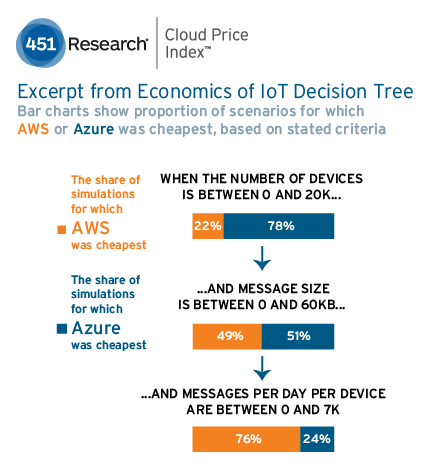
Running 10,000,000 simulations, the analysis revealed that Azure and AWS can be cost‑effective in specific scenarios, as illustrated in the decision tree diagram. Microsoft generally emerged as the cheaper option at large scale, while AWS offered the lowest prices for most typical enterprise use cases. Google Cloud did not appear as the cheapest in any simulation.
Key Takeaways for Enterprises
- ML as a Service Unlocks Insight—The study demonstrated that cloud‑based machine learning tools can uncover hidden cost efficiencies, but success requires deep domain knowledge to interpret complex pricing models.
- Complexity Persists Even with Simplified Models—Despite efforts to streamline pricing, nuances remain that often compel organizations to manually calculate expected costs, a practice that is neither practical nor scalable.
Because cloud billing is far from a “just like electricity” utility, many consumers struggle to grasp what they are paying for. This knowledge gap presents a clear opportunity for service providers to reduce complexity, broker across platforms, and simplify machine‑learning access for non‑experts.
Author: Owen Rogers, Research Director – Digital Economics Unit
Internet of Things Technology
- MQTT vs. DDS: Choosing the Right M2M Protocol for IoT
- How Cloud Providers are Transforming IoT Data Management and Analytics
- Cisco 1G Bidirectional Transceivers: Boosting Service Provider and IoT Network Efficiency
- Edge & Cloud Computing in IoT: A Concise Evolutionary Overview
- Fog vs. Cloud: Optimizing IoT Deployments for Speed and Scale
- How IoT Boosts Productivity, Longevity, and Maintenance for Industrial Robots
- Fog Computing Explained: Transforming IoT Data Flow and Reducing Cloud Load
- Machine Vision: Driving Industry 4.0 and the Industrial IoT
- Industrial IoT Unveiled: How It Drives Enterprise Value and Efficiency
- Volvo Drives Innovation: Leveraging IoT & AI to Revolutionize Vehicle Connectivity and Maintenance