



Cortex‑M33 Microcontrollers Elevate IoT Security with TrustZone
LONDON — In a rapidly connected world, security has become a top priority for IoT devices. STMicroelectronics and NXP Semiconductors are leading the charge with new Cortex‑M33‑based microcontrollers that embed Arm TrustZone for robust hardware‑level protection.
STMicroelectronics unveiled the STM32L5 series this week. Building on the Cortex‑M33’s secure architecture, the STM32L5 adds flexible software isolation, secure boot, encrypted key storage and hardware cryptographic accelerators. Designed for ultra‑low‑power operation, it leverages ST’s adaptive voltage scaling, real‑time acceleration, power‑gating and multiple low‑power modes. The result is an MCU that can run for years on a coin cell or harvested energy, drawing as little as 33 nA in shutdown and scoring 402 ULPMark‑CP in the EEMBC ULPBench.
NXP’s LPC5500 series delivers single‑ and dual‑core 100 MHz Cortex‑M33 MCUs fabricated in 40 nm flash technology. Targeted at industrial and edge IoT applications, the LPC55S69 offers 32 µA/MHz efficiency at the full core clock, dual‑core processing, tightly coupled accelerators for signal processing and cryptography, and up to 640 KB Flash with 320 KB SRAM on‑chip.
“Security must be baked into every device,” said Matt Short, senior director of IoT at IHS Markit. “Both vendors are listening to the same customer concerns and are responding with hardware roots of trust.” Short highlighted the trade‑offs: “ST chose a mature 90 nm process optimized for battery life, while NXP pursued higher performance in 40 nm.” He added that the true differentiator lies in the ecosystems and partnerships built around these MCUs.
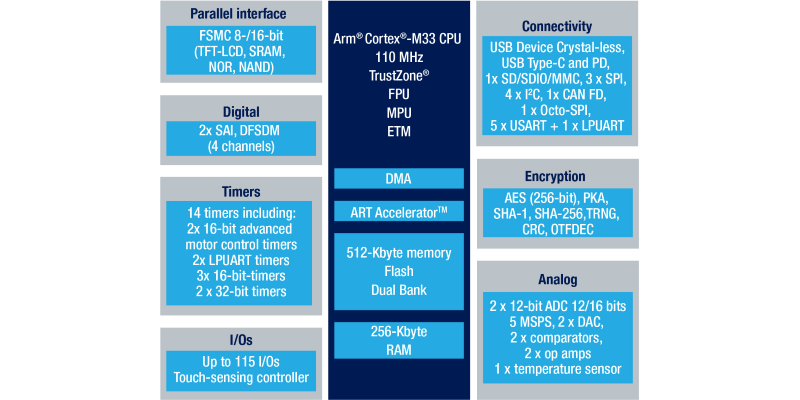 The STM32L5 architecture. (Source: STMicroelectronics)
“When IoT demands security and trust, a hardware root of trust is essential,” Short concluded. “The conversation is moving beyond hardware and software to the ecosystems that support them.”
Internet of Things Technology
- Securing the Industrial IoT: A Practical Roadmap
- Four Critical IoT Security Threats in 2015 — What Developers Need to Know
- Two Essential Strategies for IoT Security
- 5G’s Backbone at Risk: Insecure IoT Devices Undermine Network Security
- IoT Security – A Practical Guide from Perry Lea
- Cypress Enhances IoT Security with PSA‑Certified PSoC 64 MCUs
- IoT Security: Cryptographic Foundations for Robust Device Protection
- IoT Security – Who Holds the Responsibility?
- The Rise of IoT: Why Security Must Be Built In from Day One
- IoT Security: Overcoming Deployment Barriers