



LoRa and NB‑IoT Lead Early LPWAN Race, Poised to Capture 86% of Deployments by 2023
In the rapidly evolving Internet‑of‑Things landscape, LoRa and 5G’s Narrowband‑IoT (NB‑IoT) have surged ahead of the broader low‑power wide‑area network (LPWAN) cohort, according to a fresh IHS Markit analysis.
While the 4G LTE‑M variant trails, and Sigfox remains a distant follower, the data signal a clear consolidation in the LPWAN arena.
In 2018, IHS estimated that just 150 million LPWAN links were active worldwide. The study projects a 63 % compound annual growth rate, expecting the figure to swell to 1.7 billion by 2023.
Emerging alternatives are also gaining traction. Several vendors have begun shipping their inaugural 900 MHz Wi‑Fi chips for HaLow, a long‑range Wi‑Fi variant, and last year CEA‑Leti unveiled preliminary work on a patented Turbo‑FSK waveform.
IHS forecasts that NB‑IoT and LoRa could command a combined 86 % of all LPWAN links in 2023. “We foresee a two‑horse race by 2023, with LoRaWAN dominating the private sector and NB‑IoT primarily deployed on public networks,” said Christian Kim, co‑author of the report.
Huawei’s HiSilicon division currently supplies the majority of NB‑IoT chips, with 90 % of those chips deployed in China. Mediatek in Taiwan follows as the second‑largest supplier, and China’s RDA Unisoc rounds out the top three. NB‑IoT traces its roots back to UK start‑up Neul, which Huawei acquired in 2014.
The LTE‑M market lags, led by Qualcomm, with Sequans and Altair trailing. In contrast, Semtech remains the dominant provider of LoRa chips, holding the leadership position among LPWAN silicon vendors.
Geographically, 54 % of last year’s LPWAN deployments occurred in China, with roughly 23 % each in the Americas and the EMEA region. Government‑backed smart‑city initiatives in China are driving NB‑IoT adoption across smart meters, parking solutions, and street lighting.
“Most projects are financed by public funds,” Kim added. “Many enterprises remain cautious about adopting NB‑IoT, even within China.”
LPWANs are often described as solutions seeking problems. IHS currently tracks 20 distinct use cases for these links.
In China, the government is actively promoting NB‑IoT for smart‑home applications—such as electronic locks and smoke detectors—and Huawei has outlined potential uses in precision agriculture, notably in dairy operations. However, these deployments remain in nascent stages.
Across the United States, Wi‑Fi and Bluetooth dominate the smart‑home landscape, while developed countries already run dairy farms at high efficiency levels.
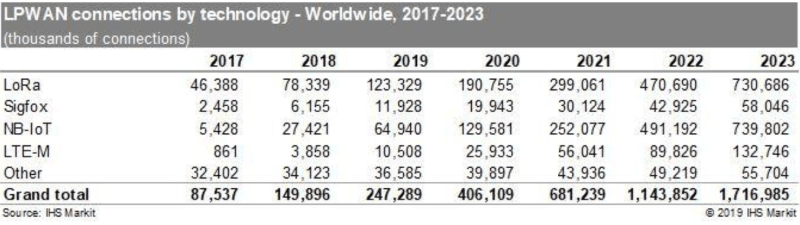
LoRa and NB‑IoT could command 86% of all LPWA deployments by 2023. (Source: IHS Markit)
Internet of Things Technology
- Cisco Unveils Industrial Network Director: Streamlined IoT Network Management for Operations Teams
- Cisco 1G Bidirectional Transceivers: Boosting Service Provider and IoT Network Efficiency
- NB‑IoT Architecture Demystified: A Practical Guide for IoT Engineers
- Fog vs. Cloud: Optimizing IoT Deployments for Speed and Scale
- Link Labs Introduces Low‑Power, Long‑Range M2M Network for Diverse Industries
- IoT Security: A Core Priority for Network Operators in the RAN and Edge Era
- Why the Cloud Is Not the Only Solution for IoT Success
- Huawei Earns Gold Medal for NB‑IoT Technology at World IoT Expo
- Senet & SimplyCity Expand LoRaWAN IoT for Smart Farms, Industry, and Urban Sustainability
- Why 5G is Key to Unlocking IoT's Full Potential