



Two‑Microphone Voice Control: XMOS Unveils the XVF3510 to Cut Device Footprint
XMOS, a leading fabless semiconductor firm, has taken a decisive step toward embedding voice control into everyday devices. Their new XVF3510 voice processor demonstrates how only two microphones can deliver robust, real‑time speech recognition, dramatically reducing cost and size.
For context, XMOS specializes in voice solutions, audio products, and multicore microcontrollers that run real‑time tasks, perform intensive digital signal processing (DSP), and maintain deterministic behavior. Their xCORE architecture connects multiple RISC processor tiles via a high‑speed switch, allowing each tile to execute up to eight tasks concurrently. Tasks communicate through channels—whether local or remote—and, when necessary, through shared memory.
The xCORE design embeds core real‑time operating system features—task scheduling, timers, I/O, and channel communication—directly into hardware. By removing timing uncertainties such as interrupts, caches, and shared buses, xCORE devices can respond to external events in nanoseconds, enabling hard real‑time applications without dedicated hardware.
In 2017, XMOS acquired Setem Technologies, pioneers of advanced blind source separation. Setem’s patented algorithms empower consumer devices to isolate a single voice amid background noise, enhancing speech‑recognition accuracy.
Typical voice assistants, like Amazon’s Echo and Echo Dot, rely on arrays of seven microphones to filter noise, cancel echo, and pinpoint speaker location. While effective, this approach raises cost and space concerns. XMOS’s XVF3510 addresses these challenges by delivering comparable performance with just two microphones.
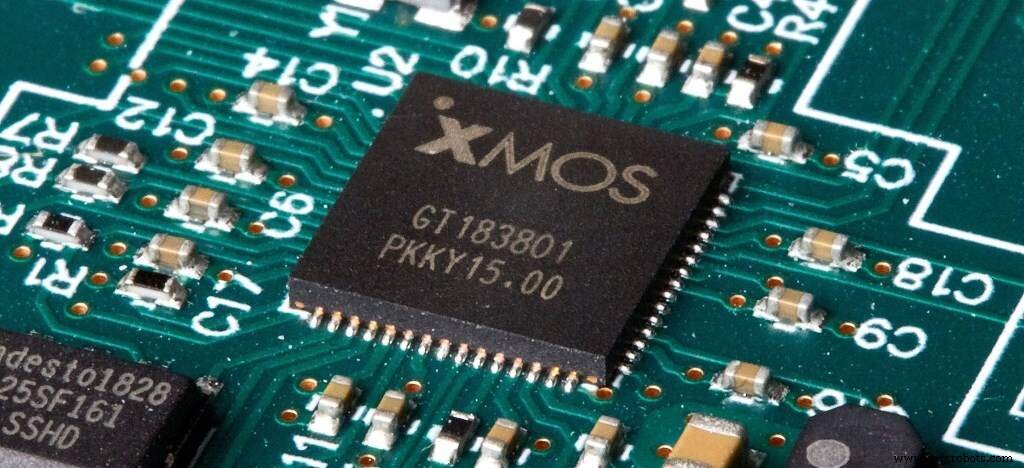
XVF3510 mounted on a PCB (Source: XMOS)
The XVF3510’s firmware incorporates advanced interference cancellation to nullify unwanted background sounds, stereo acoustic echo cancellation to eliminate speaker echo and enable barge‑in, and adaptive delay estimation to dynamically adjust reference signal latency. Together, these features deliver a smooth, real‑time audio experience.
Internet of Things Technology
- Evolving Embedded Systems: Tackling Modern Design Challenges
- Industrial Manufacturing to Deploy Over 15 Million AI‑Enabled Devices by 2024, ABI Research Forecasts
- Choosing the Right 3D Printing Solution for Your Business
- Embedded Hardware Hacking for IoT Devices: Tools, Techniques, and Business Implications
- Top 2019 IoT Devices That Will Revolutionize Your Daily Life
- Plastic vs. Polyurethane: Which Material Is Truly Eco-Friendly?
- Industrial IoT vs. SCADA: Determining the Superior Control System
- Which CNC Approach Best Fits You?
- Choosing Crane Repair or Replacement: Key Factors to Guide Your Decision
- CNC Machining vs. 3D Printing: Which Technology Delivers Superior Performance?