



Fiber‑Optic Communications: Fundamentals, Architecture, and Pros & Cons
Explore the foundational concepts of fiber‑optic communication systems in this comprehensive primer.
This article explains the key components of optical communication systems and details the transmitter and receiver circuits used in fiber‑optic networks.
What Is an Optical Communication System?
For decades, electronic data has been transmitted through traditional hard‑wired cables or radio links, each with limitations such as signal loss, interference, and bandwidth constraints. Optical fiber links—whether for audio, video, or data—offer distinct advantages over conventional cables, including higher bandwidth, immunity to electromagnetic interference, and lower attenuation over long distances.
With the rapid growth of information technology, fiber‑optic communication has become indispensable for modern telecommunication infrastructures, powering everything from broadband internet to high‑speed local area networks (LANs). Its ability to deliver high‑quality, high‑speed signals makes it the backbone of contemporary communication systems.
How Fiber Optics Work
An optical fiber link transfers analog or digital data encoded in light through a cable with a highly reflective core. The core acts as a light guide, reflecting photons along the fiber via total internal reflection. A typical optical communication module comprises a transmitter (Tx) and a receiver (Rx), as illustrated below.
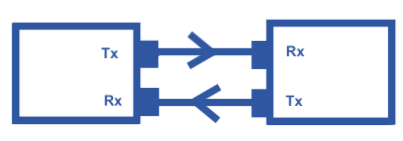
A simple receiver‑transmitter block diagram
In this configuration, the transmitter—located at one end of the fiber—converts an electrical input into an optical signal using either a light‑emitting diode (LED) or a laser diode. The optical signal is coupled into the fiber via a connector and propagates to the receiver, which detects the light and reconverts it to an electrical signal for downstream processing.
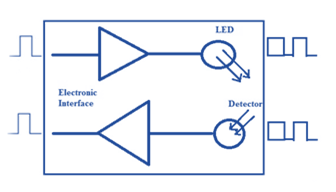
Block diagram of a typical optical transmitter and receiver
Pros and Cons of Fiber Optics
Fiber‑optic links excel in several key areas:
- Immunity to Electromagnetic Interference: The non‑conductive core eliminates electrical noise and crosstalk, ensuring clean signal transmission.
- High Bandwidth and Low Attenuation: Capable of supporting terabits per second over kilometers, ideal for bandwidth‑intensive applications.
- Lightweight and Environmentally Resilient: Thin, flexible, and tolerant to temperature extremes and harsh chemicals, making them suitable for challenging installations.
- Security: Physical tapping is difficult, enhancing data security.
However, fiber optics also present certain challenges:
- Cost of Transceivers: Encoders and decoders (transceivers) add to the initial investment, though prices have dropped significantly.
- Installation Sensitivity: Sharp bends or mechanical stress can cause loss of signal; careful handling and proper cable management are essential.
- Conversion Requirement: Electrical signals must be converted to optical and back, adding complexity to system design.
When deployed correctly, fiber‑optic systems provide reliable, high‑performance connectivity that supports the demands of modern telecommunication networks.
Internet of Things Technology
- Optical Data Communication: Harnessing Light for High‑Bandwidth, Interference‑Free Transmission
- Optical Fiber: Technology, Production, and Future
- Mastering Wireless Communication Range: How Power, Data Rate, and Interference Shape Connectivity
- Carbon Fiber Weaves: Types, Properties & Industrial Applications
- PolyOne Introduces Advanced ECCOH Grades for High‑Performance Optical Fiber Cable Jacketing
- Breakthrough Optical Fiber Achieves 1 Petabit/Second Transmission Speed
- Big, Bold, Fast: Advanced Optical Metrology for Large-Scale Industries
- 500°C Rated Optical Fiber for Reliable High‑Temperature Applications
- Revolutionary Compact Optical Amplifier Promises Noise‑Free Space and Fiber Communications
- Fiber Circuits Explained: A Beginner’s Guide to Modern High-Speed Communication