



Optical Data Communication: Harnessing Light for High‑Bandwidth, Interference‑Free Transmission
Introduction
Modern networks increasingly rely on light to carry digital data. Instead of converting binary signals into electrical voltage swings, optical transmitters (LEDs or solid‑state lasers) generate pulses of light that can be received by photodiodes or phototransistors, enabling a seamless electronic‑optical‑electronic conversion chain.
Why Light? The Clear Advantages
Optical links offer a level of performance unmatched by copper: they eliminate inductive and capacitive loading, provide immunity to electromagnetic interference, and support data rates in the hundreds of gigabits per second. These traits make fiber optics indispensable for backbone networks, data centers, and emerging high‑speed applications.
Fiber Architecture: Core, Cladding, and Total Internal Reflection
At the heart of a fiber optic cable lies a core of ultra‑pure glass whose refractive index is slightly higher than that of the surrounding cladding. When light enters the core at an appropriate angle, it is reflected repeatedly by the core‑cladding interface—a phenomenon known as total internal reflection—and thus travels along the fiber’s length without escaping.
Typical fibers feature a 125 µm cladding diameter, giving the cable flexibility while maintaining the necessary optical confinement. To protect the delicate glass, manufacturers apply a thin plastic buffer, reinforce the assembly with kevlar strands for tensile strength, and finally sheath the bundle in a protective polymer jacket comparable to that of conventional copper cables.
Performance Metrics: Speed, Bandwidth, and Reliability
Because the optical signal is immune to electromagnetic interference, fibers can sustain remarkably high bandwidths. However, physical imperfections—such as microbending and modal dispersion—can degrade signal quality, especially over long distances.
Microbending: Small‑Radius Deformation and Signal Loss
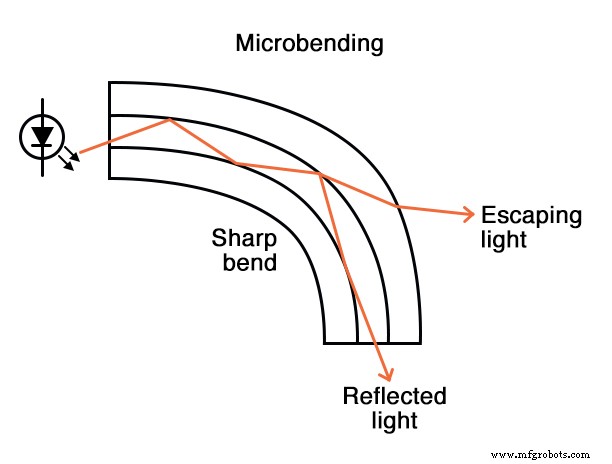
When a fiber is bent with a radius below its minimum threshold, microbending forces a portion of the light to escape into the cladding. This loss not only weakens the transmitted signal but also introduces a potential security vulnerability: a strategically placed photodetector could intercept data from a sharply bent section.
Modal Dispersion: The Pulse‑Stretching Problem
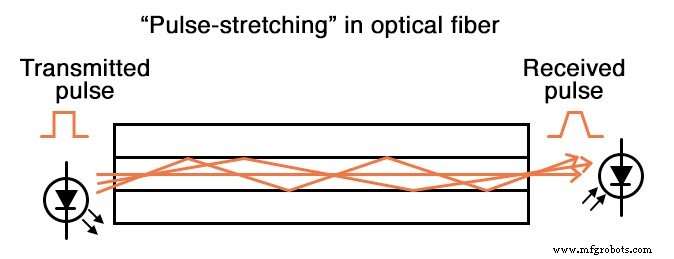
In multimode fibers, light can travel along multiple paths—each slightly longer than the others—causing pulses to arrive at the receiver over a spread of times. The resulting distortion of the signal’s edges is known as pulse stretching and limits the achievable bandwidth over long runs.
Choosing the Right Fiber: Single‑Mode vs. Multimode
Single‑Mode Fiber
With a core diameter near 5 µm, single‑mode fibers allow only a single propagation path. This design eliminates modal dispersion, making it the preferred choice for long‑haul links spanning several miles. The trade‑off is a lower total optical power transmission compared to multimode fibers, which may necessitate repeaters or amplifiers over very long distances.
Multimode Fiber
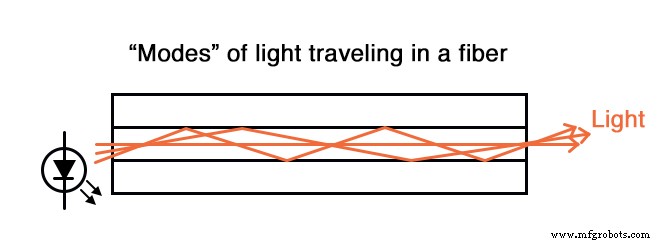
Featuring a larger core, multimode fiber supports many propagation paths, resulting in higher total transmitted power. However, the diverse path lengths introduce modal dispersion, which can severely limit bandwidth on longer runs. Multimode fibers are ideal for short‑distance applications such as within buildings or data centers.
Conclusion
Optical data communication remains the backbone of modern high‑speed networks. By understanding the physical principles—total internal reflection, microbending, modal dispersion—and selecting the appropriate fiber type, engineers can design systems that deliver unparalleled bandwidth, reliability, and security.
Industrial Technology
- Understanding Data Flow: From Simplex to Full‑Duplex Communication
- Optical Fiber: Technology, Production, and Future
- Fiber‑Optic Communications: Fundamentals, Architecture, and Pros & Cons
- Breakthrough Optical Fiber Achieves 1 Petabit/Second Transmission Speed
- AI-Driven Photonic Chips Shape Broadband Light for Smart Optics
- Arduino Serial Communication: Mastering UART Basics and Troubleshooting
- Revolutionary Compact Optical Amplifier Promises Noise‑Free Space and Fiber Communications
- Revolutionizing Data Transmission: Multiplexed Optical Antennas for Ultra-Fast Communication
- Fiber Circuits Explained: A Beginner’s Guide to Modern High-Speed Communication
- Straton Tutorial 2: Mastering MMS Communication in IEC 61850