



The 5‑Layer IoT Technology Stack: A Product Manager’s Blueprint
Discover how the five foundational layers of the IoT stack—device hardware, device software, communications, cloud platform, and cloud applications—can shape your product strategy and roadmap.
While the Internet of Things promises transformative change, many Product Managers still wrestle with its core concepts and how to leverage them for tangible customer value.
Note: If you’re new to IoT, start with What is the Internet of Things.
Approaching IoT as a black box only fuels confusion. Instead, view it as a collection of distinct, interlocking components—the five layers of the IoT technology stack. Every IoT product, whether consumer or industrial, shares these layers.
In the sections that follow, I’ll explain each layer in detail and demonstrate how this model can guide discussions with engineering, sales, marketing, and executive stakeholders.
Let’s dive in!
Introducing the 5 Layers of the IoT Technology Stack
Product Managers who master the five layers gain clarity on the trade‑offs and opportunities at every stage of the solution. The layers are:
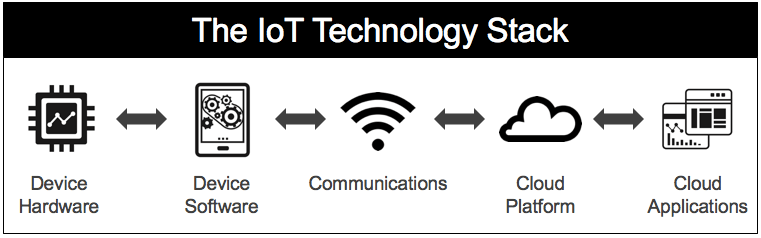
Consider a wind‑turbine health‑monitoring product that predicts maintenance needs—saving millions in downtime and repair costs. This example illustrates how each layer contributes to the overall solution.
Layer 1 – Device Hardware
Devices are the tangible “things” that bridge the physical and digital realms. They form the foundation of the IoT stack.
Decide whether your product is a fully integrated device (e.g., a Nest thermostat) or a retrofit solution that adds sensors and connectivity to an existing asset. In our wind‑turbine scenario, we’re adding an accelerometer and an industrial computer to an existing turbine—an example of a brownfield retrofit.
Key hardware decisions involve sensor selection, processing power, local storage, and connectivity options. Consider trade‑offs around cost, size, deployment ease, reliability, and lifespan.
For lightweight wearables, a System‑on‑Chip (SoC) may suffice, whereas industrial deployments might require embedded PCs such as Raspberry Pi, Arduino, or more robust compact RIO/PCIe solutions.
Our turbine monitor would use an industrial computer with an integrated accelerometer to capture vibration data. This device will also need communication hardware to relay data to the cloud.
Recommended article: How Does an IoT Device Work?
Layer 2 – Device Software
Device software transforms hardware into a “smart” device. It defines how the device collects, processes, and forwards data.
Software‑defined hardware allows a single piece of hardware to serve multiple applications through firmware updates—reducing risk and extending product lifecycle.
Device software typically comprises two components:
Device Operating System
Select an OS that matches your real‑time, I/O, and networking needs. Common choices include Linux, Brillo, Windows Embedded, and VxWorks.
Device Applications
These run atop the OS and implement specific logic—data acquisition, local analytics, control, and more. For the turbine, the app filters raw vibration data, sending only anomaly alerts and performing emergency shutdowns when thresholds are breached.
Product Manager tip: Treat hardware and software as separate layers because they involve different teams, processes, and timelines—facilitating clearer roadmaps and cross‑functional collaboration.
Layer 3 – Communications
Communications encompass the physical network and protocols that enable data exchange between devices and the cloud. This layer dictates how you connect, what bandwidth you require, and how you manage latency and reliability.
Choices include Wi‑Fi, LAN, WAN, cellular (4G/5G), LoRa, NB‑IoT, and industry‑specific protocols like BACnet for building automation.
Communication strategy also shapes system topology: direct device‑to‑cloud versus gateway aggregation. Each decision has cost, deployment, and complexity implications.
In a remote wind‑farm, cellular connectivity may be the only viable option, making bandwidth costs a key consideration. Pre‑processing data on the device to send only actionable insights can significantly reduce data transfer expenses.
Layer 4 – Cloud Platform
The cloud platform is the backbone that aggregates, stores, and processes device data, enabling analytics and integration with external services.
Data Collection & Management
Plan for scalable ingestion pipelines that can handle the high volume and velocity of IoT data streams. Design data retention policies and tiered storage to manage growth over time.
Analytics
From simple dashboards to predictive machine‑learning models, analytics unlock actionable insights. Your cloud layer should support both batch and real‑time processing to meet diverse customer needs.
Cloud APIs
Exposing well‑documented APIs lets customers and partners integrate with your platform—an important business decision that can open new revenue streams.
Product Managers must evaluate whether to build a custom platform or leverage a PaaS offering. Factors include cost of ownership, time to market, and alignment with long‑term strategy.
Recommended articles: Big Data: 6 Key Areas Every Product Manager Should Address, The Business of APIs: What Product Managers Need to Plan For, What is an IoT Platform (and how to choose one)
Layer 5 – Cloud Applications
These are the user‑facing interfaces—web, mobile, desktop, or wearable—that let customers interact with their devices from anywhere.
Design applications around the specific jobs your users need to accomplish. For industrial contexts, consider both customer‑facing dashboards and internal tools for provisioning, troubleshooting, and fleet monitoring.
In the turbine example, a web app for operators displays real‑time health metrics across thousands of turbines, triggers maintenance alerts, and enables rapid response.
Recommended article: Why It’s So Hard to Create a Good User Experience in IoT
What About “Edge” Computing?
Edge computing—processing data closer to the source—has become a buzzword. I deliberately omitted it from the five‑layer model for simplicity, as the definition of “edge” varies across vendors and industries.
If your solution benefits from edge analytics, you can extend the model to include a dedicated edge layer, whether it’s a device, gateway, on‑premise server, or telco edge. The key is to maintain a clear, shared vocabulary with stakeholders.
The IoT Technology Stack as a Communication Tool
Use the five‑layer diagram to align engineering, sales, marketing, compliance, and executive teams around a common language. Start meetings by confirming the layer under discussion, then dive into the specifics.
This framework removes the “black‑box” perception of IoT, making it accessible to non‑technical audiences and fostering informed decision‑making.
For deeper strategic guidance, explore my IoT Decision Framework and IoT Product Manager Certificate Program.
The Bottom Line
As IoT adoption accelerates, Product Managers must master each layer of the technology stack to make sound technical and business decisions that drive product success.
If you found this article helpful, consider sharing it with your product network.
Next, read my post on the IoT Decision Framework to apply this model to your product strategy and roadmap.
Internet of Things Technology
- 5 Key Wireless Standards Powering IoT Connectivity
- Two Essential Strategies for IoT Security
- Printing the Future: Flexible Electronics Powering the Internet of Things
- Democratizing the Internet of Things: Next‑Gen Satellite IoT Brings Universal, Affordable Connectivity
- Harnessing IoT to Protect the Planet: Proven Success Stories
- Exploring Cutting-Edge IoT Innovations & Real-World Applications
- How the Auto Industry Leverages IoT: 6 Key Innovations
- The Future of Cruising: How IoT Is Transforming the Passenger Experience
- Securely Binding IoT Devices with Distributed Ledger Technology
- Revolutionizing Automotive Operations: How IoT Drives Efficiency and Oversight