



Wi‑Fi Standards Every Engineer Needs to Know – From 802.11a to 802.11ad, AF, and HaLow
Wi‑Fi Standards Every Engineer Needs to Know – From 802.11a to 802.11ad, AF, and HaLow
Over the past two decades, Wi‑Fi has evolved from a niche technology into a backbone of modern connectivity, powering everything from home routers to industrial IoT devices. This guide breaks down the most critical IEEE 802.11 standards, their technical milestones, and how they impact range, speed, and application.

Key Modern Standards Designed for Speed and Range
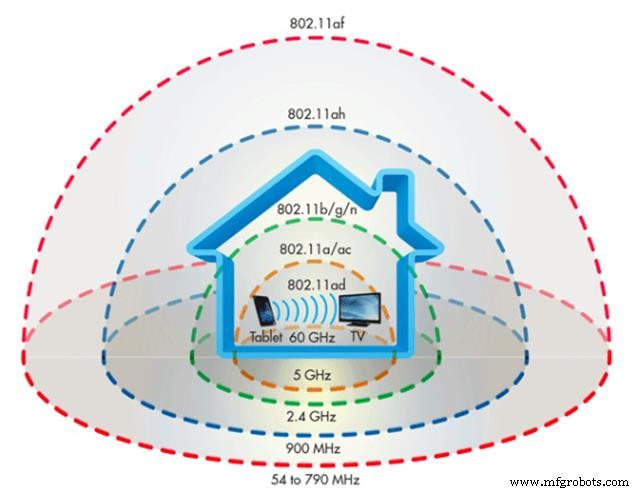
- 802.11ad (2012) – Multigigabit wireless in the 60 GHz band, ideal for high‑performance networking without cables.
- 802.11af (2014) – Operates in unused TV white‑space, extending coverage for applications similar to HaLow.
- 802.11ah (2016) – HaLow – Low‑rate, long‑range network for sensors and controllers, operating below 1 GHz.
These amendments were introduced to meet two universal demands: greater range and faster throughput.
IEEE’s Role in Wi‑Fi Standardization
The Institute of Electrical and Electronics Engineers (IEEE) is the governing body that develops and ratifies protocols for wireless communication. Each standard receives a unique 802.x number, where “802” denotes networking technology. For example, Ethernet uses 802.3, Bluetooth 802.15, and Wi‑Fi 802.11.
Historical Overview of Wi‑Fi Standards
- 802.11a (1990) – First 5 GHz OFDM amendment, reducing congestion in the 2.4 GHz band.
- 802.11b (2000) – 2.4 GHz, max 11 Mbps; still widely supported (≈80% of Wi‑Fi traffic), but largely superseded.
- 802.11g (2003) – 2.4 GHz, 54 Mbps; offered a fivefold speed increase over 802.11b.
- 802.11n (2007) – Dual‑band (2.4 GHz & 5 GHz), MIMO up to 450 Mbps, extended range.
- 802.11ac (2013) – 5 GHz “Gigabit Wi‑Fi,” nearly 1 Gbps, 20× faster than 802.11n.
- 802.11ax (2021) – OFDMA & MU‑MIMO, improves throughput in dense environments.
| Feature | 802.11b | 802.11a/g |
|---|---|---|
| Frequency Band | 2.4 GHz ISM | 2.4 GHz ISM & 5 GHz U‑NII |
| Channel Bandwidth | 25 MHz | 20 MHz |
| Radio Technology | Direct Sequence | OFDM |
| Modulation | QPSK | BPSK, QPSK, 16‑QAM, 64‑QAM |
| Encryption | Optional – RC4, AES (802.11i) | Optional – RC4, AES (802.11i) |
| Access Protocol | CSMA/CA | CSMA/CA |

Choosing the Right Standard for Your Project
When designing or upgrading a wireless system, consider:
- Desired data rate – AC or AX for gigabit speeds.
- Operating frequency – 5 GHz for less interference, sub‑1 GHz for long‑range sensors.
- Environmental constraints – indoor vs outdoor, wall penetration, and interference.
- Device compatibility – legacy 802.11b/g devices still need support in many deployments.
Align your choice with your application’s performance and coverage requirements to future‑proof your network.
For more information on IoT networking, consult the latest IEEE publications and industry whitepapers.
Author: Mayank Singh, IoT Instructor at Eckovation
Internet of Things Technology
- Essential Injection‑Molding Strategies for Mechanical Engineers
- Why Manufacturers Must Embrace IoT Asset Management Today
- Essential Quality Foundations for Manufacturers: Boost Engagement, Control, and Customer Delight
- Four Key Robot Types Manufacturers Must Understand
- Key Supply‑Chain Insights Every CEO Must Master
- 4 Essential Insights Every Employer Needs on Supply Chain Law
- 5 Essential Insights Every Business Needs About Agile Software Development
- Everything You Must Know About Wi‑Fi 6E: The Next‑Generation Wireless Revolution
- Metal Casting 101: A Comprehensive Guide to the Art of Molding Metal
- Cooling Towers Explained: Function, Importance, and Industry Applications