



Standardizing Flow Meter Calibration: Emerson’s Global Upgrade with SEH Device Servers
When Emerson Automation Solutions expands into new markets, its IT infrastructure must evolve accordingly. The Micro Motion division in Boulder, CO, which specializes in flow automation and measurement across industries—from oil and gas to pharmaceuticals—relies on highly accurate meters to monitor and regulate liquid flows through pipelines, pumps, and mixers, according to Jörg Hecke, the company’s senior calibration engineer.
Because flow‑meter accuracy is critical, Emerson operates its own calibration centres where meters are rigorously tested before shipping and periodically thereafter. The company maintains roughly 34 centres worldwide, ranging from small workshops to large, dedicated labs.
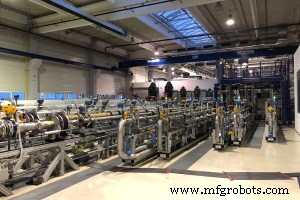
One of Emerson’s newest and largest labs is located in Cluj, northwestern Romania. The facility, at least half a football field in size, houses a swimming‑pool‑sized tank that tests a wide variety of flow meters. Initially, the lab ran on a bespoke software stack—eleven custom PCs running proprietary code that is now obsolete—and relied on RS‑232 HART adapters to transmit data from the flow sensors.
To bring the Cluj lab in line with Emerson’s global standards, the company replaced the custom boxes with a single, centralized control‑room computer. Instead of rewiring the entire lab, Emerson chose to convert the RS‑232 interfaces to USB and then to Ethernet, using a network‑based device server from SEH Computertechnik GmbH. The SEH INU‑100 industrial USB‑to‑network device server, a DIN‑mounted solution that carries USB 2.0 and USB 3.0 traffic over IP, was selected for its reliability and speed.
At SEH headquarters, Micro Motion’s engineers subjected the INU‑100 to a proprietary “hammering” test that drove the calibration transmitters at maximum speed for 20 minutes. The device held up, while a competing model failed and did not support USB 3.0, a critical requirement for high‑throughput flow monitoring. USB 3.0 Gigabit speeds ensure that data from dozens of sensors can be streamed to the lab’s network without bottlenecks.
Today, the Cluj lab uses 22 INU‑100 units, managed by SEH’s UTN Manager software running on the control‑room PC. These units route signals from all test sensors to the lab’s Ethernet switch. When the lab’s load exceeded the manager’s processing limit—35 devices running simultaneously—the SEH team released a rapid software patch that increased the cap to 44 devices.
With the updated configuration, Micro Motion reports “excellent uptime and throughput” and notes that communication reliability has improved dramatically. The lab plans to deploy additional INU‑100 units as it upgrades more facilities worldwide over the coming months and years.

The author is Jörg Hecke, head of product management at SEH Computertechnik GmbH.
About the author
Jörg Hecke leads product management at SEH Computertechnik GmbH, a pioneer in network solutions for licensed software, USB management, and printing sectors. All SEH technology, including the INU‑100 USB industrial device server and the SU‑320 serial‑to‑USB converter, is designed and manufactured in Bielefeld, Germany, with a U.S. headquarters in Phoenixville, PA, and offices across Europe, Asia, and North America.
Internet of Things Technology
- A Practical Taxonomy for Industrial Internet of Things (IIoT) Systems
- Designing Security into the Industrial IoT: Expert Guidelines for Protecting IIoT Systems
- How Industrial IoT Sensors Drive Modern Factory Efficiency
- Blockchain for the Internet of Things: Unlocking Secure, Decentralized Data Exchange
- Unlocking Efficiency: Digitizing Electrical Equipment for the Digital Age
- The 21st‑Century Systems Integrator: Bridging Skills Gaps and Driving Digital Transformation
- AI Drives Industrial Operations Toward Zero Unplanned Downtime
- Transforming Manufacturing: How Smart Factories Drive Efficiency and ROI
- 5G: Preparing for Exponential Data Growth in Telecom
- Elevate Your Warehouse: Modern Management Systems Drive Efficiency & Growth