



NASA Langley Research Center: Pioneering Aeronautical Innovation
The facility now known as Langley Research Center was founded under NASA’s predecessor — the National Advisory Committee for Aeronautics (NACA) — in 1917, making it the first civilian aeronautical laboratory in the United States. Construction began near Hampton, VA at Langley Field later that year.

In 1931, work was completed on what was then the world’s largest wind tunnel with a 30 × 60-foot test section known as the Langley Full Scale Tunnel. The tunnel could study entire full-sized aircraft of the time and was instrumental in doing drag cleanup studies for nearly every U.S. fighter aircraft design in the World War II era. The Full Scale Tunnel went on to test the Mercury space capsule, the lunar lander test vehicle, F-16, concepts for supersonic transports, and the space shuttle.
Langley’s National Transonic Facility uses liquid nitrogen to more closely model flight conditions and provides some of the world’s most accurate wind tunnel data. Since the tunnel began operations in the early 1980s, it has provided data for Boeing 777 and 767, the space shuttle launch configuration, business jet concepts, and Orion launch abort system.
As NASA began to grapple with the challenges of putting people in space, Langley contributed to the effort. The Space Task Group, situated at Langley until a move to Houston in the early 1960s, set about planning the United States’ early space program. Langley staff designed the Lunar Landing Facility, a 250 × 400-foot-long truss-work gantry with a lunar lander that was suspended by a cabling system that supported all but 1/6 of the lander’s weight and was used to train all Apollo astronauts to land on the Moon. When the Apollo Program wound down, the facility was converted to suspend instrumented full-size aircraft and helicopters, which were released to crash conditions to improve aircraft crash worthiness. With the development of the Orion concept, the facility was used to understand the stresses on landing Orion first on soil and with the addition of a hydro impact basin, to understand a water landing.

In the mid-1960s, Langley designed a Rendezvous and Docking Simulator to train Gemini and Apollo astronauts. The system suspended a full-size Gemini and later Apollo capsule from the ceiling of the Langley Research Hangar. The simulator has since been dismantled but the suspension system remains in the ceiling of the hangar.
Langley today supports NASA goals for aeronautics exploration, science, and space technology, with a variety of flight simulators, wind tunnels, labs, and computational software.
Aeronautics
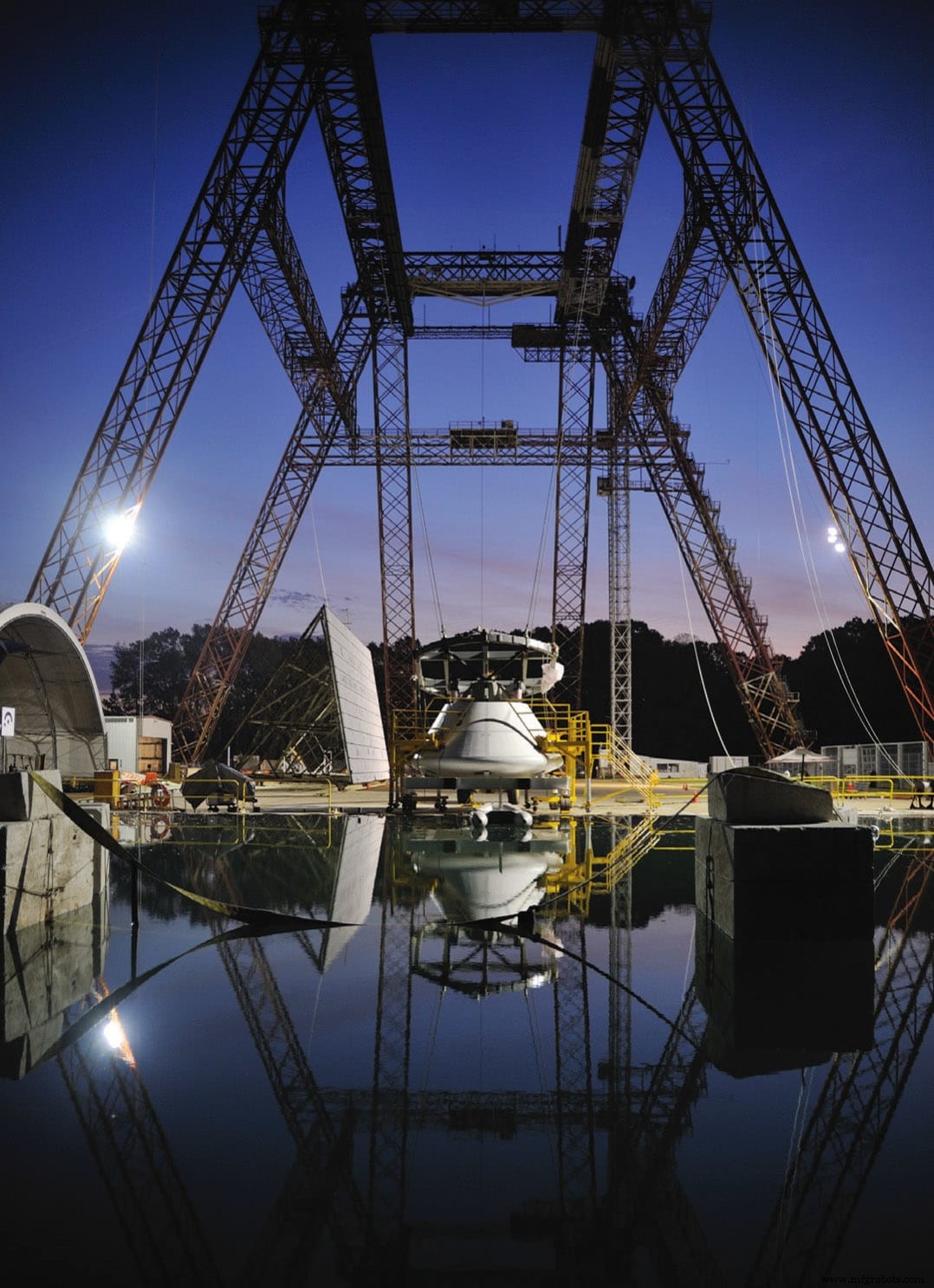
Whether working to make coast-to-coast supersonic commercial airline flights possible or helping to make aircraft safer, quieter, and more fuel-efficient, Langley’s aeronautics experts guide ideas from the drawing board to reality.
Working with the Federal Aviation Administration (FAA), Langley researchers conducted a test that will help experts assess aircraft crash safety. With an eye toward reducing fatalities, researchers dropped a full-sized F-28 Fokker transport aircraft at Langley’s Landing and Impact Research Facility to generate data for computer models that measure crashworthiness. The data will help set standards for innovative aircraft of tomorrow.
NASA continued to open possibilities for future quiet supersonic flight through its Low-Boom Flight Demonstration Mission. For this mission, Langley shares management responsibility for developing the X-59 Quiet SuperSonic Technology aircraft and spearheads plans to evaluate response to the sound of the X-59 across several U.S. communities, a step toward lifting current bans on supersonic overland flight.
Langley researchers successfully tested the X-59’s eXternal Vision System. It replaces a forward-facing cockpit window with a combination of sensors, cameras, and computer displays, giving the pilot an augmented-reality view ahead. It will be ready for the X-59’s first flight scheduled for this year.
Langley also tests new efficient aircraft concepts and studies all-electric technologies to make flying both cleaner and quieter. With Boeing, Langley researchers designed, built, and tested a transonic truss-braced wing model that could lead to more fuel-efficient aircraft. They also contributed design methods and analysis for the X-57 Maxwell, NASA’s first all-electric experimental airplane.
With affordable electric drones swarming the marketplace and businesses channeling money into concepts such as air taxis and autonomous personal aircraft, it seems a new aviation age is dawning. Drone safety tools developed at Langley address the practicalities of pilotless flight: How to keep unmanned aerial vehicles (UAVs) from flying where they shouldn’t, how to keep them from crashing into each other, and how to help them land safely in an emergency.
To understand how new air vehicles will operate in towns and cities, a team of researchers created Langley Aerodrome No. 8, an electric airplane that takes off like a helicopter. The unmanned vehicle, created with 3D-printed parts, was tested in Langley’s 12-foot Low Speed Wind Tunnel. Along with autonomy, Langley explores a host of other issues vital to new air vehicles: air traffic management, no-fly zones, communication and guidance systems, safe flying procedures, and noise suppression.
Langley also developed two new implementations of acoustic liners for aircraft noise reduction whereby curved channels within tight spaces can be outfitted to provide noise reduction. The two implementations are flap side edge liners and landing gear door liners for air-frame noise reduction. In these applications, the acoustic liner is designed primarily to reduce aircraft noise that occurs during landing, which will help aircraft comply with increasingly stringent airport noise restrictions.
Space
Langley is actively bringing innovators, architects, scientists, and engineers together to get small payloads to space quickly and efficiently. Small satellites (smallsats) — defined by NASA as spacecraft weighing 180 kilograms (397 pounds) or less — can help the agency advance science and human exploration by providing new options for cutting costs of space missions and expanding access to space.
Shields-1, a radiation protection demonstration, became Langley’s first successful free-flying smallsat project. Riding on a 2018 launch by Rocket Lab, it blasted to orbit along with a set of other demonstrations and experiments. Shields-1 tested new shielding material developed at Langley.

The powerful Space Launch System rocket will kick off trailblazing NASA missions. Langley’s aerosciences team tested configurations in the center’s Unitary Plan Wind Tunnel, 14 × 22-foot Subsonic Tunnel, and National Transonic Facility wind tunnel.
NASA’s successful Ascent Abort-2 test flight was an important step toward protecting the astronauts who will soon embark on missions to the Moon and, one day, Mars. The Orion Launch Abort System program, managed at Langley, will make sure the abort system is ready if needed.
About half the size of a computer mouse, the Stereo Camera for Lunar Plume Surface Studies (SCALPSS) will journey to the Moon this year as a payload aboard an Intuitive Machines Nova-C lunar lander spacecraft. Four of the tiny cameras will show NASA researchers what happens under a spacecraft as it lands on the Moon. SCALPSS will provide important data about the crater formed by the rocket plume of the lander as it makes its final descent and landing on the Moon’s surface.
Data from SCALPSS will provide computer models that inform subsequent landings. The SCALPSS cameras, which will be placed around the base of the lander, will begin monitoring crater formation from the precise moment a lander’s hot engine plume begins to interact with the Moon’s surface. The cameras will continue capturing images until after the landing is complete. Those final stereo images, which will be stored on a small onboard data storage unit before being sent to the lander for downlink back to Earth, will allow researchers to reconstruct the crater’s ultimate shape and volume.
Langley also shapes technologies for robotic construction in space, allowing longer, more distant missions. The Lightweight Surface Manipulation System will be used by companies selected to land payloads on the Moon. Through a set of On-orbit Servicing, Assembly, and Manufacturing projects, researchers will learn how to use robotics and autonomy to build infrastructure on the Moon and in space.
LiDAR

Light detection and ranging (LiDAR) has emerged as a powerful and versatile tool for NASA. Langley developed Flash LiDAR for real-time terrain mapping and synthetic vision-based navigation. To take advantage of the information inherent in a sequence of 3D images acquired at video rates, Langley also developed an embedded image processing algorithm that can simultaneously correct, enhance, and derive relative motion by processing this image sequence into a high-resolution 3D synthetic image.
Traditional scanning LiDAR techniques generate an image frame by raster scanning an image one laser pulse per pixel at a time, whereas Flash LiDAR acquires an image much like an ordinary camera, generating an image using a single laser pulse. The benefits of Flash LiDAR enable autonomous vision-based guidance and control for robotic systems.
Navigation Doppler LiDAR (NDL) is being considered to assure safe and precise landings on planetary bodies. NDL, which accurately measures vehicle speed and position, could help NASA land the first woman and next man on the Moon.
Technologies
Remote, Noninvasive, Cardiac Activity Tracer (RENCAT) — This laser vibrometer sensor monitors cardiac activities remotely and non-invasively; specifically, heart functions of valve/ chamber opening and closing cycles (cardiac cycles). The device provides precise magnitude and timing information away from the heart region without interference by patient garments.
Hydrophobic Epoxy Coating for Insect Adhesion Mitigation — Fluorinated alkyl ether-containing epoxies serve as an anti-insect coating. The robust and durable coating was developed to improve aircraft efficiency but could be useful in a variety of applications where reduction of insect residue adherence is desirable such as in automotive and wind energy industries.
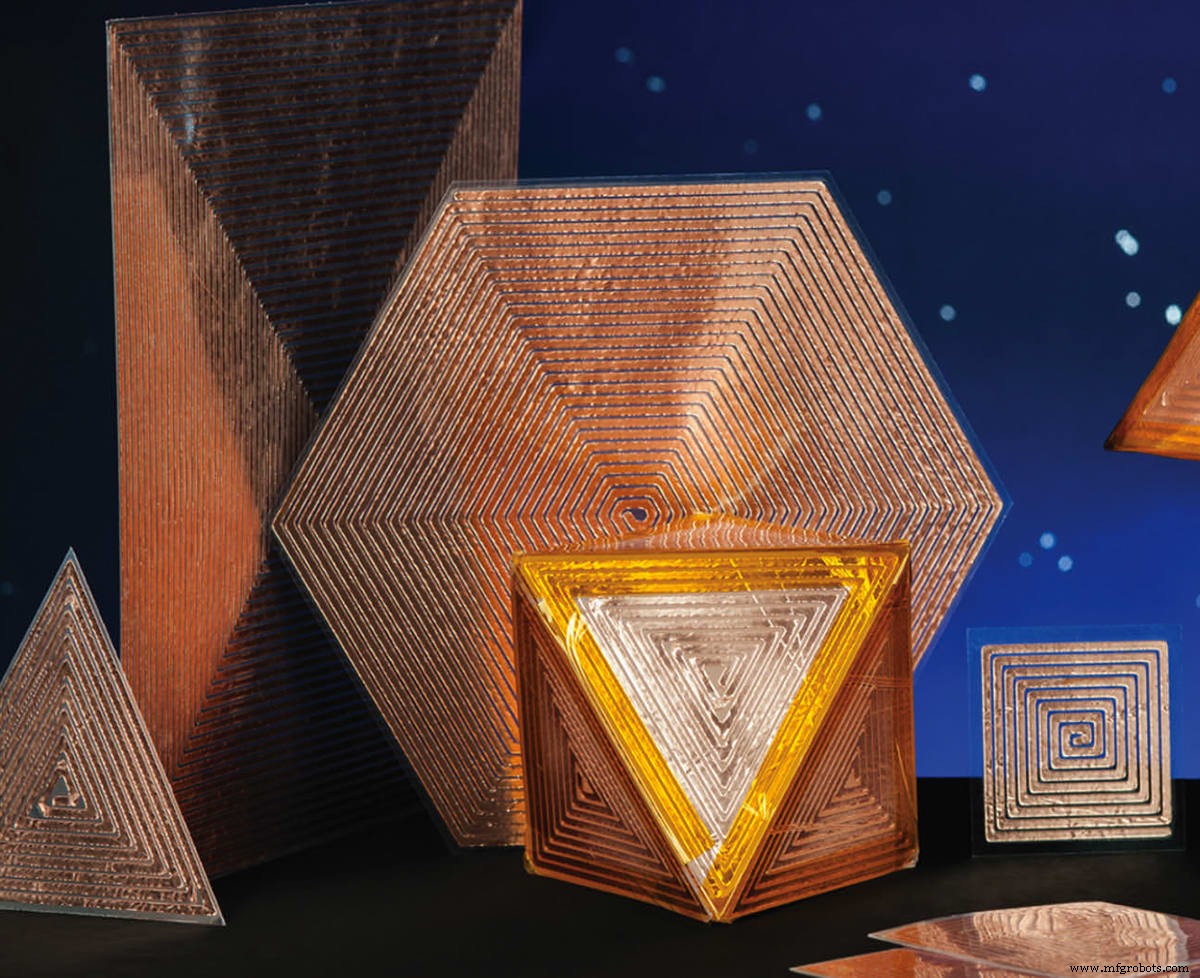
Lightning Mitigation and Damage Detection — The patented SansEC Sensor Technology is a proven wireless sensing platform capable of measuring the electrical impedance of physical matter in proximity to the sensor based on a change in its resonance response. The sensor exhibits a unique characteristic to disperse the lightning strike current to help mitigate lightning damage. In a turbine blade application, an array of SansEC sensors will cover the surface area of the composite blade, providing both lightning mitigation and damage sensing.
Wireless Temperature Sensor with no Electrical Connections — This sensor does not require an electrical connection and is built on the SansEC sensor platform, which takes advantage of measuring dielectric changes. The sensor is damage-tolerant, flexible, precise, and inexpensive. One promising application is for tire temperature sensors.
3D Printer Test Station — A test station was developed that is capable of in-situ testing of material deposition and layer adhesion in an extrusion additive manufacturing process. The technology addresses the problem of monitoring part quality during the 3D printing process. The novelty is that testing happens in situ as the component is being built.
Wireless Sensor for Pharmaceutical Packaging and Monitoring Applications — The SansEC sensor can be used for pharmaceutical applications without the need for physical contact. Many attributes of a container can be monitored such as liquid or powder levels, temperature of contents, and changes caused by spoilage. Tampering can also be detected.
Technology Transfer
Langley Research Center’s technical knowledge and data is available to licensees for commercialization. Contact NASA’s Licensing Concierge at Agency- This email address is being protected from spambots. You need JavaScript enabled to view it. or call 202-358-7432 to initiate licensing discussions. Learn more about NASA Langley here .
Sensor
- Mar-Bal Inc.: Driving Innovation through In‑House R&D
- Apex Power Tools Launches 28,000‑sq‑ft Service Center Near Louisville's UPS Hub
- Southwest Airlines to Construct 240,000‑Square‑Foot Maintenance Hangar at Houston’s Hobby Airport
- NASA Invests $6M to Pioneer Zero‑Emission Electric Aircraft
- Toray Launches Cutting-Edge R&D Innovation Center for the Future
- New Lightweight Aerogel Cuts Jet Engine Noise by 16 dB
- U.S. Army ERDC: Pioneering Engineering Solutions for Military and Civil Projects
- Spotlight on Worcester Polytechnic Institute: A Legacy of Innovation and Research
- Executive Roundtable: Elevating Facility & Network Security for Manufacturing Leaders
- Rochester Institute of Technology: Global Innovation Hub