



Designing Energy‑Efficient, Always‑On Voice Command Systems
Voice assistants are now embedded in almost every product, appliance, and technology. While they offer convenience, their constant listening for wake words—such as “okay Google” or “Alexa”—drains power. In a world where devices are proliferating, reducing this energy footprint is essential.
This article outlines key design considerations for low‑power, always‑on voice command systems that use voice activity detection (VAD). It examines trade‑offs and component choices that enable a user‑friendly, energy‑efficient voice user interface (VUI).
VAD first checks for human speech before the system listens for a wake word. This means the assistant consumes power only when needed. With 4.2 billion digital voice assistants worldwide and a projected doubling by 2024, incorporating VAD can dramatically cut energy usage for users and manufacturers alike.
Typical VUI hardware comprises microphones—single or arrays—connected to an audio processor that captures and processes voice. The audio stream can be handled by an edge audio processor, a smart microphone with an embedded processor, or a standard application processor (AP). Edge processors are optimized for low power and low latency. They can also post‑process output audio and, when cloud‑connected, communicate with the main SoC for wireless transmission.
Ultra‑Low‑Power VAD
Figure 1 shows an architecture that achieves ultra‑low power by using an analog signal path: an analog microphone, a comparator, and an interrupt that wakes an audio processor only when acoustic activity is detected. A push‑to‑talk button can also be added for manual wake‑up.
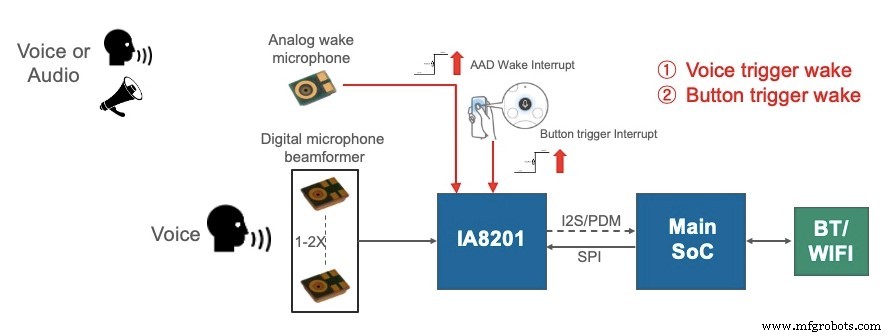
Because the analog microphone and comparator must always listen, they must consume minimal power. The Knowles IA8201 audio processor, for example, draws less than 1 mW in wake‑up mode and offers 1 MB of memory for advanced processing. This simple AAD (acoustic activity detection) approach works well for low‑power devices such as remote controls and wearables but can lead to higher overall consumption in noisy environments, as it wakes on any sound. Moreover, cloud‑connected VUI systems require pre‑roll audio—typically 500 ms before the wake word—to improve detection accuracy, a feature needed for Alexa and similar smart speakers.
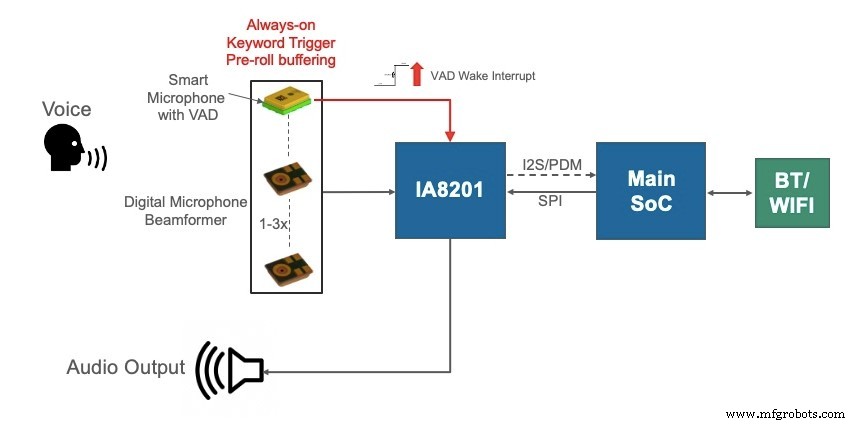
Figure 2 illustrates an architecture that supports pre‑roll buffering for smart speakers. These devices, often powered by larger batteries, record a circular buffer of 500 ms that is used to calibrate ambient noise levels while always listening.
Choosing the front‑end architecture depends on microphone count, analog vs. digital signals, and the required processing.
For the architecture in Figure 1, a single analog microphone and comparator trigger the processor. A low‑power analog mic with an SNR > 62 dB—such as the Knowles SPV1840LR5H‑B Kaskade—consumes only 45 µA when active. The entire always‑on analog path draws < 67 µA. Piezoelectric microphones can offer even lower power (≈ 10 µA) but typically suffer from low SNR, affecting system performance.
For pre‑roll capable systems like Figure 2, a microphone with an embedded processor and 2 s circular buffer—e.g., the Knowles IA611—is suitable. The IA611’s always‑on power is 0.39 mA @ 1.8 V (90 % efficiency), making it ideal for battery‑operated devices such as Bluetooth speakers. It accepts PDM input from digital microphones and can forward audio to a host processor for beamforming once the system wakes.
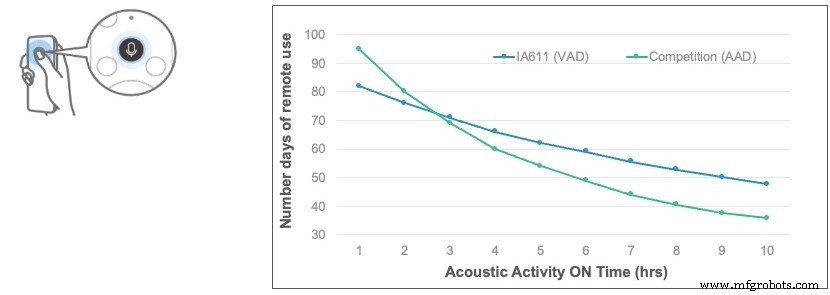
Figure 3 compares battery life for a typical TV remote using VAD on the IA611 versus a competitor’s piezoelectric AAD mic. When acoustic activity lasts 5 h, the VAD solution provides eight extra days of battery life—critical as U.S. households watch an average of eight hours of TV daily. Intelligent VAD wake‑ups help designers build more power‑efficient VUI systems.
Conclusion
Voice technology is reshaping industries—from smart homes and hospitality to digital workplaces, voice payments, energy management, edge computing, healthcare, and industrial IoT. Each application demands a specific hardware architecture and microphone selection. Designers must evaluate the device’s voice use case, desired capabilities, and power constraints to choose the optimal VUI solution.

Raj Senguttuvan has over 15 years of experience in new technology development for consumer and industrial applications, early‑stage business development, and project management for companies including Analog Devices and Texas Instruments. As director of strategic marketing for Knowles, he leads system‑level development, drives venture investments, and shapes marketing strategy for IoT and consumer technologies—including audio processors, algorithms, microphones, sensors, and receivers. Raj holds an MBA from Cornell University and a PhD in electrical engineering from the Georgia Institute of Technology.
Related Contents:
- Add voice on a microcontroller without having to code
- What’s behind the move to custom voice agents?
- Voice biometric solution targets authentication
- AI finds its voice in audio chain
- How extensive signal processing chains make voice assistants ‘just work’
- Dev kits speed Alexa integration
Sensor
- Key Design Principles for Optimizing Metal 3D Printed Parts
- 4 Key Design Principles for Successful 3D Printing
- Design Engineering for Energy‑Efficient Power Plant Generation Systems
- Benefits of Embedded Technologies in Modular Design
- Optimizing Illumination Design for Robotic Surgery Vision Systems
- 10 Essential Tips for Designing Low‑Noise Amplifiers
- Essential Tips for Successful PCB Assembly
- Key Impedance Design Strategies for Flex‑Rigid PCBs
- Essential Factors for Successful Medical Device Manufacturing
- Part 1: Critical Cooler Design Considerations for High-Performance Centrifugal Compressors