



Integrated Flow‑Temperature Sensors Drive Efficiency in Dairy Processing
In the competitive dairy industry, achieving high product quality while maintaining operational efficiency hinges on advanced automation, hygienic equipment design, rigorous cleaning, and uncompromised food safety. Sensors now serve as the linchpin that synchronises these elements.
Sensing & Instrumentation Specialist Baumer collaborates closely with clients to develop custom flow‑temperature sensors that meet the stringent demands of dairy filtration. As protein‑enriched products such as yogurts, milk drinks, and quark become staples for athletes, the need for precise filtration has never been greater.
Homann, part of the Müller Group, produces a wide array of dairy items—including yogurts, milk drinks, mayonnaise and salad dressings. By deploying Baumer’s monitoring sensors, Homann has accelerated process optimisation, cutting downtime and boosting throughput.
Protein fortification typically starts with whey or skimmed milk, which must be filtered in stages to concentrate the protein before drying and further processing. This energy‑intensive operation relies on the filter’s condition; any deviation can compromise yield and quality.
Calorimetric flow sensors give real‑time insight into filter performance, allowing operators to adjust the process before fouling or excessive pressure loss occurs.
One Sensor for Flow Rate and Temperature
Cross‑flow filtration is the industry standard for increasing protein content. While pressure differentials indicate filter health, they do not directly reveal the medium’s flow rate. Measuring flow rate itself is essential: a rate that is too low accelerates fouling, whereas an excessively high rate risks exceeding the module’s pressure limits.
Temperature control is equally critical. Maintaining a filtration temperature near 122 °F preserves thermo‑sensitive whey proteins, ensuring product integrity.
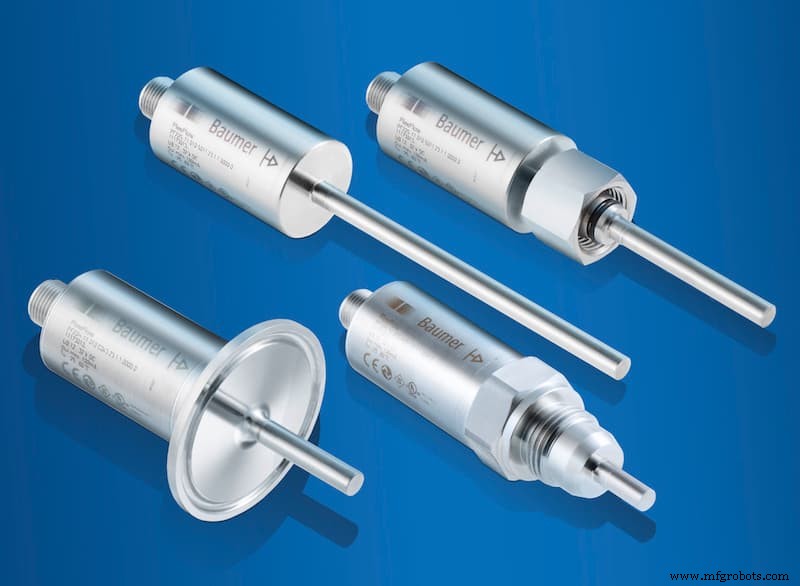
Baumer’s FlexFlow sensors combine temperature and flow measurement into a single, maintenance‑free unit. Built on a calorimetric principle, they deliver accurate readings without moving parts, making them ideal for long‑term use in dairy plants.
Key features include IO‑Link connectivity, dual switching outputs or a combination of switching and analog outputs (4‑20 mA/0‑10 V), and versions such as PF20H and PF20S that meet hygienic and industrial standards. The symmetrical, centre‑aligned design ensures precise measurement regardless of installation orientation.
With IO‑Link, multiple sensors can be configured simultaneously, simplifying set‑up during batch changes and enabling real‑time diagnostics that keep systems online.
Robust stainless‑steel housings protect integrated electronics, eliminating complex wiring and control cabinet assembly. All models are rated to 150 °C, making them CIP (Clean‑in‑Place) and SIP (Steam‑in‑Place) ready.
Conductivity Measurement in CIP Processes
Effective CIP cycles are crucial for every dairy product, demanding exact detergent dosing despite variations in pressure and temperature. At Homann’s Bottrop plant, the new Baumer CombiLyz conductivity sensor achieved a deviation of less than 1 % thanks to its rapid response time. Its 6.6 mm inductive sensing channel tolerates particulate media, allowing precise detergent optimisation and raw‑material savings.
“Baumer’s CleverLevel is a single‑sensor solution for diverse media, and since deployment we’ve seen a significant drop in technical faults,” said Frank Piatkowski, Application and Process Engineer at Homann. “We will continue to rely on Baumer products for new, state‑of‑the‑art CIP installations, as they help us meet optimisation goals amid increasing process complexity.”
Find out more here
Contact: Jon Sumner, Baumer Ltd
Tel: +44 1793 783839
email: [email protected]
www.baumer.com/gb/en/
Sensor
- Comprehensive Guide to Sensor Types and Circuit Diagrams
- MIT Breakthrough: Stretchy, Machine‑Washable Garments Embedded with Sensors for Real‑Time Vital‑Sign Monitoring
- Cost‑Effective Indoor Temperature Mapping with Low‑Cost Sensors
- Professional Raspberry Pi Temperature Monitoring with DS18B20
- Accurate Temperature Monitoring in a Server Closet with Raspberry Pi
- High-Precision Flexible Temperature Sensors for Human Body Monitoring: A Comprehensive Review
- High-Precision Eddy Current Displacement Sensors for Industrial Applications
- New Wearable Tech Camouflages Users from Heat Sensors, Adapting to Temperature in Minutes
- NASA Goddard’s Lab‑On‑Chip Sensor Delivers Real‑Time Flow & Temperature Monitoring
- Infrared Temperature Sensors: Accurate, Non-Contact Thermal Measurement