



Comprehensive Guide to Sensor Types and Circuit Diagrams
In modern homes and factories, manual wall‑switches are being replaced by automated systems that rely on sensors to monitor and control electrical loads. By converting physical or chemical changes into electrical signals, sensors enable precise, remote, and intelligent operation of appliances and industrial equipment.
What Is a Sensor?
A sensor is a device that detects changes in environmental or system parameters and produces a corresponding electrical or optical output. For example, a thermocouple generates a voltage proportional to temperature, enabling accurate temperature monitoring.
Common Sensor Types in Electronics
Sensors in everyday power systems—such as home automation, load control, and industrial automation—are typically classified as analog or digital. The most frequently used types include:
- Temperature Sensor
- Infrared (IR) Sensor
- Ultrasonic Sensor
- Touch Sensor
- Proximity Sensor
- Pressure Sensor
- Level Sensor
- Smoke and Gas Sensor
Temperature Sensor
Temperature is a critical environmental variable in many applications. Common temperature sensors are thermocouples, thermistors, semiconductor sensors, and resistance temperature detectors (RTDs). The choice depends on accuracy, range, and cost.
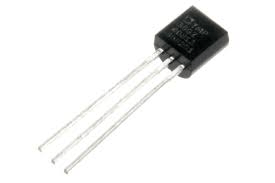
Temperature Sensor Circuit
The following simple circuit uses a thermistor, transistors, and a relay to switch a load on or off at a preset temperature. A battery supplies power, and the relay contacts the load (AC or DC).
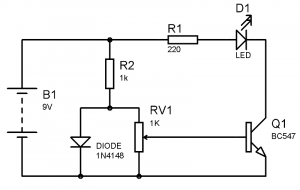
This setup is ideal for automatically controlling fans or HVAC units based on ambient temperature.
Practical Temperature Control
Digital temperature controllers integrate a microcontroller (e.g., 8051), an LCD display, and a DS1621 sensor for 9‑bit readings between –55°C and +125°C. An EEPROM stores user‑defined setpoints, and a transistor‑driven relay drives the load.
Infrared (IR) Sensor
IR sensors use a photocell to emit and detect infrared light. They are ubiquitous in remote controls, obstacle detection for robots, and proximity detection.
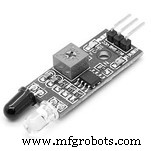
IR Sensor Circuit
The typical remote‑control circuit includes an IR emitter (LED) and an IR receiver. The emitter is driven by a microcontroller; the receiver outputs a digital pulse to the controller, which interprets the command.
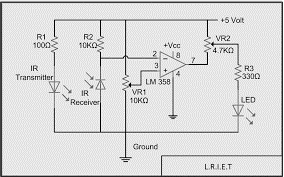
Such a design powers a robotic vehicle that follows commands from a standard TV remote.
Ultrasonic Sensor
Ultrasonic sensors emit high‑frequency sound waves and measure the time delay of the echo to determine distance. They are classified as active (emitting) and passive (only listening).
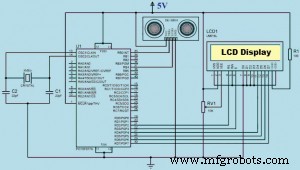
The module typically includes a transmitter, receiver, and microcontroller interface. The measured time is converted to distance and displayed on an LCD.
Practical Distance Measurement
Applications include automated parking, obstacle avoidance, and level sensing in inaccessible or hazardous environments.
Touch Sensor
Touch sensors are switches activated by human contact. Common types are capacitive, resistive, and piezoelectric.
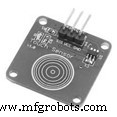
Touch Sensor Circuit
The illustrated circuit uses a 555 timer in monostable mode, a touch plate, and an LED. When the plate is touched, the timer triggers the LED for a fixed duration.
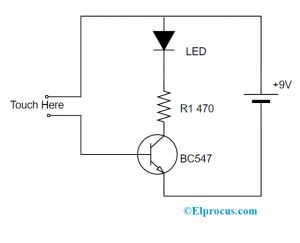
This concept extends to a touch‑controlled relay that switches a load on for a predetermined time after contact.
Proximity Sensor
Proximity sensors detect the presence or absence of nearby objects without physical contact. They are essential in retail, automotive parking aids, and industrial automation.
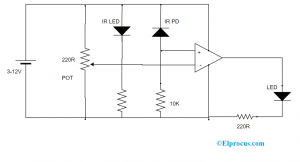
Typical types include capacitive, inductive, and photoelectric sensors.
Gas and Chemical Sensors
These sensors monitor air quality and detect hazardous or toxic gases. Common technologies include electrochemical cells, metal‑oxide semiconductors, and non‑dispersive infrared (NDIR) sensors. They are critical in industrial safety, environmental monitoring, and consumer appliances.
- Electrochemical gas sensor
- Metal‑oxide semiconductor (MOS)
- NDIR sensor
- pH electrode
Humidity Sensor
Humidity sensors measure the amount of water vapor in the air, often using capacitive or resistive elements. Accurate humidity monitoring is vital for HVAC control, pharmaceutical storage, and agriculture.
Sensors in the Internet of Things (IoT)
In IoT, sensors are the primary data collectors that feed connected devices with real‑time information. Key sensor categories include:
- Proximity
- Temperature & Humidity
- Gas & Chemical
- Light
- Motion & Accelerometer
Sensors in Robotics
Robots rely on a suite of sensors to perceive their environment and make autonomous decisions.
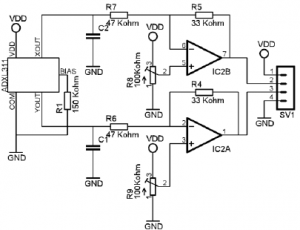
Accelerometer
Measures linear acceleration and static forces, enabling balance, navigation, and motion profiling.
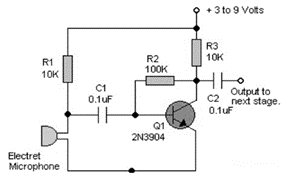
Sound Sensor
Microphone‑based sensors convert acoustic pressure into voltage. They are used for voice control and sound‑driven navigation.
Light Sensor
Photoresistors (LDRs) and phototransistors detect ambient light levels, aiding in auto‑lighting and daylight harvesting.
Building Automation Sensors
Key building‑automation sensors include temperature, motion detection, voltage/current monitoring, smoke/heat detection, camera, and gas sensors.
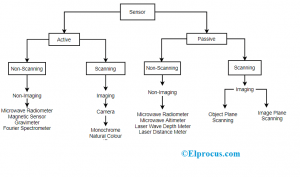
Remote‑Sensing Sensors
Remote sensing employs active sensors (e.g., radar, LiDAR) that emit energy and passive sensors (e.g., radiometers, infrared cameras) that detect reflected or emitted energy.
Download our free eBook for in‑depth circuit designs and contact us with project ideas.
Sensor
- Circuit With a Switch: A Practical Guide to Basic Electrical Circuits
- Key Automotive Sensors: How Modern Cars Use Advanced Technology
- Understanding Level Sensors: Types, Functions, and Industry Applications
- Analog vs Digital Sensors: Types, Applications, and Practical Examples
- Achieving High-Precision Temperature Measurements with Advanced Silicon Sensors
- Cost‑Effective Indoor Temperature Mapping with Low‑Cost Sensors
- Accurate Temperature Monitoring in a Server Closet with Raspberry Pi
- Robotics Sensors Explained: Types, Functions & Applications
- Fire Alarm Systems Explained: Types, Components & Wiring Diagrams
- Infrared Temperature Sensors: Accurate, Non-Contact Thermal Measurement