



Infrared Temperature Sensors: Accurate, Non-Contact Thermal Measurement
Every substance emits more infrared radiation at one particular frequency than at others. For instance, polyethylene emits most of its IR radiation at 3,430 nm, and metals emit mostly at 1,000 nm. For optimal performance, an IR temperature sensor must have its spectral range centered around these peak temperatures. Therefore it is important to either keep in mind the specific application an IR sensor is needed for when ordering it or to order a sensor with an adjustable spectral range. IR temperature sensors can be confused by background sources of infrared radiation when used as motion detectors. You can work around this problem by using the differential detection technique. To do this, wire two sensors to a differential amplifier, as opposite inputs. When wired like this, the sensors cancel out the average temperature of their shared field of view. Any fluctuations in background temperature will not be able to trigger a motion reading. This arrangement also reduces common-mode interference. Note that this technique only works for motion detection, not for temperature reading. Looking For Industrial Automation Parts? We Can Help!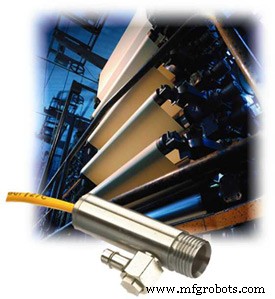 Infrared temperature sensors sense electromagnetic waves in the 700 nm to 14,000 nm range. While the infrared spectrum extends up to 1,000,000 nm, IR temperature sensors do not measure above 14,000 nm. These sensors work by focusing the infrared energy emitted by an object onto one or more photodetectors.
These photodetectors convert that energy into an electrical signal, which is proportional to the infrared energy emitted by the object. Because the emitted infrared energy of any object is proportional to its temperature, the electrical signal provides an accurate reading of the temperature of the object that it is pointed at. The infrared signals are passed into the sensor through a window made out of specialty plastic. While plastic normally does not allow infrared frequencies to pass through it, the sensors use a form that is transparent to particular frequencies. This plastic filters out unwanted frequencies and protects the electronics inside the sensor from dust, dirt, and other foreign objects.Advantages of IR Temperature Sensors
Ordering a Sensor
Background Heat Sources
To deal with the problem of background heat when measuring temperature, as opposed to motion detection, narrow the field of view of the sensor so that it is constrained entirely to the object being measured. If it is impractical to do this directly, then use plastic shields to block out elements of the background in the field of view of the sensor.
Call the Sure Controls team at 800-844-8405 or contact us online for more information on infrared temperature sensors.
Automation Control System
- The Thermometer: From Galileo’s Thermoscope to Modern Digital Sensors
- Comprehensive Guide to Sensor Types and Circuit Diagrams
- Achieving High-Precision Temperature Measurements with Advanced Silicon Sensors
- Using an MCP3008 ADC to Read Analog Sensors with Raspberry Pi
- Build a Non-Contact Infrared Thermometer with Arduino Nano and GY-906
- New Wearable Tech Camouflages Users from Heat Sensors, Adapting to Temperature in Minutes
- NASA Goddard’s Lab‑On‑Chip Sensor Delivers Real‑Time Flow & Temperature Monitoring
- AuGe12: Premium Gold-Based Soft Solder Alloy
- Rhenium: The Ultra‑High‑Density Metal for Filaments and Refractory Applications
- Precision Infrared Temperature Sensing for Color‑Sensitive Processes