



Infrared (IR) Sensors: How They Work & Practical Circuit Diagrams
Infrared (IR) technology powers everyday devices—from TV remotes to industrial automation—thanks to its low power consumption, compact design, and discreet operation. IR signals are invisible to the eye but readily detected by specialized sensors, making them ideal for motion detection, distance measurement, and temperature sensing.
In the electromagnetic spectrum, IR radiation occupies the region between visible light and microwaves, with wavelengths ranging from 0.7 µm to 1000 µm. It is traditionally divided into near‑IR (0.75–3 µm), mid‑IR (3–6 µm), and far‑IR (> 6 µm).
What Is an IR Sensor?
An IR sensor is an electronic device that emits and/or detects infrared radiation to sense its environment. Two main categories exist:
- Active IR sensors contain both a transmitter (usually an IR LED or laser diode) and a receiver (typically an IR photodiode).
- Passive IR sensors consist only of a detector that senses ambient IR radiation emitted by objects.
All objects at temperatures above absolute zero emit thermal radiation; IR sensors exploit this principle to detect heat, motion, or presence.
How IR Sensors Work
The core of most IR sensors is a photo‑coupler—an IR LED paired with an IR photodiode. The LED emits a narrow band of IR light. When this light strikes an object, a fraction reflects back to the photodiode. The photodiode’s resistance changes proportionally to the received IR intensity, producing a voltage that can be processed by a microcontroller or comparator.
Key physical laws underpinning the operation include Planck’s radiation law, the Stefan‑Boltzmann equation, and Wien’s displacement law.
Types of Infrared Sensors
Active IR Sensors
These devices generate their own IR signal. Common variants are:
- Reflective sensors emit IR and detect the reflected beam, useful for obstacle detection.
- Break‑beam sensors emit IR across a gap; interruption of the beam triggers an alert.
Passive IR Sensors
Passive sensors rely on ambient IR and do not emit light. Examples include:
- Pyroelectric detectors that respond to temperature changes.
- Bolometers that measure total power absorbed.
- Thermocouples and thermopiles, which convert temperature differences into voltage.
Passive sensors are subdivided into thermal IR sensors (independent of wavelength) and quantum IR sensors (wavelength‑sensitive and often requiring cooling).
IR Sensor Circuit Diagrams
Below are two common implementations that illustrate how to integrate an IR sensor into a circuit.
Basic Comparator Circuit (LM339)
- LM358 IC with a 2‑channel IR transmitter/receiver pair
- Resistors (10 kΩ–100 kΩ), variable resistors for sensitivity adjustment
- IR LED and photodiode pair
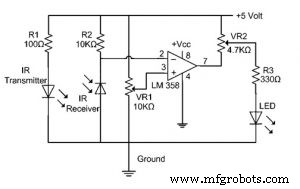
The IR transmitter continuously emits rays that the receiver monitors. A comparator (LM339) outputs high when the photodiode detects reflected IR, triggering an LED or other actuator.
Transistor‑Based Obstacle Detector
Using an NPN (BC547) and a PNP (BC557) transistor, this circuit turns on an LED when IR light is reflected by a nearby object.
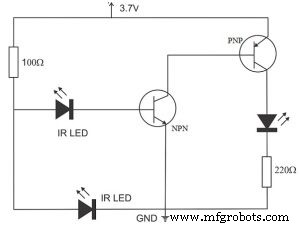
Steps to build:
- Connect the IR LED to the base of the NPN transistor.
- Link the PNP transistor’s base to the NPN’s collector.
- Place 100 Ω resistors on the LED lines and a 220 Ω resistor with the output LED.
- Apply a 5 V supply and observe the LED lighting when an object reflects IR.
Burglar Alarm with IR Break‑Beam
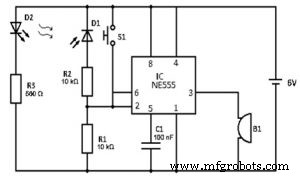
Components:
- NE555 timer
- Resistors R1 = 10 kΩ, R2 = 560 Ω
- IR photodiode (D1) and IR LED (D2)
- Capacitor C1 = 100 nF
- Push switch S1
- Buzzer B1
- 6 V DC supply
When the IR beam is uninterrupted, the circuit stays in a low state. A break triggers the buzzer until the circuit is reset.
Advantages of IR Sensors
- Low power consumption
- Reliable motion detection in light and dark conditions
- No physical contact required
- Protected from data leakage due to directed beam
- Corrosion‑resistant and robust
- High noise immunity
Limitations
- Requires a clear line of sight
- Limited detection range
- Susceptible to atmospheric conditions (fog, rain, dust)
- Lower data transmission rates compared to radio‑based sensors
Applications
Infrared sensors are ubiquitous in consumer electronics and industrial systems. Typical uses include:
- Speed sensors for motor synchronization
- Industrial temperature control via radiation thermometers
- PIR sensors for automatic door openers
- Ultrasonic sensors for precise distance measurement (often paired with IR for obstacle avoidance)
Specialized Uses
- Radiation Thermometers—non‑contact temperature measurement with rapid response.
- Flame Monitors—detect UV–IR flame signatures using pyroelectric or PbSe detectors.
- Moisture Analyzers—measure water content by detecting IR absorption at 1.1 µm, 1.4 µm, 1.9 µm, and 2.7 µm wavelengths.
- Gas Analyzers—utilize nondispersive IR (NDIR) technology to detect gases like CO₂ and hydrocarbons.
- IR Imaging Devices—thermal cameras that map temperature distributions using sensors such as InSb, GdHgTe, or HgCdTe.
Key sectors benefiting from IR sensors include meteorology, climatology, bio‑modulation, water analysis, gas detection, medical diagnostics, petroleum exploration, and railway safety.
In summary, IR sensors provide a versatile, low‑power solution for detecting heat, motion, and distance across a wide range of applications. Whether you’re building a simple obstacle detector or deploying an industrial NDIR gas analyzer, IR technology delivers reliable performance in both everyday gadgets and critical safety systems.
Feel free to share your projects or questions in the comments below—can an infrared thermometer truly work in complete darkness?
Photo Credits:
- Gas Analyzer by imimg
- IR Sensor by shopify
Sensor
- Radar Sensors Explained: How They Work & Their Modern Applications
- How Distance Sensors Work and Their Key Applications
- Sony IMX586 Camera Sensor: How It Works & Key Features
- Understanding Load Cells: How Weight Sensors Work and Their Key Specifications
- Understanding the AD8232 ECG Sensor: Functionality and Applications
- HC‑SR04 Ultrasonic Sensor: How It Works and Key Applications
- Voltage Sensors: How They Work & Key Applications in Modern Power Systems
- Lambda (Oxygen) Sensor: Function, Operation, and Key Automotive Applications
- HDC2080 Digital Humidity & Temperature Sensor: Circuit Diagram, Specs & Applications
- Piezoelectric Transducers Explained: Working Principles, Circuit Design, and Practical Applications