



Radar Sensors Explained: How They Work & Their Modern Applications
Radar sensors are the unsung heroes behind modern safety, navigation, and automation. By transmitting radio waves and interpreting their echoes, they measure distance, speed, and motion with remarkable precision—even in complete darkness or adverse weather. In this guide, we break down how these devices function, the technology driving them, and their expanding role across industries.
What Is a Radar Sensor?
A radar sensor emits high‑frequency microwave signals, listens for the returned echo, and calculates the target’s position, velocity, and trajectory. Unlike optical cameras or ultrasonic devices, radar operates independently of light conditions and can detect objects over long distances without compromising safety.
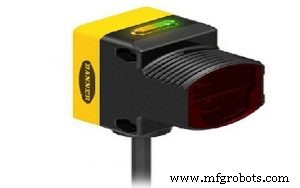
Working Principle
The core of a radar sensor is the Doppler effect: as the sensor’s wavefront reflects off a moving target, the frequency shifts. By comparing the transmitted and received frequencies, the sensor deduces both distance (via time‑of‑flight) and speed (via frequency shift).
A typical system operates at a carrier frequency around 24–77 GHz, modulated with a lower-frequency sweep (e.g., 10 MHz). The returned signal’s phase and frequency differences are processed to extract range and velocity.
Block Diagram of a 24 GHz Short‑Range Automotive Radar
Below is a simplified schematic highlighting the main subsystems:
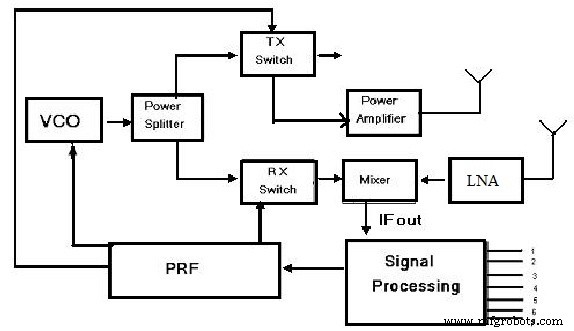
- VCO (Voltage‑Controlled Oscillator) – Generates the carrier frequency.
- Power Splitter & Amplifier – Divides and boosts the RF signal.
- Low‑Noise Amplifier (LNA) – Enhances weak echoes.
- Mixer – Produces intermediate frequency (IF) for digitization.
- Digital Signal Processor (DSP) – Computes range, speed, and target classification.
- Transmit & Receive Antennas – Provide beam steering and spatial resolution.
Types of Radar Sensors
Different radar technologies serve unique application needs:
- Millimeter‑Wave Radar – Operates at 24–77 GHz; ideal for automotive collision avoidance and industrial monitoring.
- Continuous‑Wave (CW) Doppler Radar – Uses a single frequency (e.g., 915 MHz) to measure relative speed only.
- Frequency‑Modulated Continuous‑Wave (FMCW) Radar – Sweeps frequency over time, enabling simultaneous range and velocity measurement.
Radar vs. Ultrasonic Sensors
| Radar Sensor | Ultrasonic Sensor |
|---|---|
| The radar transmits microwave echo and converts it to an electrical signal. | Ultrasonic sensors emit sound waves and measure time‑of‑flight. |
| Operates via electromagnetic waves, unaffected by light or weather. | Depends on acoustic propagation; limited by temperature and humidity. |
| Can detect objects up to several meters in range. | Effective up to ~3–4 m for most commercial units. |
| Suitable for high‑speed, long‑range applications. | Best for close‑range, low‑speed scenarios. |
| Used in automotive, industrial, and security systems. | Common in robotics, consumer gadgets, and fluid level monitoring. |
Interfacing a Doppler Radar Sensor with Arduino
The RCWL‑0516 module is a popular choice for motion detection in DIY projects. Below is a concise wiring diagram and sample code.
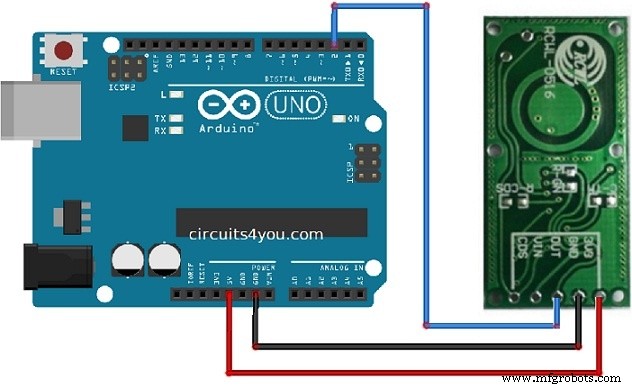
Pinout:
- Pin 1 – 3.3 V output
- Pin 2 – Ground
- Pin 3 – OUT (high when motion detected)
- Pin 4 – VIN (4–28 V supply)
- CDS – Sensor disable input
Sample Arduino Sketch:
int sensorPin = 12;
int ledPin = 3;
int motionFlag = 0;

void setup() {
  Serial.begin(9600);
  pinMode(sensorPin, INPUT);
  pinMode(ledPin, OUTPUT);
  Serial.println("Waiting for motion");
}

void loop() {
  int val = digitalRead(sensorPin);
  if(val > 0 && motionFlag == 0) {
    digitalWrite(ledPin, HIGH);
    Serial.println("Motion Detected");
    motionFlag = 1;
  }
  if(val == 0) {
    digitalWrite(ledPin, LOW);
    Serial.println("No Motion");
    motionFlag = 0;
  }
}
Advantages of Radar Sensors
- All‑weather operation – unaffected by rain, fog, or dust.
- Excellent range – up to 30 m or more in automotive variants.
- Safe for humans and animals – no harmful radiation.
- Fast, low‑latency response suitable for real‑time control.
- Robust against lighting variations, including total darkness.
- Low maintenance and high reliability in harsh environments.
Limitations
- Limited ability to resolve multiple closely spaced targets.
- Cannot provide color or detailed surface texture.
- Performance degrades in heavy water immersion or highly reflective environments.
Key Applications
- Automotive safety: collision avoidance, parking assistance, adaptive cruise control.
- Industrial automation: robot proximity, process monitoring, material handling.
- Security & surveillance: perimeter detection, intruder monitoring.
- Intelligent transportation: traffic flow monitoring, toll collection.
- Military & aerospace: target tracking, UAV navigation.
- Medical imaging and diagnostics in research settings.
FAQs
What does a radar sensor do? It transmits electromagnetic energy, receives echoes, and determines object distance, speed, and trajectory.
What are the core components of a radar system? Antenna, transmitter, receiver, diplexer, and phase‑locked loop.
Is it legal to use a radar detector? In many jurisdictions, radar detectors are prohibited in vehicles, potentially resulting in fines or vehicle seizure.
Can radar detect stationary humans? Radar senses motion via Doppler shift; a stationary person will not trigger a moving‑target radar.
Why is there a dead zone? The radar’s beam geometry and Earth’s curvature create a near‑field region where targets cannot be detected.
Modern radar sensors, such as the mmWave 77 GHz variants (e.g., ARS410, ARS430) and advanced doppler units, continue to shrink in size while boosting accuracy, opening new possibilities in autonomous systems and smart infrastructure.
Sensor
- How Distance Sensors Work and Their Key Applications
- Understanding the AD8232 ECG Sensor: Functionality and Applications
- HC‑SR04 Ultrasonic Sensor: How It Works and Key Applications
- Voltage Sensors: How They Work & Key Applications in Modern Power Systems
- Lambda (Oxygen) Sensor: Function, Operation, and Key Automotive Applications
- Image Sensors: Types, Operation, and Practical Applications
- Gyroscope Sensors: How They Work and Their Key Applications
- Flame Sensors: How They Work and Key Applications in Fire Safety
- Sound Sensors: How They Work & Practical Applications
- Humidity Sensors: How They Work and Key Applications