



Jules Verne, Airbus & Fives Launch MADRAS: 18‑m Pilot Line Boosts Composite Textile Production 5–6× Faster
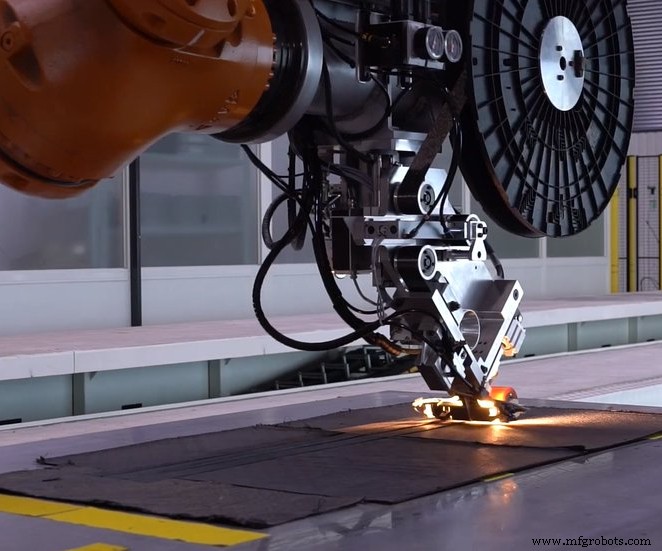
The Jules Verne Institute for Technological Research (IRT, Bouguenais, France) has inaugurated the MADRAS automated production line for production of composite textile preforms at rates 5-6 times faster than existing technologies. The 18-meter-long pilot line, installed at the Technocampus Composites (Nantes, France), has been developed in a French national collaboration with Airbus (Toulouse), Fives (Paris) and Loiretech Machining (Bouguenais). It marks a key step in this consortium’s WING project, launched in April 2017.
With a budget of 5.6 million euros, WING aims to assess the ability of textile technology to meet the high production rates for large composite structures with complex geometry for future aircraft. Research areas include preform architecture, tooling concepts and automated production lines. The challenge is to produce such parts at a cost compatible with the economic constraints of the industry.
MADRAS line
The MADRAS pilot line is divided into three robotic stations dedicated to draping, fast preforming and fiber placement. The goal is to eventually reach a deposit rate of 150 kilograms/hour or 300 millimeters/second, and to prove the technical viability of this solution by a series of full-scale tests.
The automated machines developed by Fives must allow fiber reinforcement to be deposited at four times the width and thickness versus current equipment. Loiretech, for its part, has developed specific tools that drastically reduce preforming cycle times. Goals include not only increased production rates for aerospace and industrial sectors, but also reduced production waste, leading to reduced cost and a much improved environmental footprint across industries.
"This technology will interest all industrial sectors who work on small and large parts: traditional and renewable energy, but also the transportation industry overall, whether aerospace, automotive or shipbuilding," explained Marie Weiss, IRT Jules Verne project manager.
For more details, see “With Madras, Airbus and IRT Jules Verne take composites to high speed” by Alexandre Couto at industri-techno.com.
fiber
- Seamless Workflow Management: Bridging Sales and Production in Additive Manufacturing
- Modular Production Line Converts Thermoplastic Polymers & Composites into High-Performance Organosheet Panels
- AZL and IKV Announce Standardized SMC Data Bank & Testing Initiative
- DrapeCube: Affordable 3D FRP Textile Preforming Solution
- Roth Composite Machinery's Custom Line Enhances Krempel's Prepreg Quality & Production Efficiency
- Antich & Sons Revolutionize 3D‑Woven Composite Preform Production with New Yarn‑Spinning Technique
- Arris, U.S. Army, and LIFT Partner to Cut Combat Vehicle Weight with Composite Seat Innovation
- FACC Secures ArianeGroup Contract to Produce Composite Structures for Ariane 6 Launch Vehicle
- NX Series: Modular Machining Centers for Automotive Production Lines
- VMC Machinery: Boost Production & Efficiency with Precision CNC Solutions